



When travelers ask Uncle Kham which highland summit in Chiang Mai most thoroughly embodies the crisp alpine charm of an overseas winter wonderland, Doi Ang Khang in Fang district is always my heartfelt answer. In the Northern Thai (Lanna) dialect, the word 'Ang Khang' translates literally to a 'giant iron basin' or cauldron—an apt geological moniker for this dramatically sunken mountain amphitheater cradled within the rugged Daen Lao Range along the Myanmar frontier. Perched between 1,400 and nearly 1,900 meters above sea level, Ang Khang was fifty years ago a severely scarred landscape of barren deforested peaks and illicit opium poppy fields. It was the enduring humanitarian vision of His Majesty King Bhumibol Adulyadej (King Rama IX) that completely revitalized this mountain in 1969 by founding the 'Royal Agricultural Station Ang Khang'—the kingdom's very first highland research station under the Royal Project Foundation, forever substituting poppies with temperate orchard fruits, tiered tea bushes, and world-class ornamental botanical gardens.

Royal Agricultural Station Ang Khang: Garden 80, Bonsai Groves & Winter Blossoms
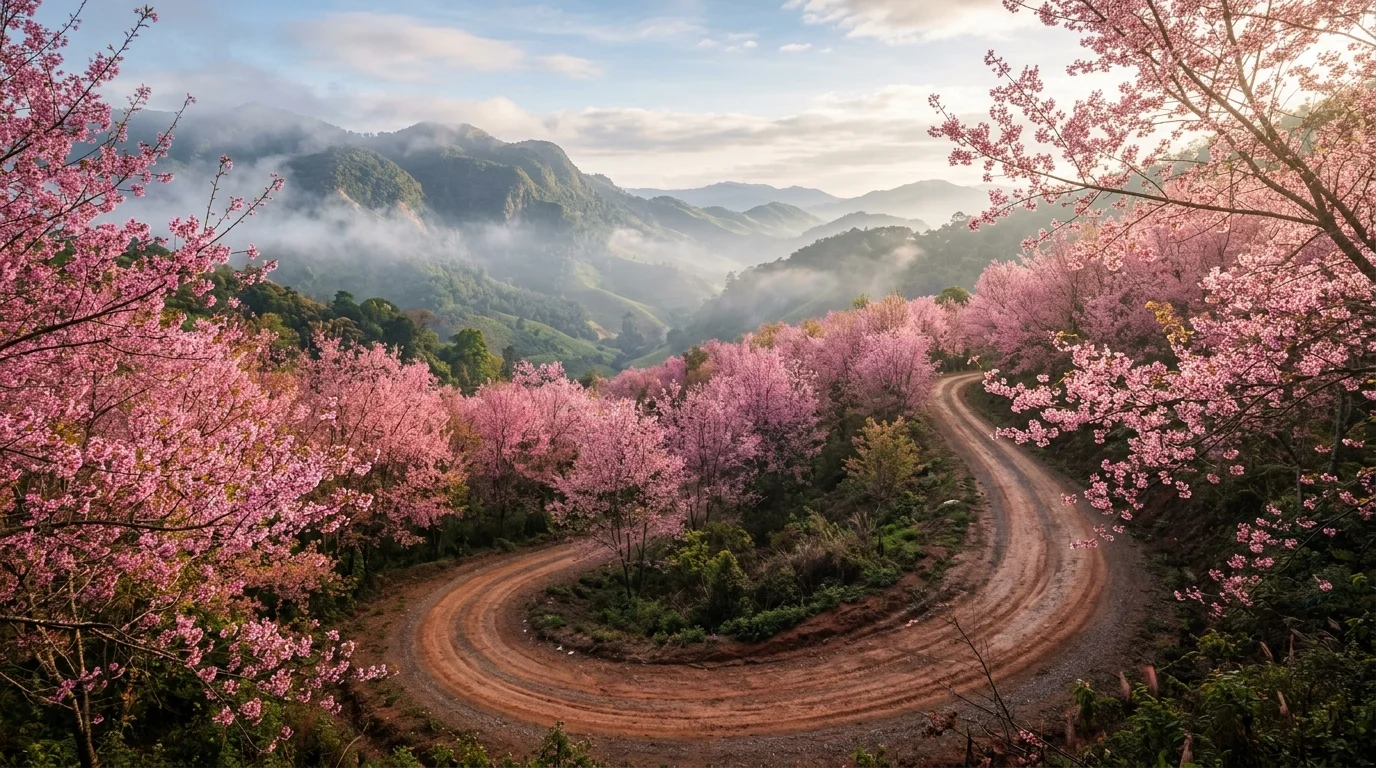
The beating heart of any Ang Khang expedition is exploring the immaculately landscaped grounds of the Royal Agricultural Station. The centerpiece highlight is 'Garden 80' (Suan Paed-Sip), a multi-tiered outdoor temperate botanical sanctuary constructed to commemorate King Rama IX's 80th birthday. Throughout the deep winter months of December and January, pristine blossoms of English heritage roses, multicolored ornamental kales, Camellias, and authentic Japanese flowering sakura trees—presented as diplomatic royal gifts from Japan and Taiwan—burst into vivid pastel pink bloom alongside indigenous wild Himalayan cherry trees. Strolling these misty pathways evokes the enchanting atmosphere of an alpine garden in Switzerland. Afterwards, wander across the wooden footbridge to the tranquil 'Bonsai and Topiary Garden', which houses centuries-old miniature temperate trees, gnarled highland maples, cascading alpine rock fountains, and rare mosses curated with exquisite meditative artistry.
Dawn Splendor at Tea Plantation 2000: Rolling Fog Over Emerald Terraces
For an encounter that will stir your soul, set your alarm for 6:15 AM and head toward 'Tea Plantation 2000', tucked away in a dramatic amphitheater valley a short drive from the Royal Station. Here, precision-terraced rows of high-grade Oolong tea carve neat geometric contours down the steep mountain slopes. Between 6:45 AM and 7:30 AM, dense ribbons of milky-white valley fog funnel through the mountain gap. As the rising sun crests the eastern peaks, piercing golden sunbeams strike the rolling mist, creating dazzling Tyndall rays that bathe the entire emerald valley in ethereal luminescence. Uncle Kham's favorite ritual is settling into the open-air wooden gazebo above the terraces with a steaming pot of freshly plucked high-mountain Oolong tea paired with piping-hot, golden-fried Chinese mantou buns dipped in sweet condensed milk. The crisp morning breeze against your skin contrasted with the soothing warmth of highland tea is an unforgettable mountain memory.
Stepped Strawberry Slopes of Ban Nor Lae & The Thai-Myanmar Border Outpost
Ascending further north along the winding ridgeline brings you to 'Ban Nor Lae', a mountaintop village inhabited by the Dara-ang (Palong) ethnic hilltribe, who sought refuge here across the border in 1984. The vibrant cultural heritage of the Dara-ang people—with village women donning traditional scarlet tunics, woven silver-bamboo waist rings, and hand-embroidered headscarves—remains warmly preserved. Just below the village unfolds one of northern Thailand's most photogenic agricultural marvels: the stepped strawberry terraces of Ban Nor Lae. Grown along dizzyingly steep ravine walls, rows of Royal Queen 80 sweet strawberries are wrapped in shimmering silver mulch film that glistens in the morning light. Visitors can wander down designated pathway contours to observe villagers hand-harvesting ruby-red strawberries. A short walk uphill leads to the 'Nor Lae Military Outpost' on the international border ridge, fortified with barbed wire trenches and sandbag parapets. From here, you can gaze directly into Myanmar's Shan State mountain ranges stretching into the infinite horizon.
Sunrise & Sea of Mist at Mon Son Campground: Sleeping Under the Milky Way
For wilderness lovers and adventurous campers, 'Mon Son Viewpoint' within Doi Pha Hom Pok National Park is Doi Ang Khang's premier camping sanctuary. Perched along a precipitous cliff ridge shaded by towering three-needled highland pines, Mon Son delivers single-digit nighttime temperatures, pitch-black dark skies untainted by city light, and clear view of the Milky Way galaxy. By 5:45 AM, campers gather quietly along the clifftop observation railing wrapped in down jackets and woolen beanies. As twilight yields to sunrise, an ocean-thick sea of white mist rolls relentlessly over the Fang valley below. When the golden sun breaks over the jagged peaks, it bathes the clouds in radiant apricot and violet tones—a glorious panoramic spectacle that reaffirms northern Thailand's status as a winter nature paradise.
Navigating the Mountain Pass: 18% Grade Fang Route vs. Scenic Arunothai Bypass
Safe navigation up Doi Ang Khang requires mechanical respect and smart route selection. Departing north from Chiang Mai on Highway 107 through Chiang Dao, drivers face two distinct mountain pathways:
1. Highway 1249 (Direct Fang Route): Spanning only 25 km from the base in Fang, this mountain pass is infamous as one of the steepest paved roads in Thailand, featuring sustained 18% inclines, blind hairpin switchbacks, and inverted vertical curves. The non-negotiable rule is shifting into Low Gear (L, 1, or 2) on both ascent and descent to enforce heavy engine braking. Riding the foot brake will inevitably overheat brake fluid and result in terrifying brake failure. If you are driving a 1.2L economy rental car or lack extensive mountain-grade experience, avoid this route.
2. Route 1178 & 1340 (Arunothai Route via Chiang Dao): Branching off at Mueang Ngai near Chiang Dao toward Ban Arunothai, this bypass approaches Doi Ang Khang from the west. While approximately 45 km longer, it climbs gradually without harrowing hairpin switchbacks. Any standard compact sedan, passenger van, or cautious visiting driver can navigate the Arunothai route smoothly, accompanied by tranquil scenic karst valley views.
Where to Stay: Summit Village Homestays vs. Valley Resorts in Fang
Choosing your base depends on comfort preferences. Rustic community homestays in Ban Khum and Ban Luang right outside the Royal Station gates offer an authentic highland immersion and immediate proximity to morning dawn spots. However, summit lodgings are basic, with limited electrical heating and rustic plumbing. For travelers seeking dependable luxury—including high-pressure hot showers, plush bedding, quiet air conditioning/heaters, and tranquil orchard surroundings—Uncle Kham recommends staying down in Fang town in the valley, a pleasant 35-minute drive from the mountain base. Fang offers charming boutique hotels, private orchard bungalows, and easy access to Fang Mineral Hot Springs, where you can soak tired muscles in steaming thermal pools. Browse top-rated lodgings with complete peace of mind, including Reserve Now, Pay Later and 100% Free Cancellation* at Browse and Book Fang & Chiang Mai Hotels to ensure your Doi Ang Khang winter holiday is seamless and memorable.
Recommended Accommodations for Your Doi Ang Khang Winter Escape
Visiting the high-altitude tea plantations and strawberry terraces of Ang Khang? Consider these well-appointed staging resorts:
• Sibsan Resort & Spa Maetaeng ↗: Perfect riverside luxury halfway between Chiang Mai city and Ang Khang.
• U Nimman Chiang Mai ↗: Urban comfort with rooftop pool and premier shopping at your doorstep.
• POR Santitham ↗: Fresh boutique living with free bikes and coffee bar.
Compare prices and book via Agoda Chiang Mai Stays ↗ with Book Now Pay Later and 100% Free Cancellation*.
📌 Related Chiang Mai Guides on Terra Lanna:
• Preparing for Single-Digit Cold at Doi Inthanon Summit: Clothing Checklist, Frost Hunting & Tips ↗
• San Pa Kia Doi Mae Taman: Pink Cherry Blossoms Framing Doi Luang Chiang Dao Peak & Nature Camping Guide ↗
• Kew Mae Pan Nature Trail Winter Opening Guide (2026): Sea of Mist, Golden Ridges & Doi Inthanon Hiking ↗
💡 Looking for more accommodation choices? Explore our comprehensive directory of 1,280 Curated Chiang Mai Hotels & Stays ↗