



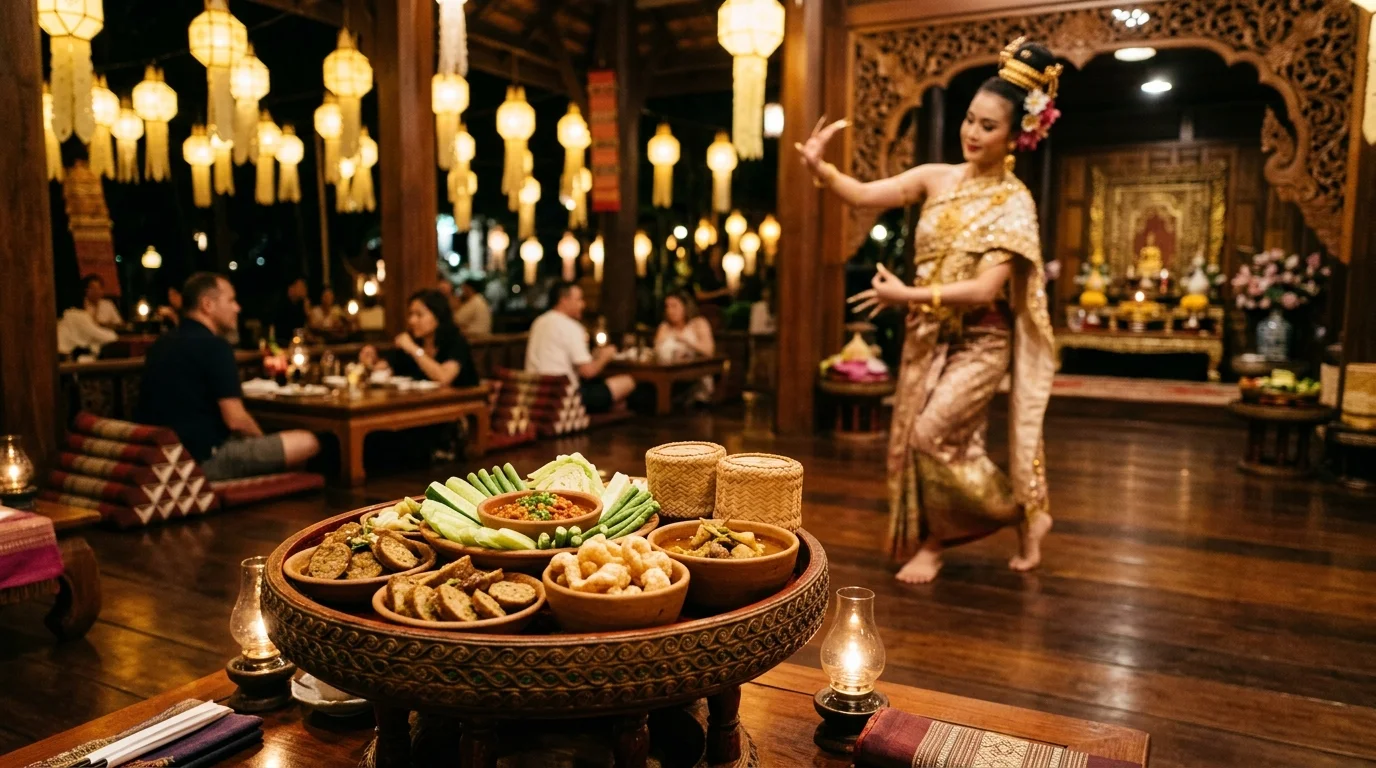
Before Chiang Mai became a city on every traveler's shortlist, there was a tradition practiced at the Lanna court — the khantoke, a low round tray of shared dishes eaten together on the floor. It wasn't just a meal. It was how a civilization chose to welcome guests.

Khantoke — The Art of Eating Together
"Khan" means a round vessel with legs. "Tok" means a small tray. Together they form the khantoke — a low pedestal table where a dozen northern Thai dishes are arranged for everyone within reach. You sit cross-legged or folded around it, roll sticky rice by hand, and dip it into whatever is closest. There is no serving order. You simply eat.
The Chiang Mai Cultural Center has kept this tradition alive — not as a museum exhibit behind glass, but as an actual meal with actual traditional performances that have retained their original choreography and costumes through decades of practice.
What's on the Khantoke
The dishes on the tray haven't changed much in generations:
- Sticky rice (Khao Niaw) — eaten by hand, rolled into small balls, paired with every dish
- Nam Prik Ong — red chili and pork tomato dip, rich and slightly smoky, served with crispy pork crackling
- Kaep Moo — Chiang Mai-style pork crackling, lighter than you expect, surprisingly delicate
- Sai Ua — Chiang Mai herb sausage with lemongrass, kaffir lime leaf, and dried chilies; grilled until fragrant
- Gaeng Hang Le — slow-braised pork curry with Burmese influence, warm-sweet-salty with deep spice and very little coconut milk
- Laab Mueang — northern-style laab, raw or cooked, spiced with Lanna herbs entirely different from Isaan laab
- Fresh and steamed vegetables — seasonal, from the morning market, to cut through the richness
Nothing is ordered separately. Everything arrives at once, and you eat as much as you want. The generosity is the point.
The Performances — Movements That Take Years to Learn
While you eat, the show begins on the central stage. Over the course of the evening, several different dance forms take turns:
Fon Lanna — The Signature Dance of the North
Fon Lep (Fingernail Dance) is the visual icon of Lanna culture. Long golden nail extensions fitted to each finger, the hands move in slow arcs while the body sways to the rhythm of the saw dung bowed fiddle and klong sabadchai drum. It looks effortless. Dance students spend years to make it so.
Fon Tien (Candle Dance) places a lit candle in each outstretched hand. The flames respond to every movement — flickering when the hands dip, steadying when they rise. Watching it in a dimmed hall, the orange light reflecting off gold-threaded costumes, is one of those images that stays with you.
Fon Ngiew — The Sound of Chiang Mai's Shan Heritage
Fon Ngiew is Shan-style dance: more vibrant colors, quicker footwork, a different pulse. It's a reminder that Chiang Mai was never a single-culture city — it was where Lanna, Shan, Burmese, and Yunnanese traders and settlers converged for centuries.
Hill Tribe Performances
Toward the end of the evening, performers often represent the traditions of mountain communities — Akha, Karen, Lisu, Hmong — each with their own textiles, jewelry, and musical rhythm. Side by side, they show why Chiang Mai resists easy summary.
Practical Information
Time and Price
- Show time: 7:00pm daily (check-in from 6:30pm)
- Price: Approximately 500–700 ฿ per person, dinner included
- Duration: ~1.5 to 2 hours
- Parking: On-site parking available
What to Know Before You Go
- No strict dress code — but modest, comfortable clothing fits the atmosphere
- Photography and video are welcome; performers are accustomed to it
- If sitting cross-legged is difficult, chairs are available at some tables — just ask staff
- There's a craft market at the entrance, open before and after the show
- Booking ahead is recommended, especially in high season (November–February)
Getting There
- Address: 185/3 Wualai Road, Haiya, Mueang, Chiang Mai 50100
- From the moat: ~15 minutes, Grab ~50–80 ฿
- Best combined with: Wat Si Suphan (the Silver Temple) is 5 minutes away on the same road
Why Come
In a city full of rooftop bars and specialty coffee shops, the Chiang Mai Cultural Center is one of the few places that lets you understand what Chiang Mai was before it became a travel destination. The khantoke meal isn't "fine dining" in any Michelin sense. But it offers something Michelin cannot — the experience of sitting in exactly the same posture, eating from the same shaped vessel, hearing the same music, that people in this valley have been doing for centuries.
You leave understanding not just what northern Thai food tastes like, but why it tastes the way it does — and who made it that way.
Photo credit: Siriwatv / Public Domain (Wikimedia Commons)
Learn more: Chapter 3 (V): Crafts, Language & Performing Arts