



In an era of relentless push notifications, digital urgency, and disposable consumer goods, Uncle Kham invites you to take off your wristwatch, leave the sterile air-conditioned shopping malls behind, and venture beneath the shady banyan canopies of Chiang Mai. Here, 'craft' is not merely a novelty souvenir peddled at tourist bazaars; it is a living meditation, a communal rhythm, and an ancestral heritage cultivated across seven centuries of Lanna civilization. Recognized by UNESCO as a Creative City of Crafts and Folk Art since 2017, Chiang Mai in 2026 thrives as Southeast Asia's artisan capital, where independent studio collectives open their doors to travelers eager to get their hands coated in cool river clay, fragrant botanical indigo, and raw golden teak.

1. The Tactile Rhythm of Wet Earth: Wheel-Thrown Pottery in Baan Kang Wat & Suthep Foothills
There is no finer launchpad for creative exploration than the tranquil western foothills bordering Doi Suthep, specifically the intertwined neighborhoods of Wat Umong, Ram Poeng, and Pong Noi. At the heart of this artistic enclave lies Baan Kang Wat, a communal village of reclaimed wooden shophouses organized around a verdant sunken amphitheater. Just down the road sits InClay Studio Pottery, founded by master ceramicist Jirawong Wongtrangan, whose philosophy centers on honoring local earth, slow manual wheels, and high-fire botanical ash glazes.
The moment your foot engages the pedal of the pottery wheel, cool, damp Chiang Mai stoneware clay glides between your palms. Your instructor gently guides your wrists to achieve 'centering' (การตั้งศูนย์ดิน)—the supreme foundational discipline of the craft. If your mind is cluttered with worries, the spinning clay wobbles erratically; but as you anchor your posture and exhale slowly, the mound stabilizes into a serene, perfect cylinder. Under light fingertip pressure, the walls blossom outward into a Japanese-style chawan teacup, an organic cereal bowl, or a slender bud vase. After trimming and hand-dipping in wood-ash or ancient Celadon (crackle jade) glazes, the pieces endure a 1,250°C high-fire kiln transformation, rendering them dishwasher- and food-safe for daily breakfast rituals back home (allow 3-4 weeks for kiln drying and firing; studios offer insured worldwide parcel shipping).
2. The Living Blue Alchemy: Botanical Indigo & Northern 'Hom' Tie-Dye in Mae Rim & Doi Saket
Have you ever pondered how authentic Lanna indigo fabrics achieve that hypnotic midnight-blue radiance that synthetic dyes can never emulate? Stepping into a master dye studio like Studio Naenna (nestled at the base of Doi Suthep, founded by legendary textile historian Patricia Cheesman) or rural riverside craft workshops in Mae Rim reveals an astonishing reality: natural indigo is alive. Northern dyers maintain living fermentation vats using 'Hom' (Strobilanthes cusia) and botanical indigo leaves, nourished inside large earthen jars with wood ash lye, coconut sugar, and wild rice spirits until a golden-blue froth—called 'Phrai Kram' (indigo blossoms)—blooms across the surface.
In an artisan dye session, you will learn the geometric wizardry of Shibori folding and clamping (Itajime), as well as traditional Lanna thread-binding (Kumo). By sandwiching folded organic handspun cotton between wooden blocks, only the exposed borders absorb the dye vat's liquid. The genuine magic happens when your cloth is lifted from the vat: emerging as a chartreuse-yellow-green fabric, the pigment encounters atmospheric oxygen, instantly undergoing an oxidation reaction that morphs it into deep, velvet royal indigo blue before your eyes. Rinsed in mountain spring water, your handcrafted scarf or canvas tote bag becomes an irreproducible textile fingerprint.
3. Carving Sacred Grain: Traditional Lanna Teakwood Relief Studios in Baan Taway & San Kamphaeng
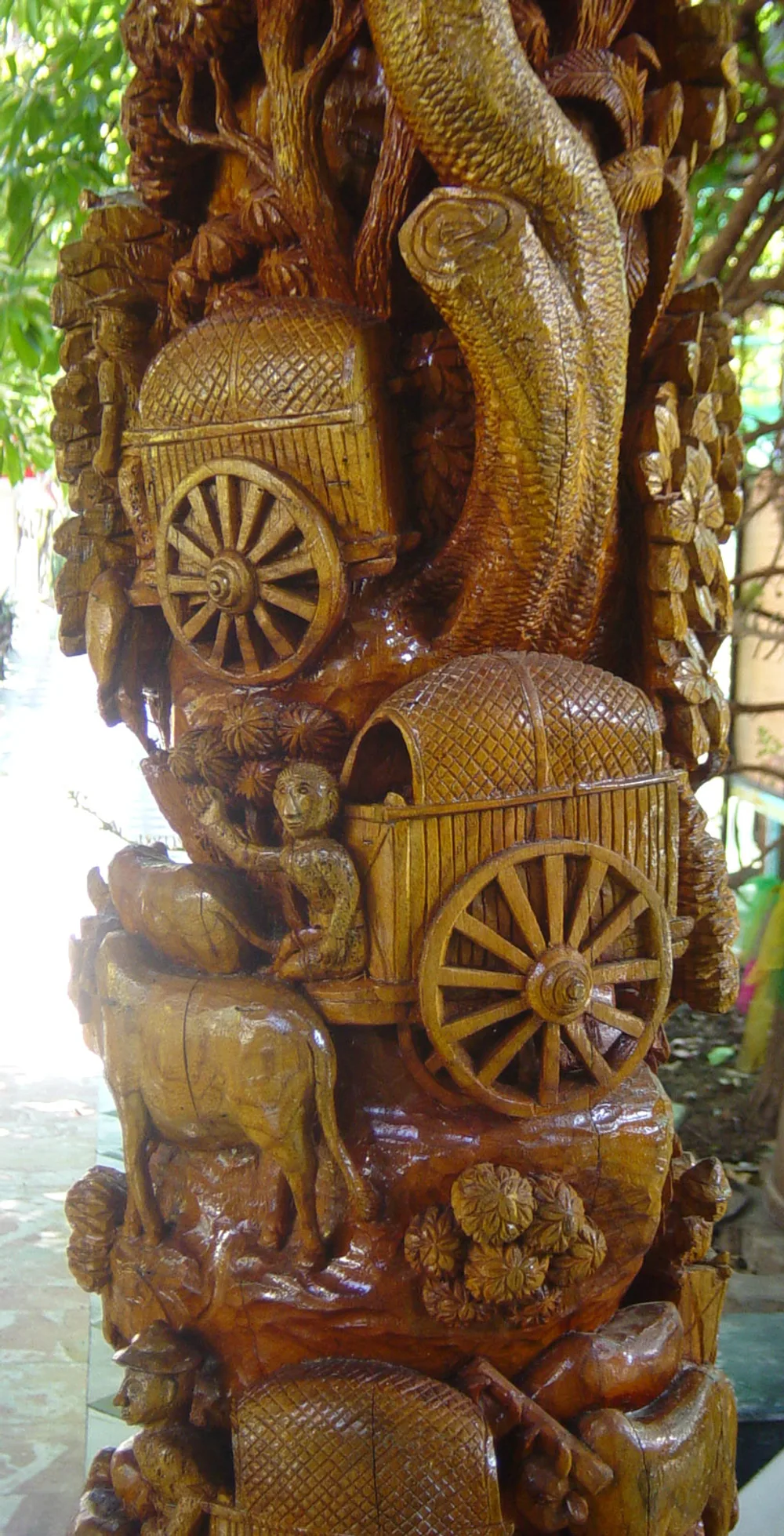
For centuries, the gables, eaves, and temple pediments of northern Thailand have been enlivened by master woodcarvers (Sala Mai). While mass-market souvenir stalls offer machine-milled plaques, the true soul of Lanna relief carving endures in artisan family compounds across Baan Taway Handicraft Village (Hang Dong) and San Kamphaeng. In specialized beginner workshops, you are handed a block of sustainably sourced, air-cured golden teakwood (Mai Sak), pre-sketched with classic auspicious motifs like the Dok Prajam Yam (four-petaled guardian lotus) or galloping Lanna elephant.
The wooden mallet strikes the steel gouge with a rhythmic 'thwack... tap... tap', sending paper-thin ribbons of fragrant teak curling onto your worktable. The art lies not in muscular force, but in respecting the timber's grain orientation to prevent splintering. Once the bas-relief depth is achieved and smoothed with graduated sandpaper, the wood is massaged with a blend of wild honey beeswax and virgin coconut oil—infusing the grain with a warm golden luster that matures gracefully across generations, completely free of toxic polyurethane lacquers.
Essential Etiquette & Preparation Tips for Chiang Mai Craft Workshops
- Reserve 3-7 Days in Advance: To ensure high instructor-to-student ratios, top studios cap sessions at 4 to 8 participants. During the cool winter peak (November through February), weekend workshop slots fill up weeks ahead.
- Dress in Studio-Friendly Clothing: While canvas aprons are provided, micro-droplets of natural indigo and clay slurry have a knack for finding sleeve edges. Wear dark, breathable cotton garments.
- Trim Your Fingernails Short: Long fingernails will inadvertently gouge wet clay walls on spinning pottery wheels, making delicate cup lips difficult to pull smoothly.
- Kiln Firing Lead Times: Ceramic pieces require roughly 3-4 weeks for slow dehydration, bisque firing, glaze immersion, and final high-fire kilns. Provide clear domestic or international shipping details upon completion.
Curated Boutique Stays for Art & Design Travelers in Chiang Mai
Staying at a hotel that honors local craftsmanship elevates your creative journey from an afternoon activity to a complete lifestyle experience. Here are Uncle Kham's top accommodation recommendations:
- Suthep Foothills & Wat Umong: Villa Mahabhirom ↗ — A museum-caliber sanctuary composed of 14 antique Lanna teakwood villas restored to five-star luxury, located on Suthep Road just 5 minutes from Baan Kang Wat and InClay pottery studios.
- Mae Rim Riverside: Raya Heritage ↗ — A breathtaking riverside design resort celebrating traditional artisanal weaving, terracotta masonry, and wicker craft in serene northern countryside.
- Nimman Creative Hub: U Nimman Chiang Mai ↗ — A sleek urban retreat blending contemporary aesthetics with Lanna accents at the vibrant junction of Nimmanhaemin Road.
- Search & Book Boutique Hotels near Chiang Mai Craft Studios on Agoda ↗ with zero booking fees, pay-later flexibility, and 100% free cancellation* on Agoda.
Artisan craft is never about industrial symmetry or factory perfection; it is about the gentle thumb imprint in a clay bowl, the natural ombre gradation of a botanical indigo dip, and the distinctive gouge mark in aged timber. They are permanent proof that human hands, heart, and patience brought this object into being. When you place that handmade treasure on your desk back home, Uncle Kham promises that a warm piece of Chiang Mai's mountain serenity will always smile right back at you.
📌 Related Chiang Mai Guides on Terra Lanna:
• Baan Mueang Kung Pottery Village (Hang Dong): Ancient Lanna Earthenware, Water Jugs & Wood-Fired Kilns ↗
• Unique Chiang Mai Artisan Souvenirs Shopping Guide: Woven Rattan, Handloom Cotton & Modern Crafts ↗
• Chiang Mai Design Week 2026 Complete Guide: Exhibition Map, Creative Hubs, Craft Markets & Workshops ↗
💡 Looking for more accommodation choices? Explore our comprehensive directory of 1,280 Curated Chiang Mai Hotels & Stays ↗