



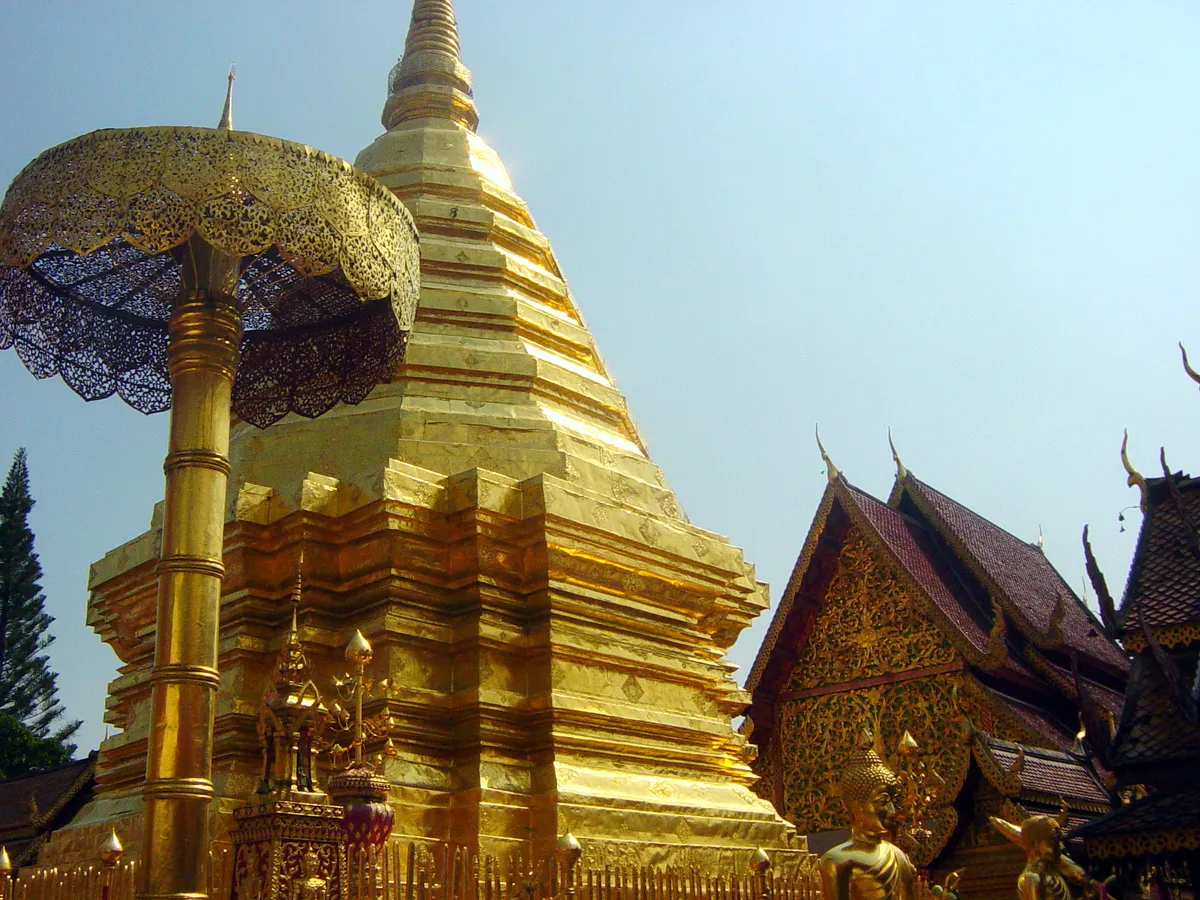
Everyone says if you come to Chiang Mai and skip Doi Suthep, it is like going to Paris without seeing the Eiffel Tower. Fair enough. But Doi Suthep has far more to offer than one golden temple on a mountaintop. Plan it right, and a full day up the mountain becomes the highlight of your entire trip rather than a box-ticking exercise.

The White Elephant Legend
The founding story goes like this: a monk named Phra Maha Swami enshrined a holy relic on the back of a white elephant and set it free. The elephant climbed the mountain, trumpeted three times, turned in three circles, and knelt down. That spot, at 1,055 meters above sea level, became Wat Phra That Doi Suthep. The year was 1383, during the reign of King Kue Na, the sixth ruler of the Mangrai dynasty.
This is not just folklore. It explains why the temple sits where it does, why the road twists through 48 switchbacks up the mountainside, and why the people of Chiang Mai have revered this site as the spiritual heart of their city for more than 600 years.
The 309 Naga Staircase — Easier Than You Think

The number 309 sounds daunting, but the staircase was built for people of all ages. The steps are wide, the gradient is manageable, and there are handrails the entire way. At a comfortable pace, it takes 15 to 20 minutes. Rest wherever you like — nobody rushes.
The staircase was constructed around 1557 under the leadership of Kruba Srivichai, the most venerated monk in Lanna history, who also mobilized local communities to build the winding road up the mountain. The handrails are seven-headed Naga serpents — guardians of Buddhism and an iconic motif of Lanna temple architecture.
If stairs are not an option, an inclined electric tram runs alongside the staircase. The fare is 50 baht, and it is a practical choice for elderly visitors or anyone with knee problems.
At the Top — What to See
Wat Phra That Doi Suthep is not a sprawling temple complex, but every square meter carries weight:
- The golden chedi — the stupa enshrining the sacred relic, covered entirely in gold. It catches the sunlight in a way that genuinely stops you mid-step. Walk clockwise around it three times holding flowers, incense, and a candle — follow the locals.
- The viewpoint terrace — a 180-degree panorama of Chiang Mai city spread out below. On a clear day, you can see as far as Lamphun province.
- The Emerald Buddha replica — a copy of the famous Phra Kaeo, housed in the main viharn.
- The white elephant statue — at the front entrance, commemorating the founding legend.

Best Time to Visit — Sunrise or Sunset?
Both have their strengths:
- Early morning (6:00–7:30am) — cool air, almost no crowds, the sound of monks chanting at dawn, soft light hitting the golden chedi. Best for a peaceful, unhurried visit.
- Late afternoon (4:00–6:00pm) — warm golden light on the stupa, a spectacular sunset over the city below. More crowded, especially on weekends.
- Avoid: 10:00am to 2:00pm — peak heat, peak crowds, tour buses lined up in the parking lot.
How to Get There — Four Options Compared
1. Red Songthaew (the Classic Way)
Catch a red songthaew from in front of Chiang Mai University or Chiang Mai Zoo. The fare is 40 to 60 baht per person each way (negotiable for groups). The driver waits until the vehicle is full, or you can charter the whole truck for 300 to 400 baht. The drive up takes about 30 minutes.
2. Grab or Taxi
The most convenient option. Call a Grab from your hotel — the fare runs 200 to 350 baht each way depending on your starting point. The drawback: during peak hours, finding a ride back down can be difficult. Book a round-trip or ask the driver to wait.
3. Motorbike or Scooter
Rent a scooter for 150 to 250 baht per day and ride up yourself. The road is steep with tight switchbacks — ride slowly, keep your headlight on, and watch for tour buses in blind curves. An international or Thai driving license is required.
4. Guided Tour
Many operators combine Doi Suthep with Bhubing Palace and the Hmong village in a half-day package priced at 500 to 1,200 baht per person including hotel pickup. A good choice if you prefer not to organize transport yourself. Book a Doi Suthep tour
Dress Code — More Important Than You Expect
Wat Phra That Doi Suthep enforces a strict dress code because it is an active sacred site:
- No shorts above the knee — sarongs are available for rent at the entrance (20 baht), but bringing your own is better.
- No tank tops, spaghetti straps, or bare shoulders — carry a light shawl as backup.
- Shoes off before entering the chedi area — the ground gets hot at midday, another reason to visit early or late.
- Wear proper walking shoes for the 309 steps — high heels and slippery flip-flops are a bad idea.
Beyond the Temple — Doi Suthep-Pui for the Full Day
Doi Suthep-Pui National Park
The temple sits within Doi Suthep-Pui National Park, covering 261 square kilometers of montane forest. Multiple hiking trails, Monthathan Waterfall, Mok Fa Waterfall — with an extra half day, the park turns a temple visit into a proper mountain trip the way Chiang Mai locals experience it.
Bhubing Palace
Located four kilometers above the temple, Bhubing Palace is open to visitors when the royal family is not in residence. The grounds feature some of northern Thailand's finest cool-climate gardens — roses, sakura cherry blossoms (January to February), and hundreds of ornamental species. Admission is 50 baht. Open 8:30am to 3:30pm (check for closure days before visiting).
Hmong Village at Doi Pui
A Hmong hill tribe village near the summit of Doi Pui. A small market sells traditional embroidered textiles, silverwork, fresh strawberries (in winter), and local coffee. You can walk through the village in about an hour. The pace and silence are a world away from the city below.
The Monk's Trail — A Hidden Forest Path
A footpath from the base of the mountain all the way up to the temple. The hike takes roughly 1.5 to 2 hours, passing through forest and Wat Pha Lat (also called Wat Phra Chan) — a half-hidden monastery midway up where monks have walked in meditation for decades. It is the ideal alternative for hikers who want to skip the crowded staircase. The trailhead is near Chiang Mai Zoo, on a small lane to the left before Huay Kaew Waterfall.
How to Avoid the Crowds
- Arrive before 7:00am or after 4:00pm — tour groups typically come between 9:00am and 2:00pm.
- Avoid Thai public holidays, Buddhist holy days (Wan Phra), Visakha Bucha, and Makha Bucha — Thai visitors come in large numbers for merit-making.
- Midweek, mid-month (not a Wan Phra) is the quietest window.
- Rainy season (June to October) brings fewer visitors, though fog may obscure the view — the upside is cooler air and lush green forest.
- If joining a tour, a private or early-morning tour delivers a far better experience than a standard afternoon group.
A Full-Day Itinerary
Here is a suggested program for one full day on Doi Suthep:
- 6:00am — Leave Nampiangdin Boutique Hotel (about 20 minutes by car) and head up the mountain.
- 6:30am — Climb the 309 Naga staircase in the cool morning air.
- 7:00am — Explore the temple, pay respects at the chedi, take in the panoramic view.
- 8:30am — Drive up to Bhubing Palace and stroll through the gardens.
- 10:00am — Hmong village at Doi Pui for coffee and local crafts.
- 11:30am — Head back down, stopping at the Monk's Trail or Monthathan Waterfall.
- 1:00pm — Return to the city for a bowl of khao soi.
If you have the evening free, pair the trip with a Khantoke dinner at the Chiang Mai Cultural Center — nature and culture in one day.
Or combine it with a visit to the Organic farm day trip the following day — from mountaintop to rice paddies, two sides of Chiang Mai back to back.
Looking for accommodation near Doi Suthep? Browse our curated list of Hotels near Doi Suthep — only places worth staying — or book a room with us at Nampiangdin Boutique Hotel, just 20 minutes from the base of the mountain.