



























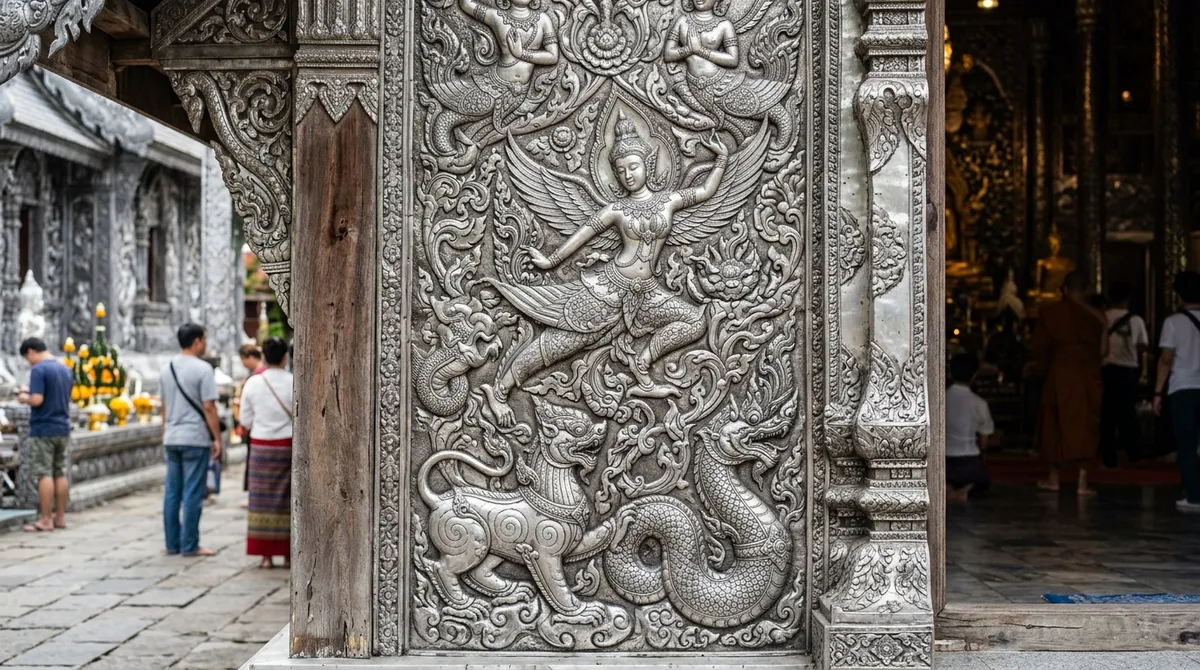
If you wander south of Chiang Mai's ancient fortified moat and turn into Wualai Road in the mid-morning light, the very first sensation that greets your ears is not modern city traffic, but an ancient, rhythmic metallic cadence: “Tok... tok... ting...” reverberating from open-front teak timber workshops. I grew up listening to that steady, hypnotic chime. The elders in my childhood always remarked that the ring of silver hammers is the true pulse of Chiang Mai. As long as the hammers echo along Wualai, the living artistic soul of the Lanna kingdom continues to breathe unhindered.
Origins of the Tai Khoen Silversmiths: From Kengtung to the Ping River Valley
The rich heritage of Wualai was not born in gleaming modern gift boutiques. Its roots stretch back to the late 18th century, an era known across Northern Thai history as “Kep Phak Sai Sa, Kep Kha Sai Mueang” (Gathering vegetables into baskets, gathering people into the city). Following decades of devastating Burmese occupation, King Kawila spearheaded the grand restoration of Chiang Mai. To revive the capital's shattered economy and sacred arts, royal delegations gathered master artisans and craftsmen from across the Shan highlands, particularly the Tai Khoen communities of Kengtung (Chiang Tung) in modern-day eastern Shan State.
Resettled just outside the fortified southern gate—in open grassy meadows where water buffaloes were historically corralled, hence the name Baan Wualai (Village of the Ox Corrals)—these immigrant master metalsmiths carried across the misty mountain passes their sublime secrets of hand repoussé and metal chasing. They forged sacred alms bowls, repoussé panels for Buddhist shrines, ritual silver water vessels for New Year lustrations, and delicate hairpins for royalty. If you wish to understand how this southern artisan quarter connected with the fortified royal city, I encourage you to read our local walking guide at chiang-mai-old-city-walking-guide before continuing your craft explorations.
Deconstructing Lanna Repoussé: Pitch Bowls, Torches, and Handmade Punches
Transforming a cold, flat sheet of sterling silver into a dynamic, three-dimensional sculptural relief requires astonishing forearm stamina, razor-sharp vision, and a meditative inner calm. Master silversmiths (known locally as Sala Ngern) follow four timeless technical tenets passed down across five generations:
- The Organic Chasing Pitch (Kra-tha Chan): Silversmiths never hammer delicate silver sheets directly against an unforgiving steel anvil. Instead, they embed the metal into a thick bed of warm pitch—a natural concoction of tree sap resin, vegetable oil, and crushed volcanic clay poured into a heavy cast-iron hemispherical bowl. This sticky black compound provides resilient backing that supports fine contours without puncturing the metal.
- Repeated Thermal Annealing: As silver is repeatedly struck, its molecular crystalline structure compresses, making the alloy work-hardened and dangerously brittle. Artisans periodically blast the sheet with a gas blowtorch until it glows dull cherry-red, instantly quenching it in cold water to realign the lattice and restore silky pliability.
- Bespoke Steel Chasing Punches: A master's workbench displays dozens of specialized steel punches, filed and ground by the artisan’s own hand—beveled edges for sharp outlines, rounded ball punches for swelling curves, and textured matting tools for background stippling.
- Mythological and Floral Iconography: Traditional Lanna motifs celebrate sacred animism and Buddhist cosmology—intricate creeping vine scrolls (Khruea Thao), celestial angels, flaming lotuses, and astrological zodiac beasts designed to ward off misfortune.
Planning Your Chiang Mai Trip? Book Early for Lower Rates
Check real-time rates and secret deals on Agoda, our official travel partner. Enjoy 100% free cancellation, pay at check-in, and earn Agoda Cash rewards.
Two Sacred Monuments of Silver: Wat Sri Suphan and Wat Muen Sarn
Strolling through the winding residential lanes of Wualai, you will soon arrive at the pinnacle of Northern Thailand's metalworking mastery: the world-famous Silver Ubosot at Wat Sri Suphan. Erected through community donations and the combined labor of dozens of local master silversmiths, this extraordinary ordination hall is encased from floor to vaulted roof in hand-beaten aluminum, nickel, and pure silver panels. You can explore the fascinating historical regulations and architectural details of this shrine in our dedicated feature at wat-si-suphan-silver-temple-chiang-mai.
Just a short five-minute walk deeper into the sois lies Wat Muen Sarn, another monumental focal point of the silversmith guild. During the Second World War, this monastery served as an emergency field hospital for the Imperial Japanese Army. Today, it houses a magnificent museum of Lanna repoussé masterpieces and WWII archival treasures. Take a moment to read our comprehensive review at wat-muen-sarn-silver-wua-lai to appreciate the quiet depth of this hidden sanctuary.
Inside the Workshop: Crafting Your Own Hand-Stamped Silver Ring
Wualai today is far more than a passive museum district; several generational family workshops now invite inquisitive travelers to pull up a wooden stool, put on leather aprons, and step into the shoes of an apprentice metalsmith. Having personally joined these sessions with visiting family members, I can assure you that wearing a ring you shaped with your own hands carries an emotional resonance no department store ring could ever match.
- Sizing and Cutting Certified 925 Silver: After measuring your ring finger with brass sizing hoops, your instructor snips a solid bar of 92.5% sterling silver wire to your exact mathematical perimeter length.
- Annealing over Open Flame: You guide the blowtorch over the silver until it turns a soft crimson glow, plunging the glowing band into a pickling solution to strip dark oxidation scales and soften the metal.
- Surface Texturing and Custom Stamping: Using miniature steel stamps and an eight-ounce cross-peen hammer, you strike personalized initials, lucky dates, or traditional Lanna leaf textures into the flat silver face. Finding a steady, confident hammering rhythm is half the joy.
- Silver Brazing and Torch Soldering: Curling the strip into a circle with padded pliers, you apply a droplet of borax flux and a tiny chip of silver solder alloy over the seam, heating the joint until the filler flows seamlessly into the seam by capillary action.
- Truing on the Steel Mandrel: Sliding the raw band onto a graduated steel ring mandrel, you tap it gently with a rawhide mallet until it forms a mathematically perfect circular cylinder.
- Hand Filing and Rotary Wheel Buffing: Finally, needle files erase excess solder, followed by abrasive polishing compounds and a high-speed cloth buffing wheel. Instantly, the clouded, hammered metal bursts into mirror-bright, lustrous brilliance.
Ethical Silver Shopping and the Weekend Street Atmosphere
Before purchasing silver jewelry or decorative tableware along Wualai Road, keep a few golden rules in mind. Legitimate craftsmen always stamp their pieces with an official purity hallmark—typically "925" for sterling jewelry or "999" for sacred temple-grade leaf silver. Authentic silver warms immediately to body temperature, feels comfortably dense in the palm, emits no sharp metallic chemical odors, and resonates with a melodious high chime when lightly tapped, unlike dull zinc or lead alloys.
On Saturday afternoons, Wualai Road closes to vehicular traffic, blossoming into the celebrated Wualai Saturday Walking Street. If you love bustling night markets and wish to compare this vibrant community fair with Chiang Mai’s even larger Sunday counterpart inside the old city walls, be sure to read our detailed comparative walkthrough at sunday-walking-street-chiang-mai. Visiting Wualai is an intimate opportunity to support genuine human heritage and keep an ancient art alive for future generations.
Plan Your Chiang Mai Journey · Verified Booking Partners
Compare real-time rates for stays, curated day tours, flight tickets, and transport with best price guarantee and flexible cancellation: