



























The Sound Beneath the Stilts: Why Pasang Looms Stand Apart
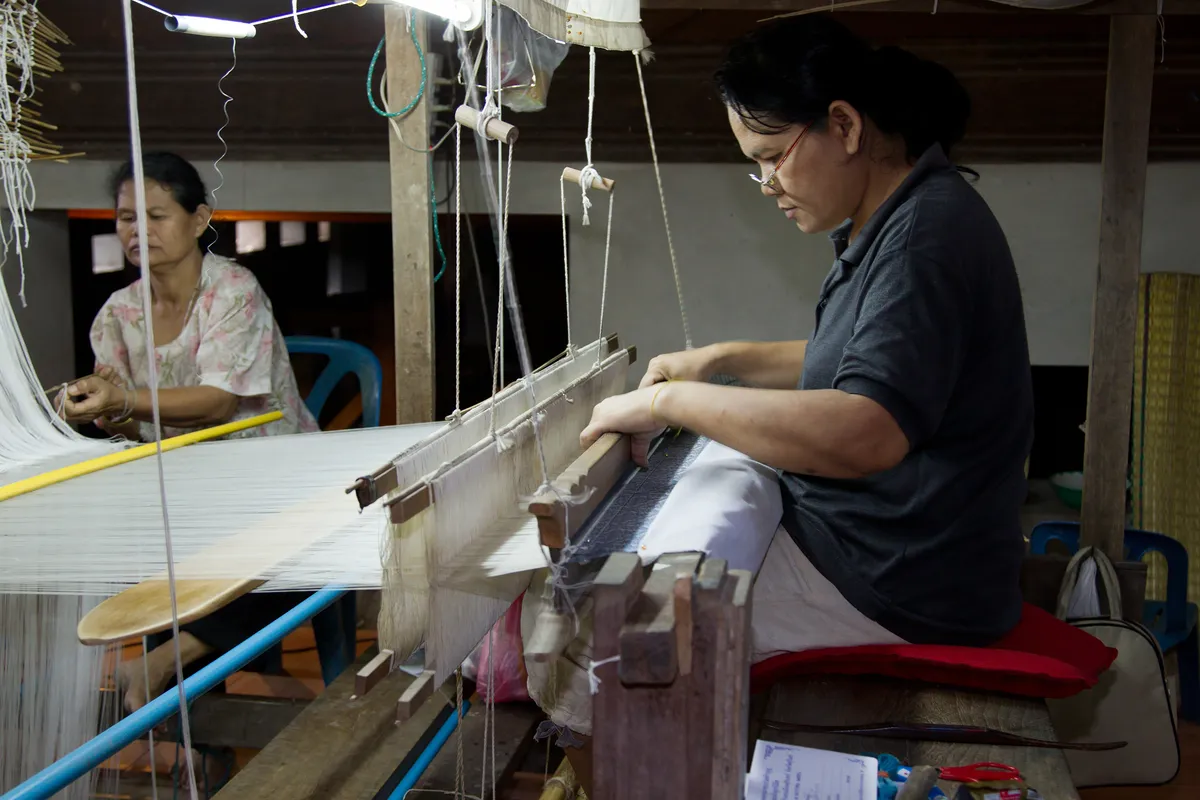
Drive twelve kilometers south of Lamphun’s old moat town down Highway 106, turn off into Mae Raeng subdistrict, and lower your car window. Before you see a single shop sign, you hear it: a dry, wooden clack-thump rolling out from shaded ground floors beneath stilt teak homes. That steady rhythm belongs to the hand looms of Pasang, a district where Tai Yong weavers who migrated from Chiang Tung more than two centuries ago still turn raw cotton into crisp striped yardage, indigo shawls, and raised-pattern spreads.
Visitors often ask me whether the cotton sold at night markets in Chiang Mai is the same as what hangs in Pasang. Honestly, much of what hangs under bright market bulbs in town comes off commercial power looms. Coming out to Ban Nong Ngoek and neighboring Ban Don Luang puts you right beside the warp beams and bobbins. You watch the weaver’s feet work the bamboo treadles, see natural dye vats cooling in the yard, and feel cotton before chemical starch hides how coarse or synthetic a cheaper bolt really is.
Ban Nong Ngoek, the Lover’s Loom, and Realistic Visiting Hours (2026)
At Ban Nong Ngoek, older weavers still preserve one of Northern Thailand’s most charming wooden inventions: the wide two-person loom, locally called khrueang tho khu. Years ago, village men farmed the cotton fields while women spun and wove indoors, yet wide household blankets required two pairs of hands to pass the wooden shuttle across the warp. Building a shared bench let husband and wife weave side by side, keeping men close to home through the dry season.
- Ban Nong Ngoek: Best known for wide handwoven cotton bedspreads, striped table runners, classic checks, and demonstrations of the rare two-person loom.
- Ban Don Luang: Just minutes away in the same subdistrict, lined with family-run cotton lanes offering natural-dyed shirts, scarves, and soft cotton yardage.
- 2026 Opening Hours: Because Pasang is an active residential weaving community rather than a gated theme park, family workshops and cooperative shops open daily from roughly 08:30 to 17:00. Arrive between 09:00 and 15:30 Monday through Saturday if you want to see weavers at work; by 16:30 most shuttles are resting for the evening.
Planning Your Chiang Mai Trip? Book Early for Lower Rates
Check real-time rates and secret deals on Agoda, our official travel partner. Enjoy 100% free cancellation, pay at check-in, and earn Agoda Cash rewards.
Four Tactile Tests: Handspun Cotton vs. Power-Loom Cloth
Before you choose a bolt or tailored shirt in Pasang, take thirty seconds to run my four simple checks. Local weavers respect a buyer who knows what they are touching.
- 1. Inspect the selvage edges: True handwoven cotton shows slight organic waviness along both side edges where the weaver turns the shuttle by hand. Power-loom cloth has ruler-straight borders often stamped with uniform pinholes.
- 2. Hold the weave up to daylight: Handspun and village-dyed cotton threads carry subtle slubs—tiny thickened wisps where two fibers overlap. If every thread looks glassy, uniform, and slightly shiny, suspect factory yarn or polyester blends.
- 3. Flip raised motifs over: On hand-picked khit or brocade accents, the reverse side shows neatly tucked floats and deliberate rhythm rather than fuzzy machine-sheared loose ends.
- 4. Press the fabric to your inner wrist: Pure handwoven Pasang cotton feels cool, matte, and breathable even in heavy weights. Machine-sized tourist cloth often feels stiff and warm like coated paper until its first wash.
Getting Here from Chiang Mai & Pairing Your Lamphun Route
Pasang sits roughly 40 kilometers south of Chiang Mai’s moat via the historic tree-lined Highway 106 (allow 50 to 60 minutes by car or hired songthaew). If you are comparing car rentals, songthaew charters, or regional bus stops, review our Chiang Mai transportation guide before locking in your fare.
My favorite unhurried day loop starts in Pasang around 09:00 while morning light filters under the stilt houses, then heads back north to Lamphun town for lunch near Kad Khua Mung Tha Sing bridge market. Culture travelers with extra stamina can widen the day with our Lamphun and Lampang heritage temple loop, while slow-food fans can swing by an organic farm in Lamphun before returning north. Back in Chiang Mai, unwind along the water at one of the best riverside hotels on the Ping River, and if you want to compare town prices the next morning, stroll through Warorot Market with a sharp eye for those same selvage edges.
Care Tips & Village Etiquette Worth Remembering
Always ask before pointing a camera beneath someone’s house; most weavers welcome curious guests happily, especially if you chat first or pick up a handwoven scarf. Once home, wash natural-dyed or indigo pieces separately by hand in cool water for the first two washes, and dry them in the shade so northern plant dyes keep their deep, earthy tone for years.
Plan Your Chiang Mai Journey · Verified Booking Partners
Compare real-time rates for stays, curated day tours, flight tickets, and transport with best price guarantee and flexible cancellation: