



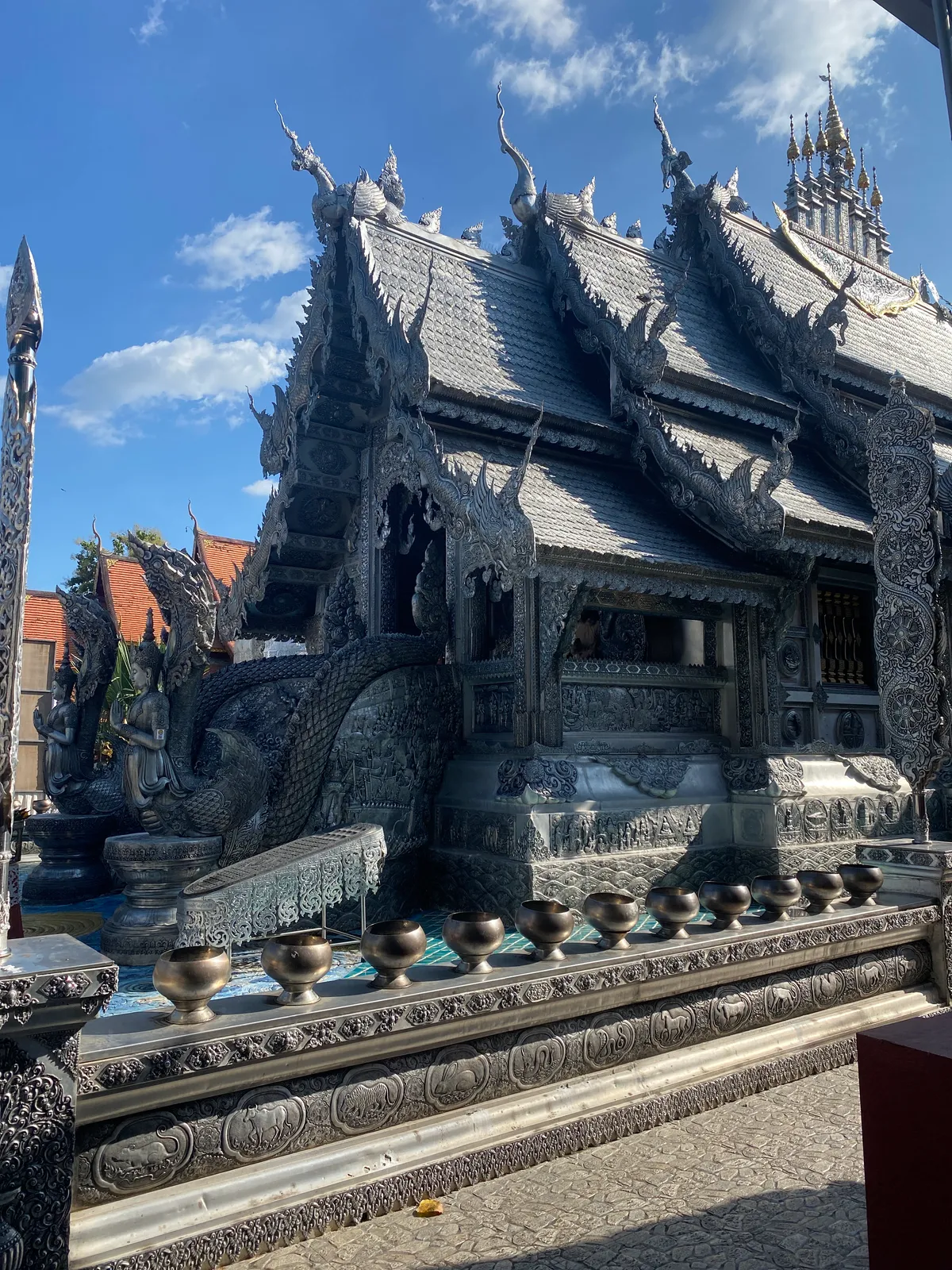
On Wualai Road, lined with silver shops on both sides, there stands a temple that catches the afternoon light and throws it back at you in a cold, brilliant white. Not paint. Not mirrors. Real silver sheets, hammered by hand, one panel at a time, by the craftspeople who have lived on this street for generations.

A Temple Built by the Silversmiths Themselves
Wat Si Suphan is not a tourist attraction built to impress visitors. It is a community temple over 200 years old, rooted in a neighborhood where Lanna silversmithing has been passed down through families since the time of the old kingdoms. The craftspeople here don't just make jewelry and tableware — they built their own place of worship.
Around 1996, the community decided to do something no outside contractor could do: restore and completely re-clad the temple's ordination hall (ubosot) using their own hands and their own craft. No mass-produced materials. No corporate sponsor. Just the silversmiths of Wualai, working in their spare time, contributing panels year after year.

The Silver Ubosot — A Work That Never Quite Ends
If you've seen photos of Wat Si Suphan online, you might assume the temple is finished. It isn't — and that's the point. Every year, craftspeople from the neighborhood continue adding new motifs, repairing aging sections, and refining the carvings in ways that will take decades more to complete.
The exterior walls are covered in hammered silver alloy panels sculpted into classic Lanna patterns: naga serpents, kinnara half-bird beings, dok phikun flowers, and guardian devas at the four corners. Inside, the ceiling is inlaid with mother-of-pearl and colored glass that shimmers in candlelight when monks chant their early morning prayers.

What to Know Before You Visit
Men Only Inside the Ubosot
This is the most important thing to know before you arrive. The silver ordination hall is restricted to male visitors only. Women are welcome to admire and photograph the temple from outside, which is still extraordinary — but only men may enter the ubosot itself.
This is a matter of longstanding religious tradition at this particular temple, not an arbitrary rule. If you're traveling as a couple or group, plan accordingly: the men can go inside while everyone else has ample time to photograph the intricate exterior carvings.
Dress Code and Temple Etiquette
- Dress modestly — no shorts, no sleeveless tops (wraps available at the temple)
- Remove shoes before approaching the ordination hall
- Ask permission before photographing inside — monks may be in prayer
- Keep voices low; this is an active place of worship, not a museum
- A donation box is provided for foreign visitors — 20 baht or more is appreciated
Best Times to Visit
Early morning (6:00–8:00am) offers the softest light on the silver panels — almost warm gold — and you'll have the temple nearly to yourself. Sunset is equally beautiful: the orange light hits the silver at a low angle and turns it amber. Avoid midday, when direct overhead sun creates harsh reflections and tour groups begin arriving.

Wualai Road on Saturday Evening
If you visit on a Saturday, plan to stay through the evening. From around 5:00pm, the entire road closes to traffic and transforms into Wualai Walking Street — hundreds of metres of stalls selling local crafts, silverwork, textiles, and street food.
Unlike the larger tourist-facing night bazaars, Wualai Walking Street is genuinely neighborhood-run. The silver vendors here are the same families whose ancestors built the temple. Don't miss the khao kaep moo (crispy pork rice crackers), nam ngiao noodles, and grilled corn water — all far more local than anything on Nimman Road.
Getting There
- Address: 100 Wualai Road, Haiya, Mueang, Chiang Mai 50100
- Hours: 6:00am–6:00pm daily
- Entry fee: Free (donation box inside)
- From the moat: ~15 min by taxi or songthaew, Grab ~40–60 ฿
- Parking: Available in front of the temple and on the opposite side of the road
- Pair with: Wat Muen San, Wat Chedi Luang, the Muser artisan quarter
Cover photo: Justraveling.com / CC BY-SA 4.0 (Wikimedia Commons)
Additional photos: Michael Jenselius / CC BY 2.0 (Wikimedia Commons) | Jtorquy / CC BY-SA 4.0 (Wikimedia Commons) | Jtorquy / CC BY-SA 4.0 (Wikimedia Commons)
Learn more: Chapter 3 (IV): Traditional Handicrafts