



























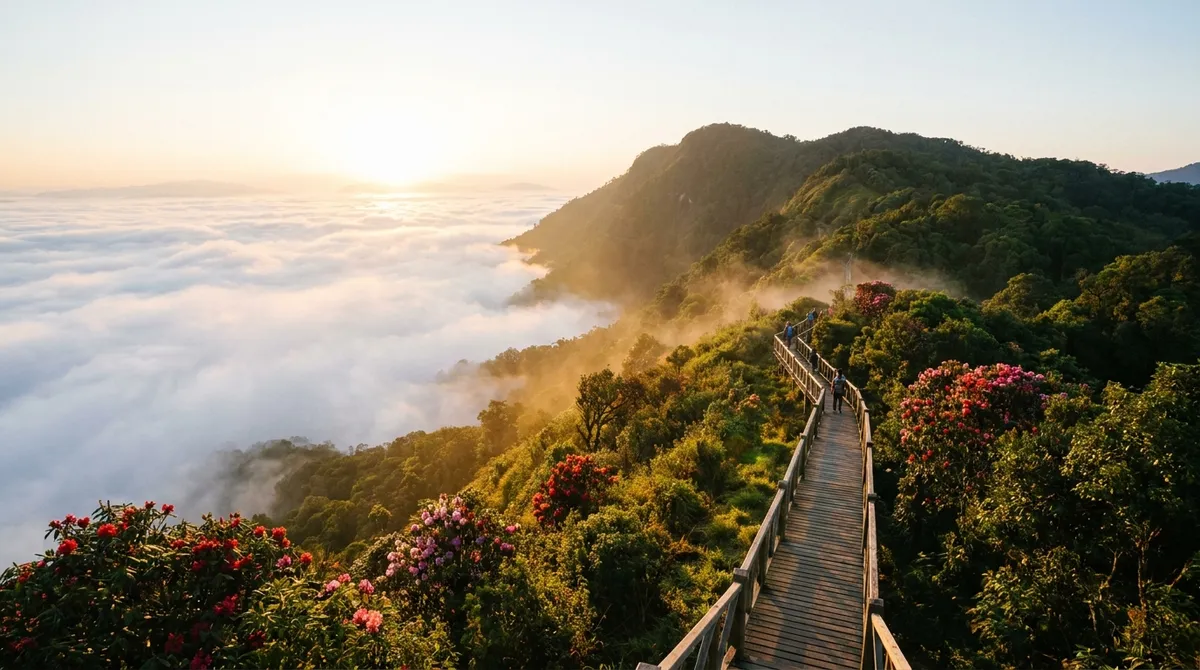
Golden Savannah in the Clouds: The Wild Allure of Doi Mon Jong
If you ask experienced Thai mountaineers to name a high-altitude wilderness trek that feels completely detached from ordinary Southeast Asian tropical jungles, Doi Mon Jong will inevitably rise to the top of the conversation. Situated deep within the pristine confines of the Omkoi Wildlife Sanctuary, straddling Omkoi District in southern Chiang Mai and Sam Ngao District in Tak Province, this monumental mountain rises 1,929 meters above sea level as an untamed sanctuary of rugged limestone crags and sub-alpine flora.
In the northern Lanna dialect, Mon denotes a gentle mountain knoll, while Jong refers to a roof gable or the prow of an ancient boat. Viewed from afar, the high limestone spine resembles a massive sleeping lion resting majestically upon the clouds—inspiring the name of its iconic summit: Hua Sing (The Lion’s Head). What distinguishes Doi Mon Jong from all other peaks in Thailand is its expansive sub-alpine grassland. After the monsoon rains cease, lush green slopes cure under crisp winter mountain winds, transforming into an undulating Golden Savannah that rolls like molten amber under blazing winter sunsets.
Trekking Doi Mon Jong is revered as one of the premier adventure and nature activities in Chiang Mai. While travelers cherish the accessible scenic walks described in our Doi Inthanon day trip guide, Mon Jong offers a genuine deep-wilderness immersion where paved roads end and authentic expedition camping begins.
Permit Procedures, Booking Quotas & Ban Musur Porters
Because Doi Mon Jong lies inside a strictly guarded Class-1 Wildlife Sanctuary rather than an open national park, access is tightly regulated to prevent ecological degradation. The mountain opens to hikers for merely 3 to 4 months annually (typically from early November to mid-February). Uncle Kham outlines the mandatory expedition logistics below:
- Securing Trekking Quotas: Independent unregulated hiking is strictly illegal. Hikers must secure an advance permit slot via the Omkoi Wildlife Sanctuary reservation channel or through the official Ban Musur Doi Mon Jong Ecotourism Community Club, which releases strictly limited daily entry quotas.
- Registration at Ban Musur Ecotourism Base: On the morning of your trek, your entire party must report to the visitor center in Ban Huai Pu Ling (Ban Musur village), Mon Jong sub-district. Here, entry permits are validated, environmental guidelines are reviewed, and park maintenance fees are settled.
- Mandatory 4WD Mountain Transfers: From the village base to the hiking trailhead (Huai Pu Ling drop-off point), visitors traverse 16 kilometers of brutally rugged, unpaved logging ruts, deep mud bogs, and rocky river crossings. Private vehicles are forbidden. You must charter an accredited local 4WD pickup driven by experienced indigenous Musur drivers (approx. 2,500 to 3,000 THB round-trip for 8 to 10 passengers), which takes roughly 90 teeth-rattling minutes.
- Employing Local Indigenous Porters: The ethnic Musur hill-tribe community maintains a rotating porter roster. Porters carry tents, communal cooking gear, and heavy backpacks, charging by actual weight (typically 30 to 40 THB per kilogram for the entire multi-day trek). Hiring porters lightens your load on steep ascents while providing critical direct income to highland families.
Planning Your Chiang Mai Trip? Book Early for Lower Rates
Check real-time rates and secret deals on Agoda, our official travel partner. Enjoy 100% free cancellation, pay at check-in, and earn Agoda Cash rewards.
The Trail to Hua Sing Summit & Spotting the Rare Wild Goral
From the 4WD drop-off clearing, hikers begin a 4 to 5-kilometer mountain trek to the wilderness campsite, typically requiring 3 to 4 hours of sustained walking. The first third winds through dense evergreen rainforest, ascending a punishing incline affectionately known by local trekkers as Noen Ma Hop (Panting Dog Hill). Breaching the tree line, the canopy vanishes, unveiling the breathtaking golden savannah undulating beneath open azure skies.
Highlights of the summit trek include:
- Conquering Hua Sing (The Lion’s Head Peak at 1,929m): From the camping hollow, trek an additional 1.5 to 2 kilometers along the narrow, windswept ridge toward the lion's snout. Standing on this dramatic rocky promontory offers an unrestricted 360-degree vista encompassing deep forested canyons in Chiang Mai and rolling mountain tiers in Tak Province. Sunset from this vantage point is a transcendent spiritual spectacle.
- Spotting the Endangered Goral (Celestial Goat): The sheer, inaccessible limestone cliffs plunging vertically below Hua Sing provide one of the final remaining refuges for the Goral (Naemorhedus griseus), a critically endangered mountain ungulate locally venerated as Ma Thewada (The Celestial Horse). Known for their uncanny agility on vertical cliff faces, these reclusive creatures emerge between 6:30 AM and 8:00 AM to graze on high cliff grasses. Bring compact binoculars and scan the shaded ledges in silence.
- Stargazing in Zero Light Pollution: Isolated dozens of miles from urban civilization, Mon Jong’s night sky is pitch black. Looking upward reveals the glowing arc of the Milky Way and countless shooting stars with staggering diamond clarity.
If you are new to mountain hiking and wish to build your stamina beforehand, begin with the pleasant uphill trail documented in our Monk's Trail Wat Pha Lat hiking guide in Chiang Mai city.
Off-Grid Wilderness Camping & Leave-No-Trace Ethics
Uncle Kham must candidly stress that Doi Mon Jong is a pure, unvarnished wilderness: there is no electrical grid, no mobile phone reception, no running water taps, and no restaurants.
Essential survival and environmental preparedness rules:
- Water Purification: A small natural spring seep located down in a forest ravine near the campsite provides water for cooking, fetched by local porters. For drinking water, pack reliable hollow-fiber water filter bottles or chlorine dioxide purification tablets to avoid waterborne stomach bugs.
- Camp Kitchen & Campstoves: Hikers must pack all provisions, lightweight backpacking stoves, butane canisters, and mess kits. Choose lightweight, high-energy dry meals that require minimal water for cleaning.
- Wilderness Sanitation: The campsite features rudimentary dry-pit canvas enclosures. Always carry personal biodegradable wet wipes, a personal waste ziplock pouch, and a powerful LED headlamp for nocturnal trips.
- The Golden Leave-No-Trace Law: Every scrap of waste generated—plastic wrappers, snack bags, candy foils, cigarette butts, and empty bottles—must be carried back down in heavy-duty garbage bags and deposited at the Musur village recycling station. Leaving trash or burying plastic threatens the fragile digestive systems of native gorals and wild boars.
Mid-winter from November through January represents the absolute best time to visit Chiang Mai, and conquering Doi Mon Jong’s golden savannah is honored as one of the 10 best things to do in Chiang Mai for true outdoor adventurers.
Summary Guide: Doi Mon Jong Expedition
| Parameter | Key Expedition Facts & Uncle Kham's Advice |
|---|---|
| Hiking Distance | 4–5 km to campsite + 2 km ridge walk to Hua Sing summit |
| Summit Elevation | 1,929 meters MSL at Hua Sing (Lion’s Head) |
| Open Season | November to mid-February annually (Winter only) |
| Trailhead Access | Mandatory 16 km 4WD pickup charter from Ban Musur |
| Connectivity & Power | Zero electricity; zero cell coverage; complete off-grid retreat |
Doi Mon Jong humbles the ego and revives the soul through its sheer scale and raw simplicity. Uncle Kham urges you to tread lightly, pack responsibly, and cherish every golden blade of grass swaying beneath the mountain winds!
Plan Your Chiang Mai Journey · Verified Booking Partners
Compare real-time rates for stays, curated day tours, flight tickets, and transport with best price guarantee and flexible cancellation: