



























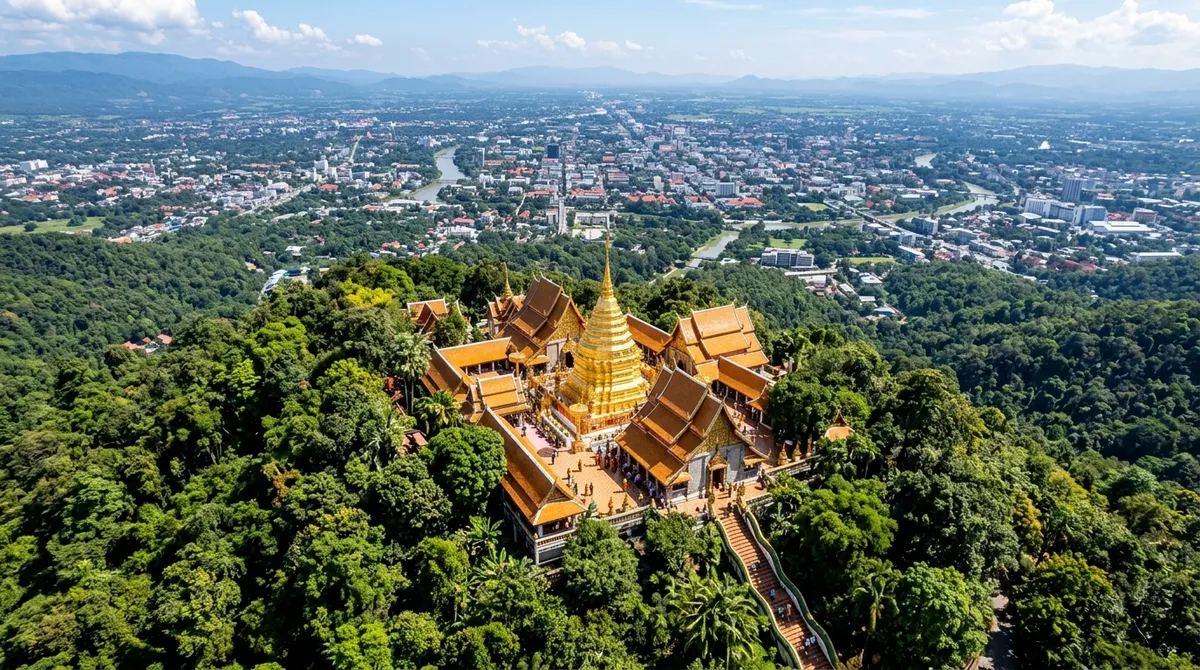
The Rise of a Grand Sanctuary in Ancient Muang Kaen
Driving north from Chiang Mai city through the fertile Mae Taeng river basin along Route 107, travelers encounter a serene rural panorama of rice paddies, teak groves, and limestone hills. Approaching Inthakhil subdistrict, the skyline suddenly yields to a breathtaking spectacle of soaring multi-tiered roofs clad in gleaming indigo-blue ceramic tiles: Wat Ban Den (officially named Wat Den Salee Sri Muang Kaen). Widely celebrated as one of the most magnificent contemporary Lanna religious complexes in Thailand, this hilltop monastery embodies the living continuity of Northern Thai Buddhist architecture.
Uncle Kham remembers when this site was merely a modest rural monastery perched on a low earthen hillock known in northern dialect as a den. Shaded by an ancient Sacred Bodhi tree (Ton Salee), the grounds belonged to ancient Muang Kaen, a centuries-old settlement dating back to early Tai kingdoms. In 1988, the deeply revered meditation master Khruba Theung Natsilo assumed the abbotship. Through his profound spiritual leadership and the boundless generosity of devotees from across Thailand and abroad, the humble village temple transformed over three decades into a peerless temple city that mesmerizes travelers worldwide.
Architectural Splendor: Indigo Roofs and 12 Zodiac Chedis
The distinctive visual identity of Wat Ban Den lies in its dramatic chromatic harmony. Unlike conventional scarlet and gold temples, its pavilions feature glazed porcelain roof tiles of deep cobalt blue, contrasted against radiant gilded finials (chofah) and pure white sculpted mortar. This striking aesthetic has earned it the moniker 'The Grand Blue Temple of Mae Taeng.' Uncle Kham highlights these primary architectural wonders:
- The 12 Astrological Zodiac Reliquaries: Rising majestically across the expansive rear courtyard is a dramatic forest of ebony-hued stupas rimmed in pure gold foil. Each pagoda enshrines sacred relics representing one of the twelve astrological birth years (from Rat to Pig), allowing Buddhist pilgrims to honor their personal birth sign without traveling across the distant provinces of Siam.
- Viharn Phra Chao Pun Ton (Hall of a Thousand Buddhas): A monumental teak timber sanctuary supported by massive polished tree columns. Multiple receding roof eaves shelter an extraordinary assembly of golden Buddha statues displayed along stepped tiers, illustrating infinite devotion through classical Lanna proportions.
- Reclining Buddha Hall & Four-Gabled Scripture Repository: A colossal gilded bronze reclining Buddha rests gracefully within a light-filled open pavilion where mountain breezes circulate freely. Beside it stands an elevated Hor Trai (Tripitaka library) covered in delicate fretwork depicting mythical celestial Kinnarees and celestial foliage.
- Cobalt Naga Stairways & Mythical Guardians: Sweeping staircases flanked by coiled indigo serpents with glistening scales guide pilgrims upward toward temple terraces, symbolically ascending Mount Meru according to Buddhist cosmology.
Planning Your Chiang Mai Trip? Book Early for Lower Rates
Check real-time rates and secret deals on Agoda, our official travel partner. Enjoy 100% free cancellation, pay at check-in, and earn Agoda Cash rewards.
Living Mastery of Lanna Teak Craftsmanship
Beyond its grand scale, what touches Uncle Kham's heart is the authentic craftsmanship embedded in every square meter. Khruba Theung gathered master carpenters, sculptors, and lacquer artisans from across Northern Thailand to preserve traditional Lanna techniques. Gigantic whole teak logs form structural pillars without reliance on hidden steel frames, celebrating the warm organic grain of native timber.
Every wooden eave bracket (hู chang) is individually hand-chiseled into fierce garudas, serpentine nagas, and floral scrollwork. Polished granite pathways kept immaculate by resident monks invite travelers to walk barefoot, experiencing cool stone textures while listening to wind chimes softly chiming from high eaves. It provides a peaceful sanctuary for mindfulness, spiritual reflection, and admiration of timeless artistic heritage.
Travel Logistics, Photography Advice, and Connecting Itineraries
Wat Ban Den is situated approximately 45 kilometers north of downtown Chiang Mai. Follow Highway 107 north past Mae Taeng district center, then turn right toward Mae Ngat Dam along Route 1150 for about 5 kilometers. The route follows smooth, well-signposted asphalt accessible by private car, motorbike, or private charter van.
For photography enthusiasts, optimal natural lighting occurs during two golden windows: 07:30–09:30 AM, when early morning sunlight hits the eastern facades and illuminates the cobalt blue glaze against crisp mountain skies, and 16:00–17:30 PM, when late afternoon warmth casts a rich golden aura across the black zodiac stupas.
Make the most of your day excursion by combining Wat Ban Den with neighboring Mae Taeng and Mae Rim highlights. Drive just 20 minutes east to scale the extraordinary Sticky Waterfalls Bua Tong Mineral Climbing Experience where mineral deposits allow bare-hand climbing directly up running cascades. On your way back toward the city, explore royal Lanna history at the Dara Rasmi Palace Museum in Mae Rim, stroll through classic landmarks using our Top Things to Do in Chiang Mai Old City Walking Guide, and complete your journey by resting comfortably in the city's trendiest neighborhood with our curated Best Nimman Hotels Chiang Mai Guide.
Plan Your Chiang Mai Journey · Verified Booking Partners
Compare real-time rates for stays, curated day tours, flight tickets, and transport with best price guarantee and flexible cancellation: