











Chapter 15: Hong Kwan: Somatic Metaphysics of the 32 Vital Souls, the Silver Sa-hlung Chalice, and the Wrist-Binding Liturgy of Reintegration
Explore Lanna's Hong Kwan: the 32 vital souls, the silver Sa-hlung Baisri, and the esoteric left-then-right wrist binding restoring the human spirit.
Somatic Metaphysics: The 32 Discrete Souls of the Northern Thai
In the ethnopsychiatric ontology of the Tai Yuan (Northern Thai), the living human body is not animated by a solitary, indivisible ghost, but by an integrated commonwealth of vital life-forces termed "Kwan" (Vital Souls). Classical Lanna physiology dictates that the healthy human frame harbors precisely thirty-two distinct Kwan, each sovereign over a specific anatomical and functional domain (the crown of the head, the eyes, the heart, the limbs, the breath, the blood).
Sanguan Chotisukharat explains that the Kwan are inherently flighty, delicate, and prone to trauma. Whenever an individual endures an existential shock—a catastrophic fall, a savage animal attack, a sudden near-death experience idiomatically termed "Tok Jai Kwan Hai" (frightened to the point of soul-extinction)—or lingers through weeks of wasting disease on a sickbed, the psychic equilibrium shatters. The thirty-two vital souls take flight, scattering into the wilderness, mountain ravines, rivers, or spirit domains. Bereft of its vital forces, the physical body languishes in chronic exhaustion, acute anxiety, and spiritual desolation. To avert ontological collapse, the community stages the "Hong Kwan" (or Hiak Kwan—The Liturgy of Calling the Souls) to summon, gather, and re-anchor the scattered spiritual anatomy into the flesh.
The Architecture of the Baisri: The Silver "Sa-hlung" Chalice
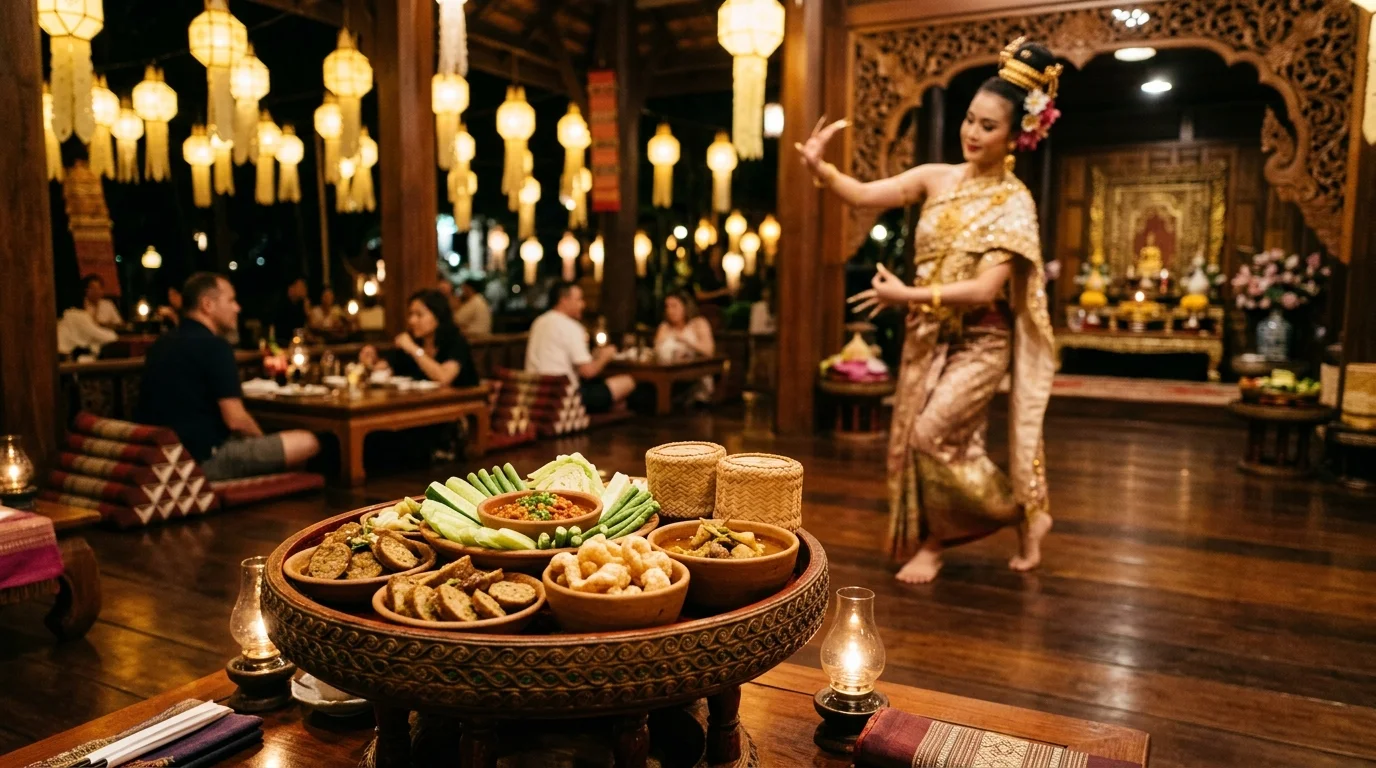
Lanna ritual diverges fundamentally from Central Siamese tradition in its ceremonial vessel. While Central Thailand erects multi-tiered arrangements of folded banana leaves (Baisri Pak Cham), Northern Thais assemble the sacred soul-tray inside a "Sa-hlung"—a chased silver repoussé bowl or an antique dark cinnabar lacquerware vessel (Khruang Khoen), mounted upon an elevated wooden pedestal tray (Phaan).
Within this silver vessel rests an eloquent triad of elemental sustenance:
- A Ball of Cooked Sticky Rice (Khao Pun): The primordial staple representing grounded stability, cohesion, and bodily fuel.
- A Single Ripe Banana (Kluay Nam Wa): Symbolizing sweetness, nourishment, and smooth passages through life's obstacles.
- A Single Hard-Boiled Egg (Khai Tom): The universal cosmological archetype of unbroken embryonic wholeness, pristine potential, and cellular rebirth.
- Fresh Flowers, Incense, Candles, and Unbleached White Cotton Cords: Prepared specifically for the closing wrist-binding rite.
This silver Baisri was not restricted to medical crises; it operated as the universal sacramental technology for all major life-cycle transitions, gracing housewarmings, elephant convalescences, and the traditional matrimony of lovers.
The Litany of Re-Gathering and the Dual-Wrist Binding Formula
The ceremony required the vocal authority of an "Achan" (a respected village master or disrobed monk). Seated face-to-face with the trembling patient, the master unrolled his mulberry paper manuscript (Pap Sa) and declaimed the "Kham Hong Kwan" in classical Northern Thai vernacular verse, chanted in an unhurried, deeply soothing, and resonant melisma lasting ten to fifteen minutes.
The text traverses the patient's anatomy, enumerating where each of the thirty-two souls belongs, while passionately commanding them to desert the shadows: "Hearken, ye wandering souls! If ye be stranded in dark mountain crevices, entangled in wild brambles, drowning in cold river eddies, or lured by phantom spirits in the woods, awaken from thy stupor! Return home unto this temple of flesh, unto these bones, this brow, and this beating heart!"
As the invocation concluded and the patient absorbed the protective warmth of the assembled family, the master executed the ritual climax: the binding of the wrists (Phuk Mue):
- He bound the LEFT wrist first: Reciting the binding formula: "Mat Mue Sai, Kwan Ma" ("Binding the left wrist, may the wandering soul return home"), drawing the straying energies back across the threshold of the body.
- He bound the RIGHT wrist second: Reciting: "Mat Mue Khwa, Kwan Yu" ("Binding the right wrist, may the restored soul stay forever rooted"), locking the thirty-two vital souls securely inside the somatic vessel.
- The master concluded with solemn benedictions of unyielding longevity and immunity from future afflictions.
Custom demanded that the white threads remain bound upon the wrists for a mandatory minimum of three days. In the case of fragile infants, parents frequently left the sacred cotton in place indefinitely, until the unbleached white threads turned dark with play and disintegrated naturally into the earth. The Hong Kwan ceremony was thus an exquisite indigenous psychotherapeutic system, deploying the restorative powers of poetry, kinship solidarity, and sacred symbolism to stitch a shattered human psyche back into wholeness.