



























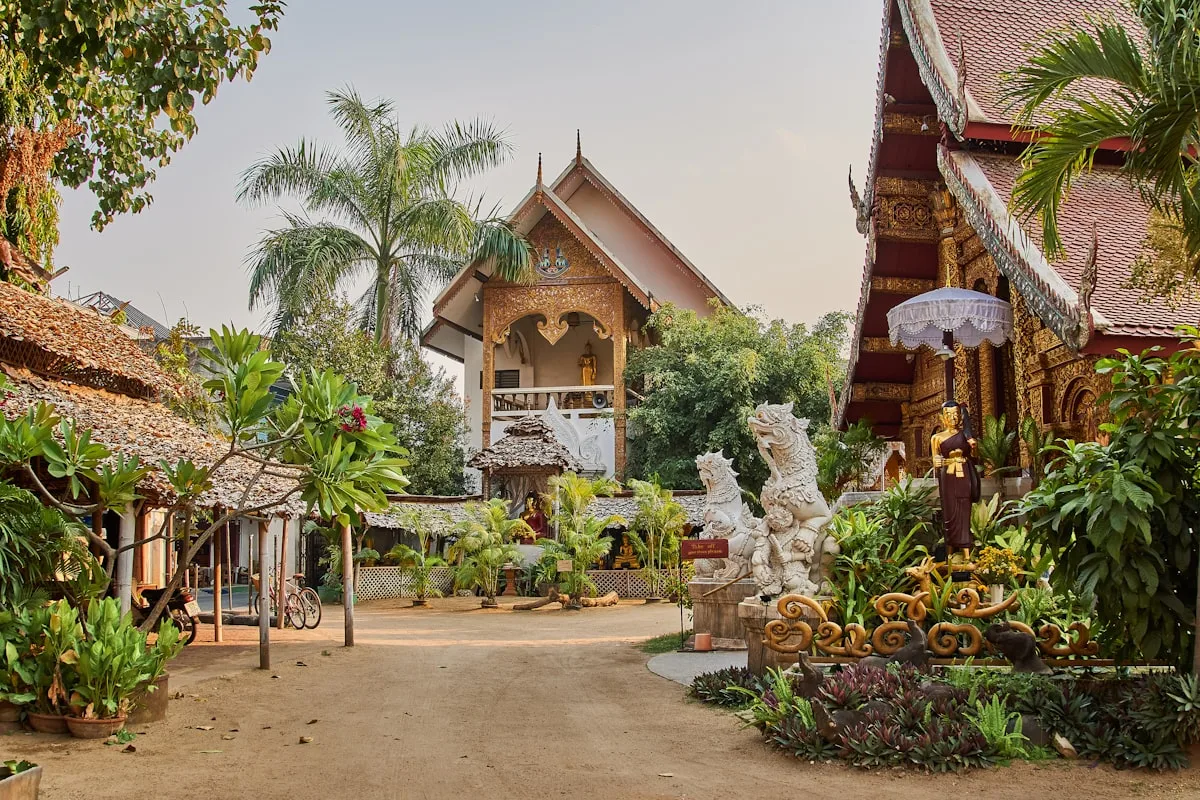
Monumental Faith Rising Above Ancient Mueang Kaen
Driving north across the rural farmland and orchards of Mae Taeng District, crossing the Ping River toward the ancient boundary of Mueang Kaen, your gaze is inevitably drawn toward an imposing hillside silhouette. Dominating the ridge are dark, soaring stupas and cascading multi-tiered rooflines of deep sapphire blue. This is Wat Den Sahlee Sri Mueang Kaen, universally cherished by locals as Wat Ban Den. I remember when this sacred knoll housed only a humble, deteriorating woodland hermitage. In 1988, revered Lanna meditation master Kruba Chao Teung Nathsilo arrived on pilgrimage and, powered by immense regional lay devotion, began crafting one of northern Thailand's most awe-inspiring modern temple complexes.
Where the delicate filigree of Wat Si Suphan the Silver Temple showcases intimate handicraft, or the historic sanctuaries on our Doi Suthep and city temple trail convey weathered antiquity, Wat Ban Den delivers sheer architectural grandeur. Seamlessly integrating traditional Lanna, Burmese, and Tai Lue motifs across expansive terraced plazas, it stands as a breathtaking monument to contemporary northern Buddhist art.
The Celestial Circle: The Twelve Birth Zodiac Pagodas
The spiritual centerpiece of Wat Ban Den is an extraordinary complex of twelve monumental stupas dedicated to the Chinese and Lanna animal zodiacs. Each chedi is an architectural homage to celebrated pilgrimage pagodas scattered throughout northern Thailand and neighboring lands (such as Doi Suthep, Hariphunchai, Cho Hae, Lampang Luang, and the Golden Rock Kyaiktiyo).
Traditional Lanna cosmology teaches that every soul is protected by the sacred relic of their birth year, and undertaking a pilgrimage to one's zodiac stupa bestows lifetime blessings and karmic merit. Recognizing that visiting twelve separate regional sites across distant provinces is physically daunting, Kruba Chao Teung gathered miniature replicas of all twelve planetary stupas onto this single ridge, allowing devotees to honor their planetary birth sign in a unified spiritual sanctuary:
- The Master Black Stupa Array: Coated in striking charcoal-black lacquer and crowned with gleaming golden umbrella htis, these pagodas cascade down the hillside contours, creating a dramatic visual silhouette against azure mountain skies.
- Zodiac Guardian Sculptures: Encircling the base of each stupa are finely sculpted depictions of the twelve astrological animal guardians—from the Rat, Ox, Tiger, and Rabbit to the Dragon, Snake, Horse, Goat, Monkey, Rooster, Dog, and Pig—accompanied by Lanna and Thai script prayer mantras.
Planning Your Chiang Mai Trip? Book Early for Lower Rates
Check real-time rates and secret deals on Agoda, our official travel partner. Enjoy 100% free cancellation, pay at check-in, and earn Agoda Cash rewards.
Teakwood Sanctuaries and Living Mythological Guardians
Beyond the stupa forest, what captivates Uncle Kham is the sheer scale of the monumental wooden halls constructed entirely from solid old-growth teakwood. The grand ordination hall (Ubosot), the Scripture Library (Ho Trai), and the Viharn of the Instant Buddha (Phra Chao Tan Jai) feature massive teak timber columns that would take three adult spans to encircle. The gable pediments and window shutters showcase the virtuosity of Chiang Mai master woodcarvers, depicting intricate scenes from the Jataka tales.
Guarding the marble courtyards are snow-white stucco sculptures of mythical Himalayan (Himavanta) creatures. Seven-headed naga serpents glide along balustrades, composite makara beasts, kinnari bird-maidens, and fierce dvarapala temple guardians stand sentinel beside arched teak doorways. Every single pavilion is roofed with shimmering dark-blue glazed tiles that catch the sun, earning the complex its popular international moniker as the "Blue Temple of Mae Taeng."
Visiting Logistics and Regional Sightseeing Links
Exploring Wat Ban Den thoroughly requires at least 60 to 90 minutes. Because the complex is spread across multiple hillside terraces with open stone plazas, carrying a sun parasol, hat, and sunglasses is highly recommended during midday hours. Respectful monastery dress is strictly enforced: shoulders, chests, and knees must remain covered, and footwear must be removed before entering any wooden viharn.
Located roughly 50 minutes north of Chiang Mai city via Highway 107, turn right at the Mae Ngat Somboon Chon Dam intersection onto Route 3038. After admiring the teak craftsmanship, head a few kilometers further north to cool down at the mineral cascades of Bua Tong Sticky Waterfalls, or book a night in a boutique valley retreat highlighted in our curated guide to Chiang Mai Lanna-style heritage hotels. To explore more foundational Buddhist heritage back within the ancient brick perimeter, delve into our collection of essential things to do in Chiang Mai Old City.
Plan Your Chiang Mai Journey · Verified Booking Partners
Compare real-time rates for stays, curated day tours, flight tickets, and transport with best price guarantee and flexible cancellation: