



























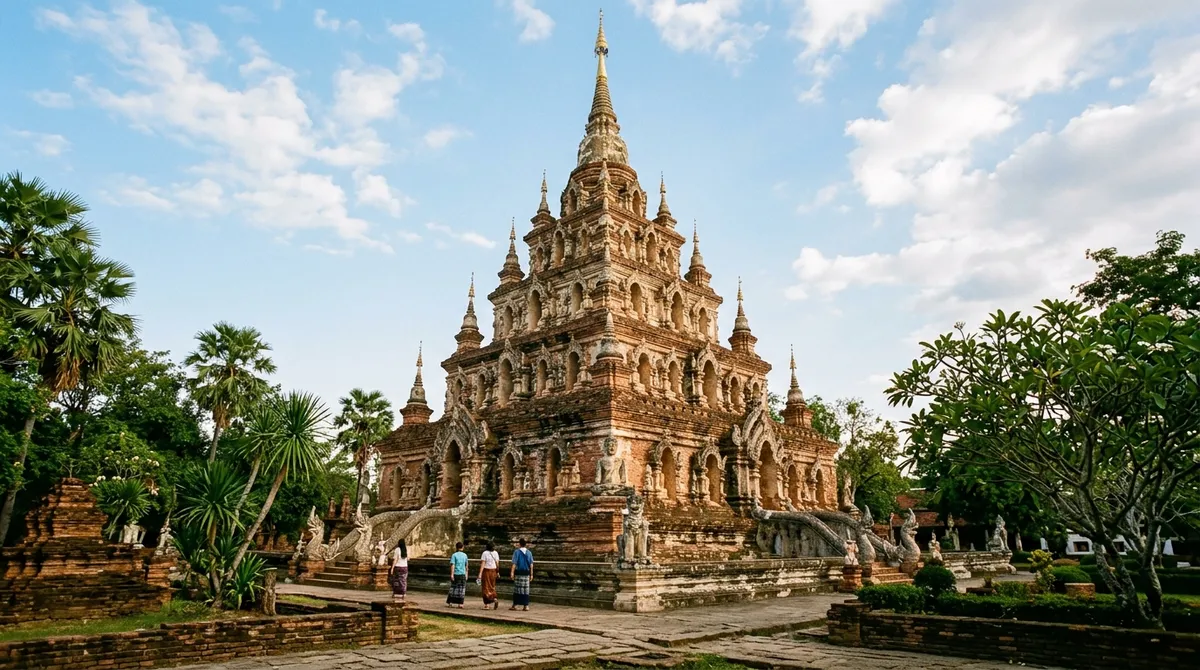
The Underground City’s Finest Surviving Stucco Gallery
Ask anyone who spends real time wandering Wiang Kum Kam in Saraphi which single ruin preserves the most delicate surviving Lanna stucco craft, and the finger points straight west toward Wat Pu Bia. Sitting along the ancient western moat and earthwork ridge in Tambon Tha Wang Tan, this complex lay buried roughly two meters beneath Ping River flood sediment until Thailand’s Fine Arts Department carefully excavated it in 1986 (2529 BE).
No surviving palm-leaf chronicle records its original royal name; villagers later named it after "Pu Bia," a small-statured elder who owned land beside the mound. Yet step down the modern stairs into the sunken courtyard and you immediately see this was a major monastery built by seasoned masters, not a minor neighborhood shrine.
Reading the Prasat Stupa, Two-Era Sanctuary & Octagonal Reliquaries
Wat Pu Bia rewards slow inspection because its entire Buddhist complex—sanctuary hall, principal stupa, ordination hall, and burial stupas—remains extraordinarily legible on the ground. It also sits close enough to Wat Chedi Liam to invite comparison: while Wat Chedi Liam showcases a bold five-tiered stepped pyramid, Wat Pu Bia stands out for its refined prasat-style (mondop-prasat) stucco stupa.
- Prasat-Style Principal Chedi: Multi-tiered indented square base moldings lift a tall four-sided relic chamber pierced with Buddha niches on every face. Look closely at the framing arches to see crisp floral vines and scrolling Lanna stucco curls blended with Sukhothai elegance, crowned above by octagonal lotus tiers and a slender bell spire.
- Layered Viharn Floor: Directly before the stupa rises an elevated brick viharn terrace showing masonry rebuilt in two distinct periods—evidence that monks and residents repeatedly raised and repaired their sanctuary floor even as Ping River floods crept higher.
- Boundary-Stone Ubosot & Octagonal Stupas: Flanking the sanctuary stands a compact ordination hall bordered by a low wall with cross-shaped lattice vents and round sandstone sema markers, plus octagonal bone-reliquary stupas that yielded ash urns, bronze Buddhas, and inscribed lead votive tablets.
Planning Your Chiang Mai Trip? Book Early for Lower Rates
Check real-time rates and secret deals on Agoda, our official travel partner. Enjoy 100% free cancellation, pay at check-in, and earn Agoda Cash rewards.
Easy Bicycle & Carriage Connections From Wat Chang Kham & Wat E-Kang
Positioned roughly one kilometer west of the Information Center and Wat Chang Kham, Wat Pu Bia links cleanly into any loop through the buried city.
- By Rental Bicycle: Rent a bike near Wat Chang Kham and the Information Center (50–100 THB/day), pause under the canopy at Wat E-Kang in the central lane, then pedal west to Wat Pu Bia and finish at Wat Chedi Liam over an unhurried 90 to 120 minutes.
- By Horse-Drawn Carriage: Most standard carriage routes (~300–500 THB per carriage) pass Wat Pu Bia’s wide approach lane. Remind your driver before departure that you want 10–15 minutes off the carriage to walk down into the sunken courtyard and examine the western stucco niches.
- From Downtown Chiang Mai: Follow Highway 106 south or call a 15–20 minute Grab or Bolt (~100–160 THB) using our Chiang Mai transportation guide.
Hours, Zero Fees, Photography Light & Preservation Etiquette
Entrance to Wat Pu Bia is completely free daily, with the clearest daylight hours from 08:00 to 17:00. Time your visit for 08:00–09:30 or 16:00–17:00, when low side-angled sunlight rakes across the western niches and throws the carved floral stucco into sharp relief.
Because centuries-old lime stucco turns crumbly with moisture and touch, keep hands strictly off the moldings, never step atop exposed brick walls, and wear modest clothing suitable for an active village heritage zone.
Continuing From Wiang Kum Kam to Old City & Lamphun
Use our complete Wiang Kum Kam guide to stitch together any remaining village ruins before heading north back inside Chiang Mai’s moat. Seeing Wat Pu Bia’s intimate stucco first makes the monumental scale of Wat Chedi Luang and the highlights in top things to do in Chiang Mai Old City come alive with fresh context.
If your schedule allows another heritage detour, swing west to Hang Dong’s wooden sanctuary via our Wat Ton Kwen guide, or keep south down Highway 106 on our Lampang and Lamphun day tour before returning to base near Tha Phae Gate hotels.
Plan Your Chiang Mai Journey · Verified Booking Partners
Compare real-time rates for stays, curated day tours, flight tickets, and transport with best price guarantee and flexible cancellation: