


















Chapter 6: Merit for the Born and the Departed: Vital Transitions, Mindfulness of Death, and the Soot Thon Exorcism
Explore ancient Lanna's death and life rites: birthday paritta origins, the Soot Thon roadside exorcism with red banners, and the mystery of Lap Luat.
Evolution of Birthday Rites and the Canonical Archetype of Longevity
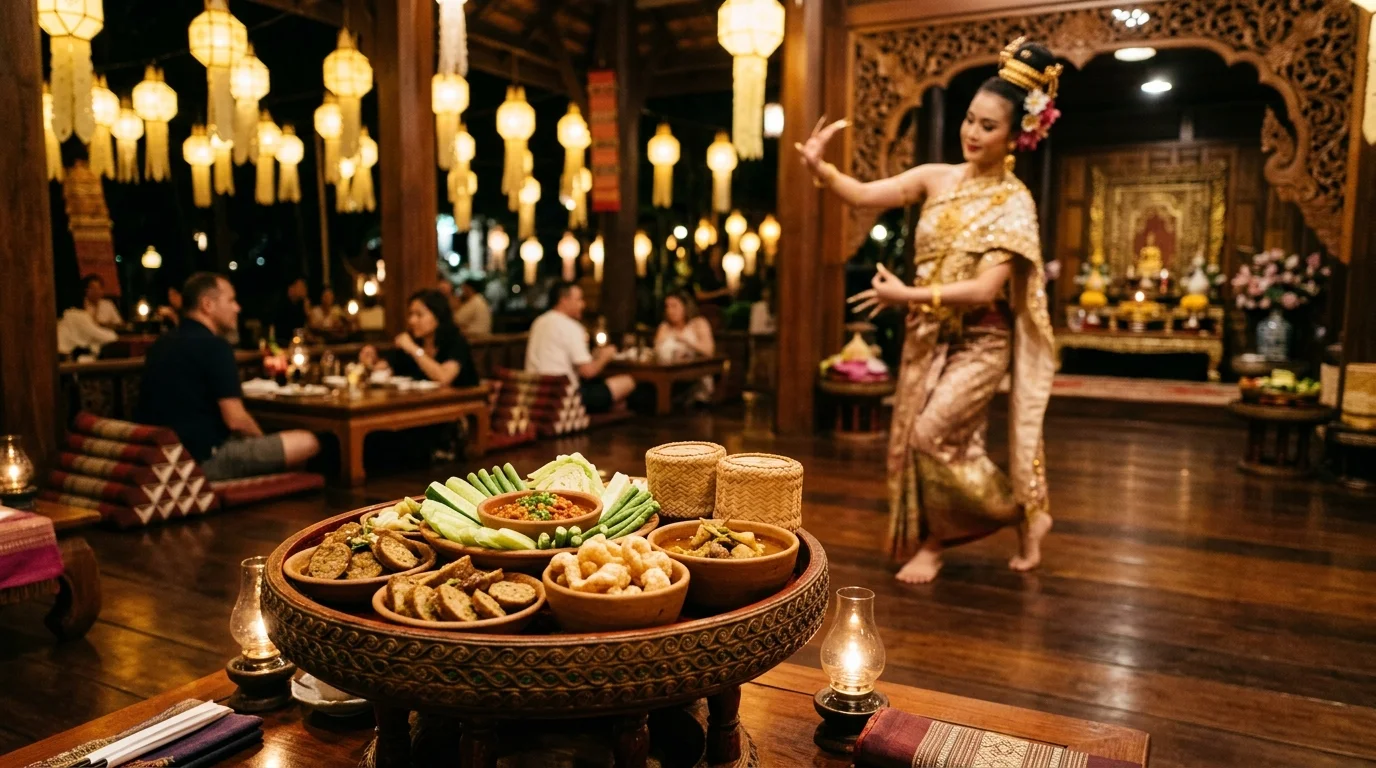
In ancient Lanna society over half a century ago, the modern ritual of annual birthday celebrations did not exist. Instead, individuals commissioned merit-making ceremonies exclusively upon reaching significant life thresholds—most notably the volatile 25-year transitional age (Benjaphet) or the completion of 12-year astrological cycles at ages 36, 48, 60, and 72. Traditional celebrations were strictly spiritual, encompassing early morning almsgiving, listening to monastic discourses, and the ceremonial release of captive fauna—such as river turtles (signifying slow, steady longevity) and swamp eels (Pa Hyaen, symbolizing smooth passage through life's karmic obstacles).
The canonical blueprint for birthday longevity rites traces back to the lifetime of Gotama Buddha and the narrative of Ayuvaddhana Kumara. Two Brahmin parents presented their infant to an ascetic hermit, who blessed the parents with long life but remained pointedly silent before the child. When pressed, the seer revealed the infant was karmically destined to die within seven days. Directed to the Buddha, the parents arranged for an unbroken seven-day monastic chanting of protective discourses (Paritta). On the final day, the Blessed One arrived in person; his radiant presence completely barred the approach of a predatory demon sanctioned to devour the boy. Spared from premature death, the child thrived to the age of 120, inaugurating the Buddhist tradition of intoning protective stanzas to safeguard human lifespans.
The author draws a sharp ethical contrast with modernity, noting that sacred birthday observances have widely deteriorated into hedonistic drinking banquets, ironically transforming days commemorating the inception of life into occasions of fatal vehicular carnage.
Lanna Thanatology: Violent Deaths and the Soot Thon Exorcism via "Red Tungs"
"One knows the day of birth, but none foresees the hour of demise." Lanna culture distinguishes fundamentally between Natural Deaths (arising from peaceful senescence or gradual disease, wherein consciousness smoothly disengages) and Violent/Untimely Deaths (Tai Hong or Tai Bor Dee), caused by sudden trauma, weaponry, murder, lightning, or road collisions.
In violent deaths—particularly those involving dismemberment or sudden bodily obliteration—the disembodied spirit undergoes profound cognitive disorientation. Unable to recognize its damaged physical vessel or realize its own transition, the consciousness suffers "Chit Tok" (fallen/trapped consciousness), binding the ghost obsessively to the exact terrestrial coordinate where trauma struck. To liberate these earthbound spirits, Lanna custom prescribes the "Soot Thon" exorcism:
- Four fully ordained Buddhist monks are escorted directly to the fatal roadside or wilderness site.
- A mound of river sand is shaped into a stupa and planted with a Tung Daeng (Red Banner), functioning as a vibrant talisman marking the perimeter of violent death.
- The monks recite the specialized Soot Thon liturgical formulas, spiritually severing the psychic clinging anchoring the deceased to the physical terrain.
If the Soot Thon is omitted, the tethered soul is believed to grow increasingly malevolent, frequently orchestrating recurrent accidents to secure a substitute victim to release its torment.
Conversely, for peaceful sudden deaths during sleep (medically linked to Sudden Unexpected Nocturnal Death Syndrome or cardiac arrest), the northern folk use the poignant idiom "Lap Luat" (to sleep through continuously). Viewed without dread, it is seen as a gentle departure devoid of prolonged physical agony. The chapter culminates in an urgent call to Appamada (heedfulness): since death arrives unheralded, one must fortify the spirit with charity, moral restraint, and mental cultivation before the breath ceases.