






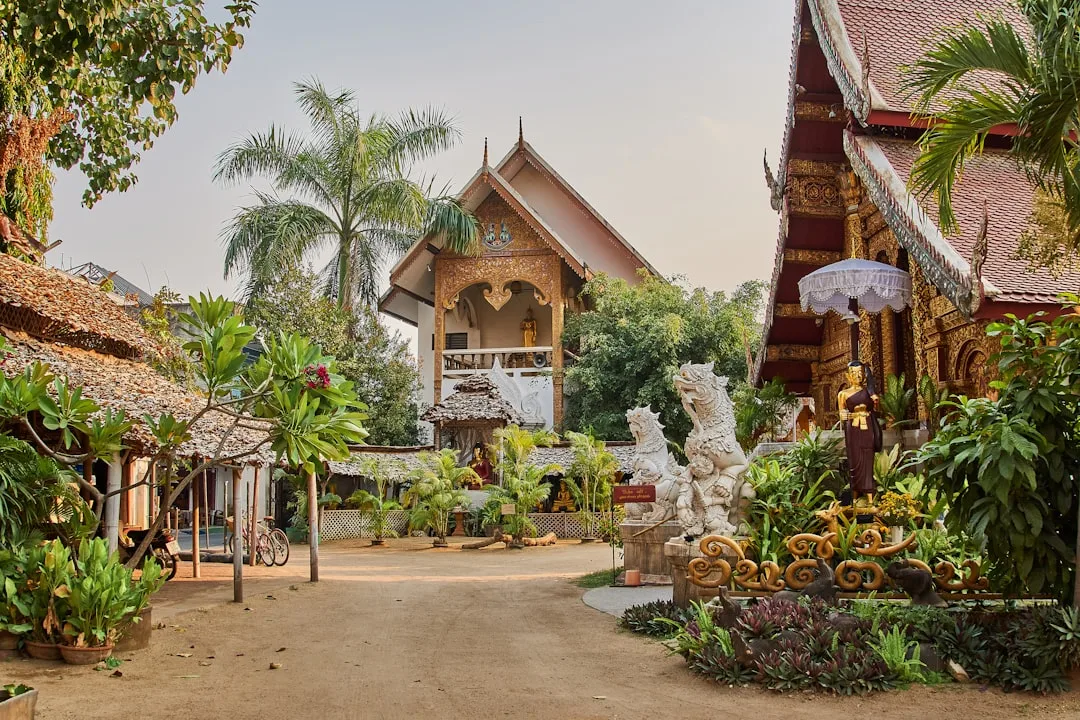







Chapter 1: The Royal Monastery of the Payom Flower Garden: Sacred Topography, Holy Relics, and Architectural Heritage of Wat Suan Dok
Wat Suan Dok History Ch. 1: Discover the royal Payom garden, the Great Relic Cetiya, the colossal Phra Chao Kao Tue bronze, and the Royal Lanna Necropolis.
Sacred Geography and Monastic Demarcation
Wat Suan Dok, designated in the modern Thai ecclesiastic hierarchy as a Third-Class Royal Monastery of the Ordinary Type, occupies an expansive precinct at 139 Suthep Road, Tambon Suthep, within Mueang Chiang Mai District. Positioned on the alluvial apron at the eastern foot of Mount Suthep, the monastery lies approximately one kilometer due west of the ancient western portal of Chiang Mai's walled city—the historic Suan Dok Gate (Pratu Suan Dok).
In official cadastral records documented by the Department of Religious Affairs in 1926 (B.E. 2469), the temple's domain was surveyed at over 90 rai (approximately 36 acres). Decades of urban expansion and private residential development eventually led to boundary disputes and legal adjustments. Today, under Title Deed No. 9533, the core sacred enclosure covers 35 rai, 2 ngan, and 44 square wah (approx. 5.7 hectares), supplemented by five plots of monastic revenue estate (thi thorani song) totaling 3 rai, 2 ngan, and 44 square wah.
The spatial perimeter of the monastery is defined by the following measurements:
- North: Measuring 183 meters, directly adjoining the thoroughfare of Suthep Road.
- South: Measuring 193 meters, bordering registered private property and public rights-of-way.
- East: Measuring 176 meters, bounded by adjacent private estates and public tracks.
- West: Measuring 176 meters, contiguous with residential holdings and public access lanes.
Originally founded as an araññavāsī (forest-dwelling) sanctuary situated in open terrain beyond the city ramparts, Wat Suan Dok is now seamlessly integrated into the vibrant municipal fabric of modern Chiang Mai, surrounded by educational institutes, trading communities, and residential neighborhoods, with Suthep Road serving as its ceremonial lifeline.
From Royal Garden to Sacred Sanctuary: The Origins of the Name
The grounds upon which the monastery stands were originally known as the Phra Ratcha Utthayan Suan Dok Mai Phayom—the Royal Payom Flower Garden. This royal pleasure estate was established and handed down through the line of the Mangrai Dynasty from the era of King Mangrai the Great, who founded the capital city of Nop Buri Si Nakhon Ping Chiang Mai in 1296 CE. The grove was celebrated for its dense stands of Phayom (Shorea roxburghii), forest trees that produced profusions of ivory-white blossoms filling the evening air with rich fragrance.
In 1371 CE (B.E. 1914 / C.S. 733), King Kue Na Dhammikaraja, the sixth monarch of the Mangrai line, moved by deep Buddhist devotion and seeking to institutionalize the reformed Lankavamsa ordination lineage in his capital, donated this pleasure estate to Phra Maha Sumana Thera, the forest monk who had conveyed the sacred Buddha relic from Sukhothai. The king dedicated the land as a permanent Buddhist monastery, naming it in formal canonical Pali as "Wat Buppharam" (pupphārāma, meaning "The Monastery of the Flower Garden"). Nevertheless, the inhabitants of the city favored the vernacular name "Wat Suan Dok" (literally "The Flower Garden Temple"), an appellation that has persevered across six centuries. The monastery received royal boundaries (Wisungkhamsima) around 1419 CE (B.E. 1962), was recognized as a Model Development Temple in 1966, and was officially elevated by royal prerogative to a Royal Monastery on July 10, 1990 (B.E. 2533).
Treasures of Sacred Art and National Heritage
The inner sanctum (Phutthawat) of Wat Suan Dok houses an exceptional collection of art and sacred monuments, formally registered on the list of National Ancient Monuments by the Fine Arts Department on March 8, 1936 (B.E. 2478, Royal Thai Government Gazette Vol. 52, Part 75):
1. The Great Relic Cetiya (Phra Borommathat Chedi)
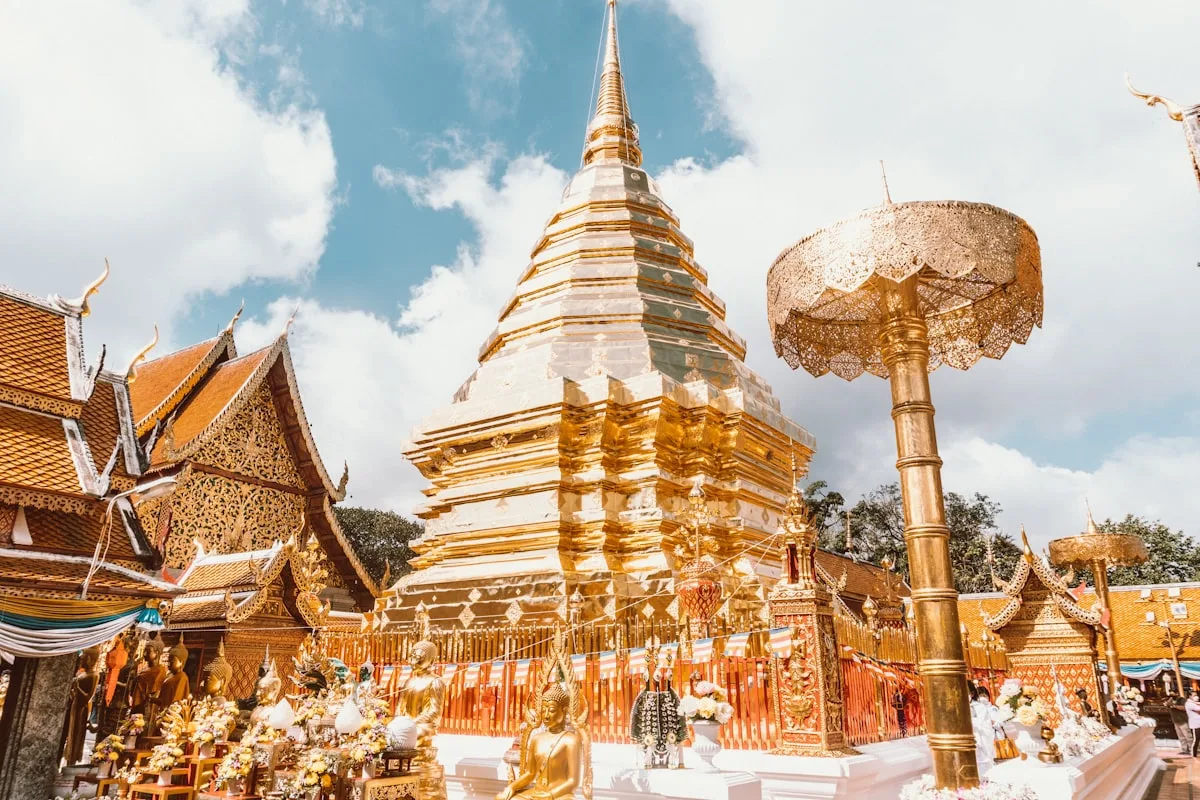
Constructed in 1373 CE (B.E. 1916) by order of King Kue Na, this monumental stupa was built to house the primary bone relic of the Sakyamuni Buddha brought from Sukhothai by Phra Maha Sumana Thera. Soaring 24 wah (approximately 48 meters) into the sky, it exhibits an early hybrid of pure Sri Lankan Mahavihara design and emerging Lanna aesthetic principles. The stupa rises from a broad, square, four-tiered stepped plinth featuring symmetrical stairways on all four sides, supporting an enormous inverted bell-dome (anda), surmounted by a tapering spire clad in gilded copper sheeting.
2. Phra Phuttha Patima Kha Khing (The Life-Sized Sovereign Image)
Cast in bronze in 1373 CE (B.E. 1916) during King Kue Na's reign, this seated Buddha image in the meditative gesture (samadhi) is enshrined as the primary icon in the Great Vihara. Measuring 2.0 meters across the lap and 2.50 meters in height, the sculpture was cast by master Lanna artisans to match the exact physical proportions of King Kue Na's body. In recognition of this royal bodily correlation, the people of Lanna bestowed upon it the revered local name "Phra Chao Kha Khing" (The Image Worthy of the Royal Body).
3. Phra Chao Kao Tue
Considered one of the pinnacle achievements of Southeast Asian bronze sculpture, this colossal image in the gesture of Subduing Mara (Bhumisparsamudra) was commissioned in 1504 CE (B.E. 2047) by King Siri Dhammacakkavatti Tilokaraja (Phra Mueang Kaeo). Uniting the classic elegance of Sukhothai sculpture with the regal authority of the Chiang Saen school, the icon measures 3.0 meters wide across the knees and 4.70 meters in height. It was cast in nine interlocking sections using 9 tue of refined bronze alloy (in ancient Lanna metrology, 1 tue represents 10,000,000 weight units, representing approximately 9 metric tons). Originally intended for the central vihara of Wat Phra Singh, the sheer scale and mass of the image prevented it from being transported through the city gateways; it was consequently consecrated within the Ubosot of Wat Suan Dok, where it remains today.
4. The Royal Necropolis of the Northern Dynasts (Ku Chao Nai Fai Nuea)
This graceful assembly of whitewashed funerary stupas (Ku) was established around 1909 CE (B.E. 2452) by Princess Dara Rasmi, royal consort to King Chulalongkorn (Rama V). Distressed that the remains of previous Chiang Mai rulers were deteriorating in an unprotected cemetery near Warorot Market by the Ping River, she obtained royal permission to disinter the royal ashes and enshrine them permanently within Lanna-style stupas on the north lawn of the Great Cetiya.
5. The Funerary Stupa of Kruba Srivichai
Erected in 1947 CE (B.E. 2490) directly south of the Great Vihara, this dedicated memorial stupa preserves a portion of the cremated relics of Kruba Srivichai, honoring the monk whose moral authority galvanized the complete restoration of the monastery in the 1930s.
6. Traditional Lanna Sermon Pulpit and Triple Arched Gateways
Commissioned in 1931 CE (B.E. 2474) during Kruba Srivichai's restoration, the triple gateways (Sum Pratu Khong) are modeled after the multi-roofed turreted palace style (prasat) of ancient Lanna, adorned with ornate plaster mouldings of intertwining vegetal motifs and mythical serpents (naga).
Edifices and Monastic Infrastructure
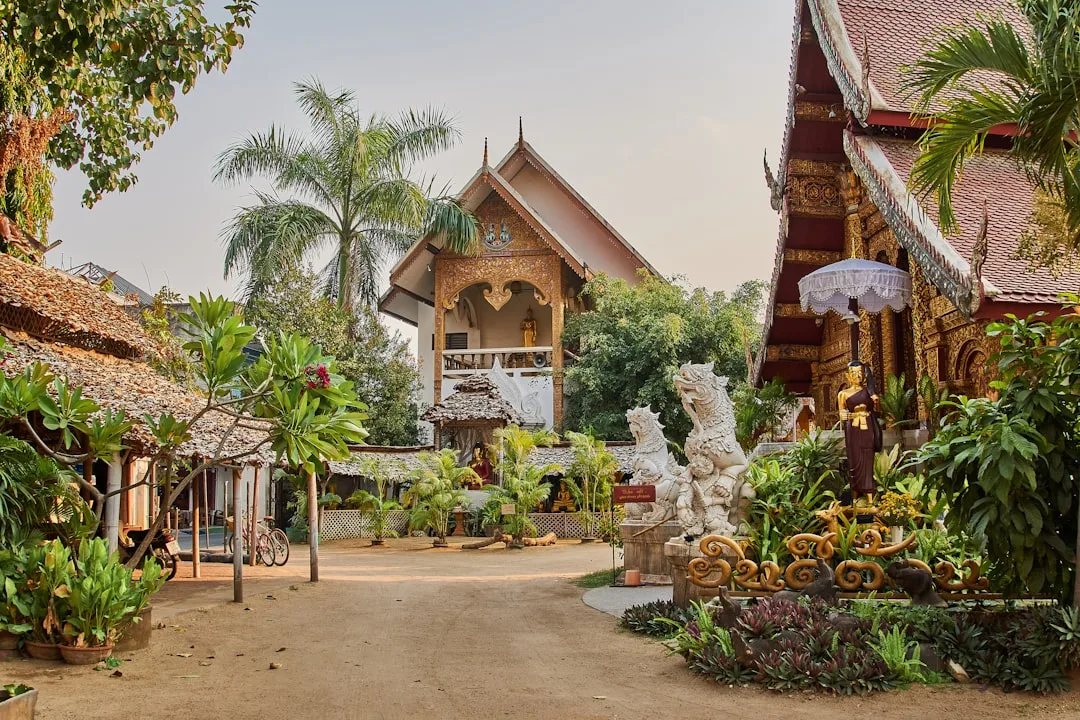
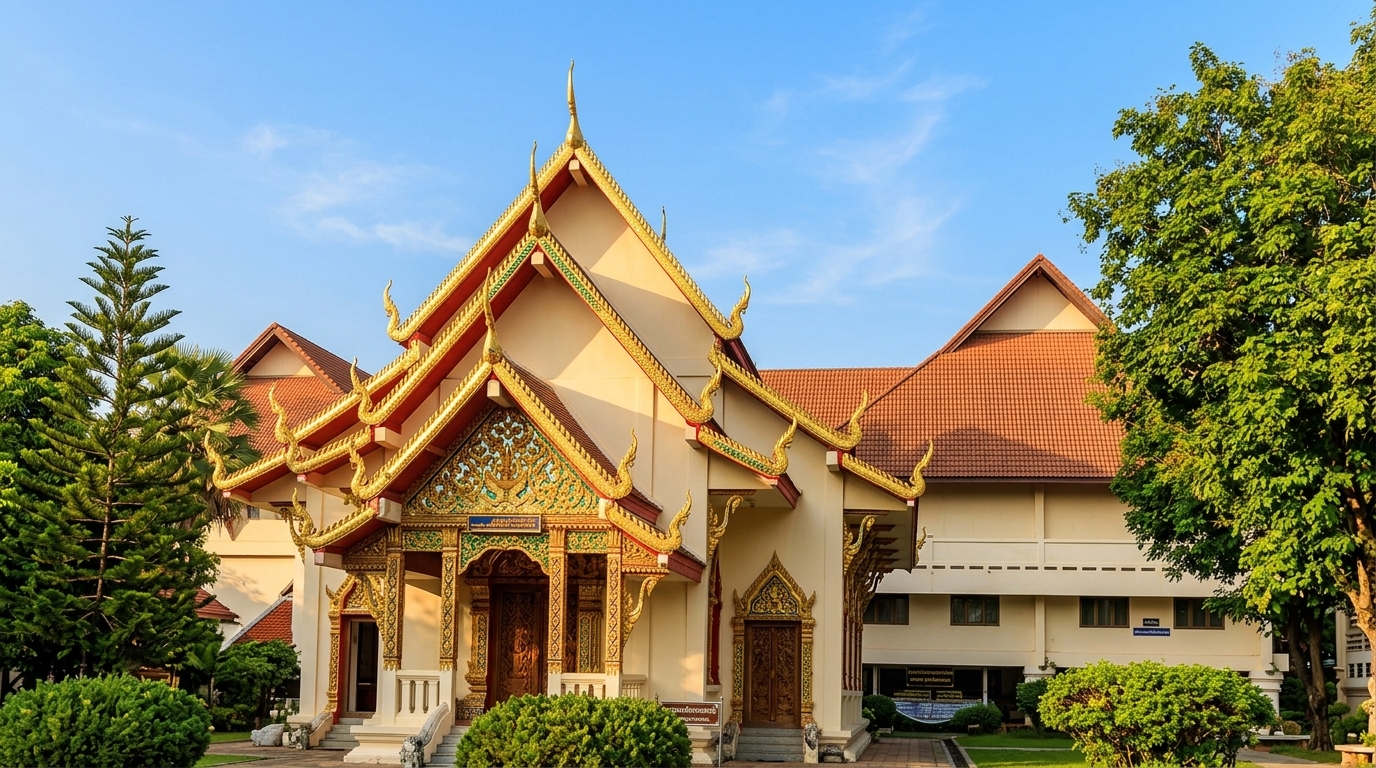
- The Great Vihara (Phra Vihara Luang): Rebuilt in 1931 CE (B.E. 2474) by Kruba Srivichai and Chao Kaew Nawarat, this monumental hall measures 25 meters in width and 26 meters in length. It is distinguished by its open-hall architectural style, entirely devoid of exterior walls, framed instead by broad colonnaded verandas supported by 56 reinforced concrete columns to optimize ventilation. The towering gables on both elevations display exquisite Lanna stucco arabesques.
- The Ordination Hall (Phra Ubosot): Measuring 12 meters wide by 27 meters long, this brick-and-mortar structure was originally established in 1504 CE under King Mueang Kaeo. Fully restored in 1962, its interior is embellished with classical murals depicting the Life of the Buddha and the Vessantara Jataka.
- Academic and Auxiliary Facilities: The Phra Khru Sukhandhasila Memorial Hall (built 1989), two multi-story classroom complexes of Mahachulalongkornrajavidyalaya University (completed in 1993 and 1995), the 700th Anniversary Chiang Mai Commemorative Hall (1995), and 21 monastic residential quarters (kuti).
Learn more: Wat Suan Dok Chiang Mai: The Royal Cemetery & 650-Year-Old Golden Stupa