★ 9.4/10 EXCEPTIONAL ON AGODA & BOOKING.COM • ROYAL FLORA RATCHAPHRUEK CERTIFIED
Overnight Nature Farmstay • KAS Farmstay
KAS Farmstay (Private Farmstay Tent & Campfire)
Experience a peaceful private farmstay amidst our organic orchards in Lamphun. Cozy tent glamping, evening campfires under starry skies, and organic garden-fresh mookata BBQ. Official online booking is now live.
A collection of translated rare books on Lanna history and culture
Terra Lanna is gathering and translating rare books on Lanna history, beliefs, and way of life — preserving these stories and sharing them with readers everywhere.
Sort by:
Listen to Lanna Stories
Translating and gathering books — coming soon
Contact Us
Talk to us, or share your feedback to help us improve and grow.
Our Hotel
NampiangdinBoutique Hotel
4-Star Lanna Boutique Hotel in the Heart of Chiang Mai
★★★★ 4-Star Boutique46 Rooms15 Min from AirportFree Airport Transfer
Nampiangdin Boutique Hotel is a 4-star boutique property blending ancient Lanna architecture with modern comfort. Located in central Chiang Mai, 15 minutes from the airport, with a warm atmosphere, heartfelt service, a lush garden, outdoor pool, and a restaurant featuring local ingredients.
Rooms
Choose the ExperienceThat's Right for You
All rooms feature a private balcony, pool view, AC, free WiFi, minibar, and breakfast included
Sorted by guest review score — prices updated daily
Active & Available in Chiang Mai
Your Eyes, Ears & Boots on the Ground in Chiang Mai
Moving, investing, or sourcing in Northern Thailand? We provide what no remote tool or overseas agency can ever match: genuine local presence, native northern dialect negotiation, and zero-bias on-site execution.
Why Technology Cannot Replace Local Boots on the Ground
Overseas expats, digital nomads, and remote investors face significant friction when managing property or sourcing in Northern Thailand. Having trusted on-the-ground representation eliminates risks, protects your budget, and gives you total peace of mind.
Common Pitfalls of Managing Remotely
Misleading Listings: Online photos are frequently edited or years out of date. In reality, properties may have hidden mold, weak water pressure, noisy air-conditioning, or loud construction right outside your window.
Unwarranted Price Markups: Without local Thai and Northern dialect negotiation skills, foreigners often face inflated quotes—paying 20%–40% above true local market rates for rent, contractor labor, and artisan craft manufacturing.
Unreliable Wi-Fi Claims: Landlords routinely advertise 'high-speed internet' that turns out to be congested shared building Wi-Fi with high latency, dropping client Zoom calls and disrupting remote work.
Zero On-Site Emergency Recourse: When an air conditioner leaks, plumbing bursts, or a guest locks themselves out late at night, remote coordination across time zones is stressful and ineffective.
The Terra Lanna Advantage
Objective High-Definition Video Inspections: We physically inspect every corner of the property, testing plumbing pressure, air-con odor, noise decibels, and surrounding neighborhood conditions without bias.
Direct Native & Northern Dialect Negotiation: We speak fluent Thai and Kam Mueang directly with landlords, technicians, and workshop owners—securing authentic, fair local terms and lease conditions.
Certified On-Site Speedtests: We plug in directly to run certified Ookla Speedtests (measuring ping latency, jitter, download, and upload speeds) before you commit to any rental deposit.
Trusted Keyholding & Urgent Dispatch: Permanently stationed in Chiang Mai, ready to handle emergency lockout rescues, supervise contractors, and deliver structured photo/video reports directly to you.
Our 4 Core Capabilities
What Overseas Clients Hire Us to Do
Four specialized on-the-ground services tailored for expats, remote entrepreneurs, Airbnb owners, and international media agencies.
For Nomads & Expats
Local Fixer & Personal Assistant
Your personal problem solver in Chiang Mai. Whether you are landing soon or already living here, we eliminate bureaucratic stress, rental headaches, and language barriers.
Core Focus
Condo pre-lease walk-throughs, Wi-Fi stability tests, lease negotiation to kill farang markups, parcel reception, and initial government/immigration logistics guidance.
Key Deliverables
Detailed video walkthrough & timestamped photo inspection
Live Ookla Wi-Fi speedtest (latency, download/upload speeds)
Lease contract review & direct Thai landlord negotiation
Urgent parcel pickup, mail forwarding & local errands
Overseas retailers and interior designers import handcrafted furniture, teakwood, ceramics, and textiles from Chiang Mai artisan hubs. We are your dedicated QC eyes on the workshop floor.
Geographical Advantage
We know the back alleys of Baan Tawai, San Kamphaeng, Bo Sang, Hang Dong, and Mae Rim. We talk directly to carvers and weavers in local dialect, preventing communication errors.
Key Deliverables
In-person workshop & factory visits across Chiang Mai & Lamphun
Foreign investors who own condos or pool villas in Chiang Mai for Airbnb need trustworthy local oversight. We inspect rooms after cleaning, hold emergency keys, and dispatch trusted tradesmen.
Timezone Synergy
We chat and report to you during your evening hours overseas, then execute daytime on-site checkups and maintenance across Chiang Mai during local business hours.
Commercial film crews, YouTube creators, and high-end travelers demand secret, authentic locations away from mass tourist traps. We scout hidden temple grounds, mountain overlooks, and private chef tables.
Exclusive Synergy
Seamlessly paired with Terra Lanna's private farmstead: organic orchard walks, botanical craft liquor workshops, and private campfire dinners in Lamphun.
Key Deliverables
On-site location scouting with lighting notes, acoustics & GPS coords
From initial inquiry to completed mission in 4 simple steps.
01
1. Send Your Brief
Share your requirements, links, or address via email or the booking form below.
02
2. Action Plan in 2 Hours
We confirm feasibility, provide an exact upfront quote, and schedule the on-site mission.
03
3. On-The-Ground Execution
We drive directly to the property, factory, or location with our equipment and live status updates.
04
4. Comprehensive Report
You receive comprehensive video walkthroughs, speedtest stats, defect photos, and our honest local recommendations.
Request a Fixer or Property Inspection
Tell us what you need done on the ground in Chiang Mai. We reply within 2 hours during active daytime hours.
Frequently Asked Questions
Everything You Need to Know
Online listings in Thailand frequently feature stale photos, hidden structural/mold defects, or inflated 'Farang' prices (20%–40% above local rates). Without speaking northern Thai or being physically present to smell the room, test the water pressure, and check for noisy construction, you risk getting trapped in an inflexible 12-month lease. We serve as your unbiased on-site representative.
We cover all major expat and residential districts: Old City (Sri Phum, Phra Sing), Nimmanhaemin, Santitham, Jed Yod, Chang Phueak, Chang Khlan / Night Bazaar, Wat Gate / Riverside, Mae Hia, Hang Dong, San Kamphaeng, Doi Saket, and Mae Rim. We also travel to Lamphun artisan workshops upon request.
Standard requests are completed within 24–48 hours. Urgent same-day emergency callouts can often be accommodated depending on current schedule. Contact us via email (terralanna67@gmail.com) for rapid dispatch.
We bring a laptop and mobile testing kit directly to the unit. We connect to the actual in-room router and run certified Ookla Speedtests measuring ping latency, jitter, download Mbps, and upload Mbps. We also check 4G/5G mobile signal backup coverage inside the room.
Never. Terra Lanna maintains a zero-kickback, zero-commission policy. When negotiating rent or product costs, 100% of the discount goes directly to you. You pay us solely for our time, expertise, and transparent on-the-ground service.
We accept Wise (formerly TransferWise), standard international bank wire transfer, Thai PromptPay / QR bank transfer, and major credit cards via Stripe.
Ministry of Education and Ministry of Interior, via the Fine Arts Department, with Chiang Mai Province · 1999 CE (B.E. 2542) · Chiang Mai
Chapter 3 (V): Crafts, Language & Performing Arts
Lacquerware, silverwork, saa paper, and weaving; Lanna language and literature; folk games, music, and dance.
Literature
Lanna literature may be divided into two categories, according to its content and use, as follows:
Oral literature refers to spoken literature, or literature transmitted from person to person through telling, chanting, or singing. Originally such literature was seldom recorded in any written medium, but today some of it has been recorded, whether as sound recordings or in books. It may be classified into various categories as follows: children's songs, folk songs, courtship verses of young men and women, folk tales, riddles, and proverbs.
Children's songs are divided into lullabies, songs to soothe children, and songs accompanying children's games. Lullabies are songs sung by a caregiver to help a child fall asleep easily; soothing songs are songs sung to comfort a crying child, or to tease a child into good humour; songs accompanying children's games are songs children sing while playing, such as lullabies and the "eu-cha-cha" song [example verses given in the source].
Folk songs in Chiang Mai Province are divided, by manner of singing, into two types: "joi" and "saw." "Joi" (read: joi) refers to chanting a verse to an existing melody; the verses used are generally compositions expressing inner feeling, and the singer of this type of verse is generally a young man travelling to or returning from visiting a young woman. Joi has several melodies [example verses given in the source]. "Saw" refers to a type of singing that requires training and the special skill of a "saw" performer, generally involving an exchange of verses between a male and a female saw singer, accompanied by a pi (reed-pipe) ensemble; the content may be drawn from jataka tales, points of Dhamma, or everyday life, set to various melodies, such as "Khuen Chiang Mai," "Cha Pu," "La Mai," "Phleng Chiao," "Phleng Phama" (the Burmese melody), "Phleng Pan Fai" (the cotton-spinning melody), and "Phleng Phra Lo Doen Dong," among others.
Courtship verses of young men and women, sometimes called "kham u su o," "kham khrao," or "kham khruea." For these courtship verses, young men and women might use set phrases handed down from ancient times, or verses composed on the spot, using the vernacular verse form called "kham ram," or "khrao" [example verses given in the source].
Folk tales refers to stories or tales widely known among ordinary villagers, which may be classified into many types and categories. Some folk tales found in Chiang Mai Province may overlap with tales found in other provinces within the Lanna cultural region. Folk tales of Chiang Mai Province include the story of the Old Tiger, the story of [a title partly unclear in the source], the story of Ai Sut Thai [name unclear], the story of Khun Kham Haeng [name unclear], the story of the Son-in-law Who Fulfilled a Vow, the story of the Phi Pok Ka Long ghost, and the story of the Phi Ma Bong ghost, among others [an example of the Son-in-law Who Fulfilled a Vow is given in the source].
Riddles are a heritage of local wisdom that, besides providing amusement, also help to cultivate an inquisitive disposition in children. Examples of riddles from the Lanna region are given [in the source].
Proverbs are well-turned sayings suited to various occasions, such as maxims and blessings. Examples are given [in the source].
Written literature refers to literature that has been recorded and handed down in written form. Those interested may study the details of the written literature of Chiang Mai Province and other provinces within the Lanna cultural region from the research on this subject by Udom Rungruangsri and Lamun Chantahom, whose names appear in the bibliography at the end of this volume. Here, examples of certain works, or certain passages, will be presented, organised by content as follows:
1. Historical literature
Inscriptions. The inscriptions found in Chiang Mai Province discovered to date number no fewer than 500 pieces, which may be classified by the material inscribed into four broad categories: stone, wood, metal, and other materials such as pottery sherds and bricks. These may be further divided into ordinary inscriptions and those that take the form of devotional sculpture, such as Buddha images or images of disciples bearing inscriptions.
According to Lanna Inscription Archive Bulletin No. 3, produced by the Social Research Institute, Chiang Mai University, the following details are given regarding the number of inscriptions found in Chiang Mai Province:
Stone inscriptions: 44 inscribed stone tablets, and 5 inscribed devotional sculptures. Examples include:
The Wat Chiang Man stone inscription. This inscription is a stone slab located at Wat Chiang Man, Mueang District, Chiang Mai Province, inscribed in the Fak Kham script in the Lanna Thai language, in prose form, and preserved at the Regional National Library No. 2 [Chiang Mai], catalogued by the Committee for the Publication of Historical, Cultural, and Archaeological Documents, Office of the Prime Minister, as Inscription No. 76. Its content recounts the history of Wat Chiang Man, from its founding in the reign of King Mangrai in Chulasakarat (C.S.) 654, corresponding to B.E. 1835 (1292 C.E.); later, in C.S. 833, or B.E. 2014 (1471 C.E.), King Tilokarat rebuilt the chedi in laterite for a second time; later still, in C.S. 920 [figure as given, though inconsistent with the preceding date — unclear in source] (B.E. 2001 [sic]), Chiang Mai came once more under the dominion of the Burmese king, and King Bayinnaung granted a number of temple attendants (kha wat) to the temple.
The Wat Phra That Sri Chom Thong stone inscription. This inscription is of grey sandstone, 42 centimetres wide, 111 centimetres tall, and 8 centimetres thick, inscribed in the Fak Kham script in the Lanna Thai language, in prose form, and preserved at Wat Phra That Sri Chom Thong, Tambon Ban Luang, Amphoe Chom Thong, Chiang Mai Province. Professor Dr. Prasoet na Nakhon studied and corrected the text for publication in the Collected Stone Inscriptions, Part 4, published by the Committee for the Publication of Historical Documents, Office of the Prime Minister, catalogued as Inscription No. 105. Its content concerns the supreme sovereign lord who was ruler of Chiang Mai (Ping) and patron of the great relic shrine, who [performed a dedicatory act] in C.S. 918, corresponding to B.E. 2099 (1556 C.E.), and granted temple attendants to Wat Phra That Sri Chom Thong in their entirety, charged with the duty of caring for the temple and regularly offering alms food.
The stone inscription at the base of the Buddha image, Wat Chiang Man. This inscription is located at the base of a bronze Buddha image in the alms-bowl-carrying posture, 176 centimetres tall, now preserved at Wat Chiang Man, Mueang District, Chiang Mai Province. Arun Senaphan has studied this inscription, and the findings show that this Buddha image was created in C.S. 879 (B.E. 2060 [1517 C.E.]), under the sponsorship of Phra Maha Chapanyana, Phra Maha Phutthayana, and Phra Maha Thammachan as presiding [monks] over its creation, with Lady Saen Lao as the principal patron of faith. The script used in this inscription is the Dhamma script, in the Pali and Lanna Thai languages.
Metal inscriptions: 24 inscribed metal plates, and 61 inscribed devotional sculptures.
Inscriptions of other materials: 49 inscribed tablets, and 46 inscribed devotional sculptures.
Legends. Chiang Mai Province, once the centre of the Lanna kingdom, has a long history and a great many important monuments and antiquities; Chiang Mai Province is accordingly rich in legends, which may be divided into various categories, as follows:
Legends concerning persons, such as the legend of the elderly couple [Pu Ya Thai Luek and Waen, names as given in the source]; the legend of Chao Luang Kham Daeng, who entered the great cave of Chiang Dao and has never emerged to this day; the legend of Phra Nang Sam Phio, who hid in a white cave to escape the threat of King Sutho [name as given], a Burmese king; the legend of the great scholar-monk Maha Yana [name as given]; the legend of Maha Then Chan of Wat Umong [details partly unclear]; and the legend of Khruba Chao Sri Wichai walking through the rain without getting wet, among others.
Example: The legend of Phraya Kham Fu, who died in the water because he was not faithful to his friend (summarised from the Committee for the Publication of Historical Documents, Office of the Prime Minister, "Chronicle of the Chiang Mai Region").
Legends about Places (continued)
Legends concerning places and rock outcrops along the Ping River in the Samoeng district area: the legend of Phra Bat Si Roi (the Four Footprints) on the hill of Mueang Khuea [name unclear]; the legend of Phra That On Pia [name as given] of Mueang Samoeng; the legend of Pha Koeng; the legend of the Mae Raming (Ping) River; the legend of Chiang Dao Cave; the legend of the Buddha's Circuit of the World (Phra Chao Liap Lok); the legend of Mueang Chiang Dao; the legend of Wat Suan Dok; the legend of Wat Buppharam; the legend of Phra Bat Si Roi in Amphoe San Sai; and the legend of Sorat Sa Pukmueang [name as given], among others.
Example: The Legend of Phra Bat Si Roi (The Four Footprints)
Phra Bat Si Roi is enshrined at Ban Saluang, Tambon Saluang, Amphoe Mae Rim, Chiang Mai Province. The legend relates that, in the time of the Buddha, the Lord Buddha came to this place and encountered a father-and-son pair [and an elderly couple — details of the family relationships are unclear in the source], who would later become figures in the legend of the founding of the city of Hariphunchai.
The elderly couple, upon seeing the Buddha, pursued him intending to eat his flesh. The Buddha performed a miracle, pressing his foot upon a stone slab so that it left a footprint. The elderly couple, struck with fear, then listened to the Buddha's teaching until its conclusion, whereupon the two of them asked as a boon that they be permitted to eat only buffalo meat, and only once a year — and from this arose the tradition, among the Lanna people, of the rite of offering to the spirits of the ancestral "Pu Ya" (grandfather-grandmother spirits). As for the footprint left by the Buddha, it survives to this day together with the footprints of three other past Buddhas, the four together being known as "Phra Bat Si Roi" (the Four Footprints), a name that has continued in use down to the present.
Legends about Temples
Examples include the legend of the Emerald Buddha, the legend of the Phra Sing image, the legend of the Phra Saen Kham [image] of Wat Chiang Man, the legend of the Phra That [relic] of Doi Suthep, the legend of the Phra That of Mueang Fang, and the legend of the Reclining Buddha of Khon Muang [name as given], among others.
Historical Legends
These consist of the recording of history by taking legendary and popular tales and blending them with actual places and times in history, comprising the sequencing of royal dynasties in the traditions of various peoples together with dynastic sequences that hold true against the actual chronology of the period — such as the Chamadevivongsa (Chronicle of Queen Chamadevi), the Chronicle of Chiang Saen, the Chronicle of Chiang Mai, the Chronicle of Mueang Fang, the Mulasasana (Chronicle of the Origin of the Religion), the [Mula Mangrai chronicle of dynastic succession], the legend of the establishment of the city pillar (Sao Inthakhin) of Chiang Mai, the legend of the Lawa people of Hariphunchai who assisted Thai people fleeing defeat in battle [as they fled] from the Lawa, and the legend of the treaty of friendship made between the Lord of Chiang Mai and the Lord of Yang Daeng, as in the following example:
When Phraya Kawila ruled Chiang Mai, he ordered the Uparat (Vice-Regent) Thammalangka to go and inspect the western border, and found that Mueang Yang Daeng, on the western frontier, though not under the dominion of Ava, [was strategically significant]; the Uparat accordingly persuaded the Lord of Yang Daeng to submit and enter into friendly relations with Chiang Mai, so that Yang Daeng would serve as a forward outpost to relay news of Burmese troop movements to Lanna. The Lord of Chiang Mai and the Lord of Yang Daeng thereupon performed a rite to seal their treaty of friendship: a [holy man/shaman] took liquor and a water buffalo, which was slaughtered as an oath of fidelity between them, swearing that for as long as the Ping River does not run dry and the buffalo's horns do not grow straight — that is, unless the [bond] should fail — Chiang Mai and Yang Daeng would remain in friendship for that long.
Law
Chiang Mai Province was formerly the centre of government of the Lanna kingdom, and the kings who ruled the kingdom accordingly issued royal decrees proclaiming statutes and enacted various laws for use. These ancient laws include the Khlong Thammasat (a law code concerning the division of inheritance), the Thammasat law concerning compensation for damages and the payment of fines, ancient law concerning the adjudication of property disputes, ancient law concerning rules of evidence, the sale of lost property and compensation for damages, the Law of King In [name as given], and the Law of King On [name as given], among others.
Example: the Mangrai Sat (Laws of King Mangrai). Believed to date perhaps as far back as the era of King Mangrai, the first king of the Lanna kingdom, this is a work of written literature in the genre of ancient law, providing insight into certain aspects of Lanna social conditions. A passage from this legal-verse text reads, in part [quoted below]:
...[The following passage, describing a hierarchical system of civil and military command — units of ten commoners under a leader of ten, then fifty, a hundred, a thousand, and ten thousand, up to the ranks of "Saen" and "Muen" officials, with penalties described for officials who fail in their duties, including confiscation of household and property — is rendered here as closely as the source text (itself evidently corrupted or garbled in transmission) permits; several words and phrases in the source could not be confidently reconstructed.]
Nirat (Travel Poetry)
This is literature that emphasises the expression of the poet's own emotion, describing the sorrow of separation from one's home, functioning rather like a travel diary; it has accordingly attracted interest as a means of verifying routes, place names, and social and environmental conditions of the period in which the poet lived. Examples follow:
"Khlong Mangtra Rop Chiang Mai" (The Verse of the Mang Traa's Attack on Chiang Mai). Certain passages of this work are also referred to as "Lanna verse"; its content concerns the poet's journey [as a captive] together with a certain princess and a number of prisoners of war who were being led away, providing certain items of historical information. It is written in Lanna verse form; some original manuscripts of this work were recorded using the Thai Nithet script, or the "mueang" script.
A passage from the Khlong Mangtra: [A passage of verse follows in the source, in archaic Lanna verse form, describing the Burmese general's (Mang Traa's) campaign against Chiang Mai and the aftermath of the city's fall; portions of the source text are corrupted and could not be confidently reconstructed.]
"Khlong Nirat Hariphunchai" (The Verse Nirat of Hariphunchai). This work was likely composed in the period B.E. 2000–2060 (c. 1457–1517 C.E.); its content concerns a journey made to pay homage to the Phra That of Hariphunchai, passing through various places, interwoven with certain reflections of the poet.
A passage from the Khlong Nirat Hariphunchai: [A passage of verse follows in the source, describing the poet's journey — through forest paths, rivers, and the invocation of guardian spirits associated with King Mangrai; portions of the source text are corrupted and could not be confidently reconstructed.]
Treatises
Treatises of many kinds exist in great number in Chiang Mai Province, which may be classified by purpose into two broad categories: treatises providing knowledge on various subjects, and treatises giving instructions on how to do or make various things. By content, however, they may be divided into further categories, as follows: treatises on ancient law, treatises of moral instruction, treatises concerning historical events of the past, treatises of astrology, treatises on the composition of verse, treatises on occult practices and the performance of various rites, treatises of medicine, and treatises of craftsmanship.
Treatises of moral instruction comprise admonitions, teachings, and articles of belief, together with behaviour to be cultivated or avoided by members of society, as recorded in this category of treatise. Examples include various articles of belief, the "Khao Son Chao Tho Rat" [title as given], the Lanna verse-riddle treatise (Khlong Kon Bot Lanna), the "Chan Wannasali" [title as given], the "Nissai Yuk Lok Thai" [title as given], "Buddhacarita" (Life of the Buddha), "Manutsayawinai" [title as given, on human discipline], "Sappha Son Then Chan" [title as given], "Suphasit Son Lan" (Maxims to Teach One's Grandchildren), and "Withi Son Lok" (The Way of Teaching the World), among others.
Astrological treatises, for example: birth-year origins, purification criteria, the Suriyaphorn [Suryabharana?] treatise, prediction by year and day of birth, dream interpretation, methods of calculating dates, months, and auspicious constellations, and methods for determining auspicious times for entering or leaving [a place or undertaking], among others.
Treatises on the composition of verse: compared with other categories of treatise, there are very few treatises of this kind. Examples include "Klon Phra Narai" [title as given], the Lanna verse-riddle treatise, the "Chan Wannasali," and the "Nissai Yuk Lok Thai," among others.
Treatises on occult practices and the performance of various rites, discussed here: some treatises provide knowledge, some give instructions on procedure, and some contain more than [a simple set of contents]. Examples of this category of treatise include treatises of magical formulae (katha) and yantra diagrams, such as the Phra Sing yantra pattern, incantations for exorcism [term as given], offerings of rice to appease [spirits], protective incantations, house-warming rites, various ceremonies, offering rites at the alms bowl, the life-extension (suep chata) rite and calling of the khwan (spirit/soul), various protective recitations, and the Sangkha Ekha Parit [chanting of protective texts], among others.
Medical treatises are numerous. Examples include the Kuman Phaetthaya (Paediatric) treatise [title as given], various medicinal treatises, treatises for various fever remedies, treatises on remedies for [various ailments — terms unclear in source], and treatises concerning matters of the heart [term unclear], among others.
Treatises of craftsmanship. There are many treatises concerning craftsmanship and the making of various things; some provide knowledge, some give instructions on method, and some give instructions for accompanying rites. Examples of craftsmanship treatises include the Kuman Phaetthaya treatise, various medicinal treatises, "Laksana Bat" (the characteristics/making of the alms bowl), "Laksana [Construction of] the Great Drum and Its Accompanying Rites," methods of [a term unclear in the source], methods of building and arranging a new house, methods of establishing a rice [ceremony — term unclear], and methods of making the great drum, among others.
Buddhist and Jataka Literature
Literature of this category is the work of learned monk-scholars of ancient Lanna; originally composed entirely in the Pali language, some works have since been translated into Central Thai, and some are still studied as part of the Pali-language curriculum today, so that further information about them is not difficult to find.
Buddhist and jataka literature in Lanna is said to have flourished most greatly from the reign of Phra Mueang Kaeo onward, with such important monk-scholars as Phra Bodhiramsi, Phra Rattanapanya Thera, and Phra Sirimangalacariya. Here, Buddhist and jataka literature will be classified by content, as follows:
Explanatory or commentarial literature (atthakatha) — literature composed to explain the meaning of the Tripitaka or its grammar. This category of literature is said to have flourished most greatly in the reign of Phra Mueang Kaeo (B.E. 2038–2068 [1495–1525 C.E.]); important examples include:
Mangalatthadipani, an explanation of the Mangala Sutta, expounding the practice of the 38 blessings, composed by Phra Sirimangalacariya.
Samantapasadika Atthakatha, a work explaining the meaning of the Tripitaka, composed by Phra Nyanakitti Thera, among others.
Pannasa Jataka (Fifty Jataka Tales), a body of extra-canonical jataka tales composed in imitation of the jatakas of the Tripitaka, by monks of Chiang Mai, composed around B.E. 1995–2000 (c. 1452–1457 C.E.). Their content concerns episodes from the life of the Buddha-to-be before his enlightenment, intended to propagate and teach the religion in a form easy to remember. The Pannasa Jataka is regarded as the model for several important works of literature and spread to many countries, such as Burma, Laos, and Cambodia. Examples include the Samuddaghosa Jataka, the Sudhana Jataka, the Sirivipulakitti Jataka, the Sappalinga [Suvannasangkha?] Jataka, and the Rathasena Jataka, among others.
Besides the Pannasa Jataka, jataka tales composed for use in sermons are also found, called "tham khao" or "khao tham" [terms as given, verse-sermon compositions], composed in the verse forms known as "rai" or "klon on tham," as well as in prose. It is surmised that these drew upon material from folk tales, such as [a list of titles, some of which are unclear in the source]: Ussabharot, Chang Phong Na Phon Hom, Chanthamaka, Saeng Mueang Hong, Kamphrao Phom Dam, and Kap Mo Mo Da [titles as given, several uncertain]. More than 800 such jataka tales have been surveyed and found; most are preserved on microfilm at the Social Research Institute, Chiang Mai University.
Mahachat (The Great Life). This refers to the "great birth" — the story of the Mahavessantara Jataka, the most important of the Buddha's past lives before he attained Buddhahood, recited as a sermon during the festival of the full moon of the twelfth lunar month, which coincides with the end of the rains retreat period. This has traditionally been a very popular sermon to attend; in the past, people would listen to the recitation of all thirteen chapters (kan) in a single day, believed to yield very great merit; on occasion it might also be recited on the auspicious occasion of a housewarming.
The Dharma of the Mahavessantara, or "Mahachat," has been very popularly composed and dedicated to temples; as many as 110 different versions of its composition have been found, such as "Wiwon Noi," "Wiwon Luang," "Phrao Kwai" [title as given], "[several further titles partly unclear in the source]," each with its own recitation melody, called "rabam," of which there are many — for example, the "Rabam Nam Tok Dat" melody, the "Rabam Nok Khao Ngoen" melody, "Mo Yai Fai" [title as given], and "Ma Dai Khuen" [title as given], among others.
Example from the Mahavessantara Jataka, from the Chujok (Jujaka) chapter, in the passage describing Jujaka's house: [A passage of verse follows in the source, describing the ramshackle four-post house of the brahmin Jujaka, its walls patched with old timber; portions of the source text are corrupted and could not be confidently reconstructed.]
Literature for entertainment. Composed still for the purpose of enjoyment and amusement, while also embedding ideas and Buddhist moral teachings, this literature has its roots in jataka literature combined with folk tales, and was popularly chanted and recited aloud when people gathered socially — such as at merit-making for a funeral, and so on. It was commonly composed in the khlong and khao (c'aaw) verse forms, such as "Khlong Thum Sangka" [title as given], "Khlong Amara" [title as given], "Khlong Hong Phin" (the Verse of the Wandering Hongsa), and "Khao Sipsong" (The Twelve Khao), among others.
"Khao [Chorng] Hongsaphin" exists in several versions; its content briefly concerns the adventures of Prince Hongsaphin, who sets out in pursuit of a giant (yaksha) who had abducted [someone]. A passage from this work follows:
[A passage of verse follows in the source, a catalogue of trees, spices, and fruits — sandalwood, red-sandalwood, cardamom, betel-palm blossom, tamarind, mango — likened to the cheeks of a young woman; portions of the source text are corrupted and could not be confidently reconstructed.]
"Khao Si Bot" (The Four-Part Khao), composed by Phraya Phrom Wohan, an eminent poet of Lanna who lived approximately B.E. 2395–2430 (1852–1887 C.E.). This work is sometimes also called "Khao Chang" [title as given], "Khao Phraya Phrom," or "Khao Sam Nang Chom" (Khao Cham Nang Chom). Its content expresses a range of feelings poured out by the poet over the departure of his beloved, who left him — regarded as one of the most outstanding works of emotional literature in Lanna.
Folk Games, Performing Arts, and Music
Chiang Mai possesses a rich and varied cultural heritage, which finds expression in the way of life of the people of Chiang Mai; there are accordingly activities that express the particular identity distinctive of Chiang Mai.
Folk Games
These may be classified as follows: Children's games. Children play during their free time in daily life, as an activity providing fun, enjoyment, and relief from boredom, while also imparting to the young the life skills [needed] within society [passage partly unclear in source]. Examples: "Klong thop" (a game of shooting bamboo pop-guns, using pellets of wet clay fired down the barrel to make a sound like a gunshot); "Kai chon mamuang," or "pok ba mamuang" (mango-fighting), a game played by tying a mango with string, piercing a hole through a cluster of mangoes and threading them through, then adjusting the weight for swinging appropriately, so that the player who does not [prepare correctly] fixes a sharp spike into the back of the mango as a base, before beginning to "fight"; "Naet" — a game of running and tagging, played in several variants that are broadly similar, in which the player who is "it" runs to tag another player, so that the other player becomes "it" in turn; "Ba ba ta saeng" (also called by various names, such as "i thap," "i pik," "ba ba ta saeng"), an old game; and "Sik chung cha" — a swinging game played by children in the old days, in which adults would commonly teach the children to sing a song in time with the rhythm of the swing.
Adults' games. Adults, meanwhile, engage in three kinds of play activity: recreational games, games for relaxation and enjoyment, and games played on special festival occasions, such as beetle fighting ("kwang," a hard-shelled beetle of which the Northern Thai people are fond of pitting against one another, of which there are many species); "ma chak khok" (a game played by groups of young men and women on special festival occasions, using bamboo as the local equipment); and stilt-walking ("mai kong keng"), a game providing practical life experience, using a length of bamboo of a size comfortable to grip, with a notch cut near the base to allow the player to walk balanced back and forth; today this has been adopted as a competitive event among older boys and girls, and the Department of Physical Education has established it as an annual Thai folk sport.
Folk Music
Today, if one speaks of the folk music of Chiang Mai, one might think first of the salo-sueng ensemble, or of various kinds of drum ensembles; in truth, however, Chiang Mai folk music comprises many types, whether plucked, bowed, struck, or blown, performed either as solo instruments or in ensemble. The purpose of performance, besides public display, also serves to accompany traditional rites and beliefs. Folk music may be divided by role and function according to custom and manner of performance on various occasions, as follows:
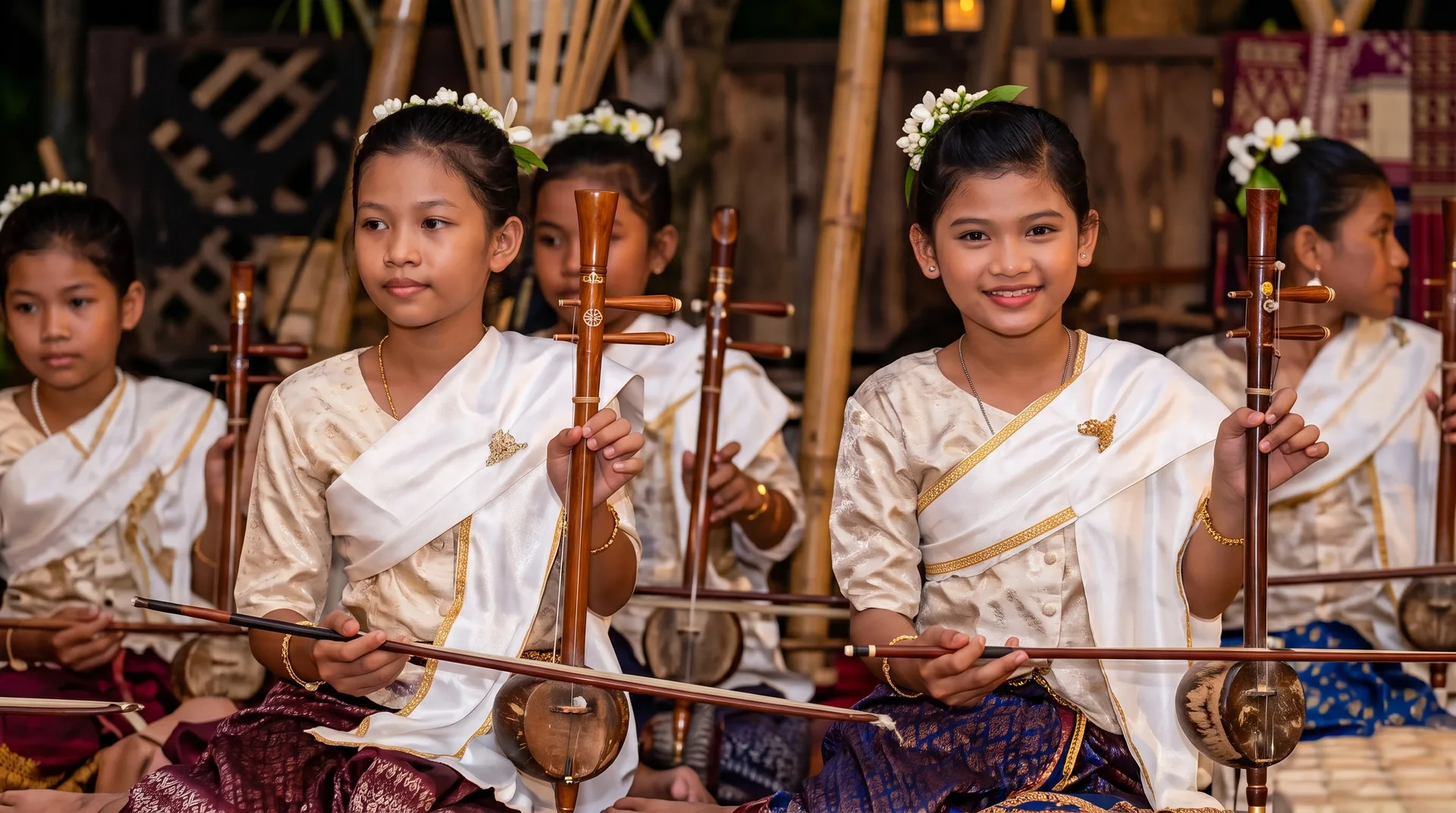
Music performed solo. Instruments popularly played solo are generally those of a size that can be carried on the person and that are not too loud — comparable to how young men would commonly carry an instrument with them, such as the phin phia (a type of plucked lute), the sueng (a plucked lute), and the salo (a bowed fiddle), among others.
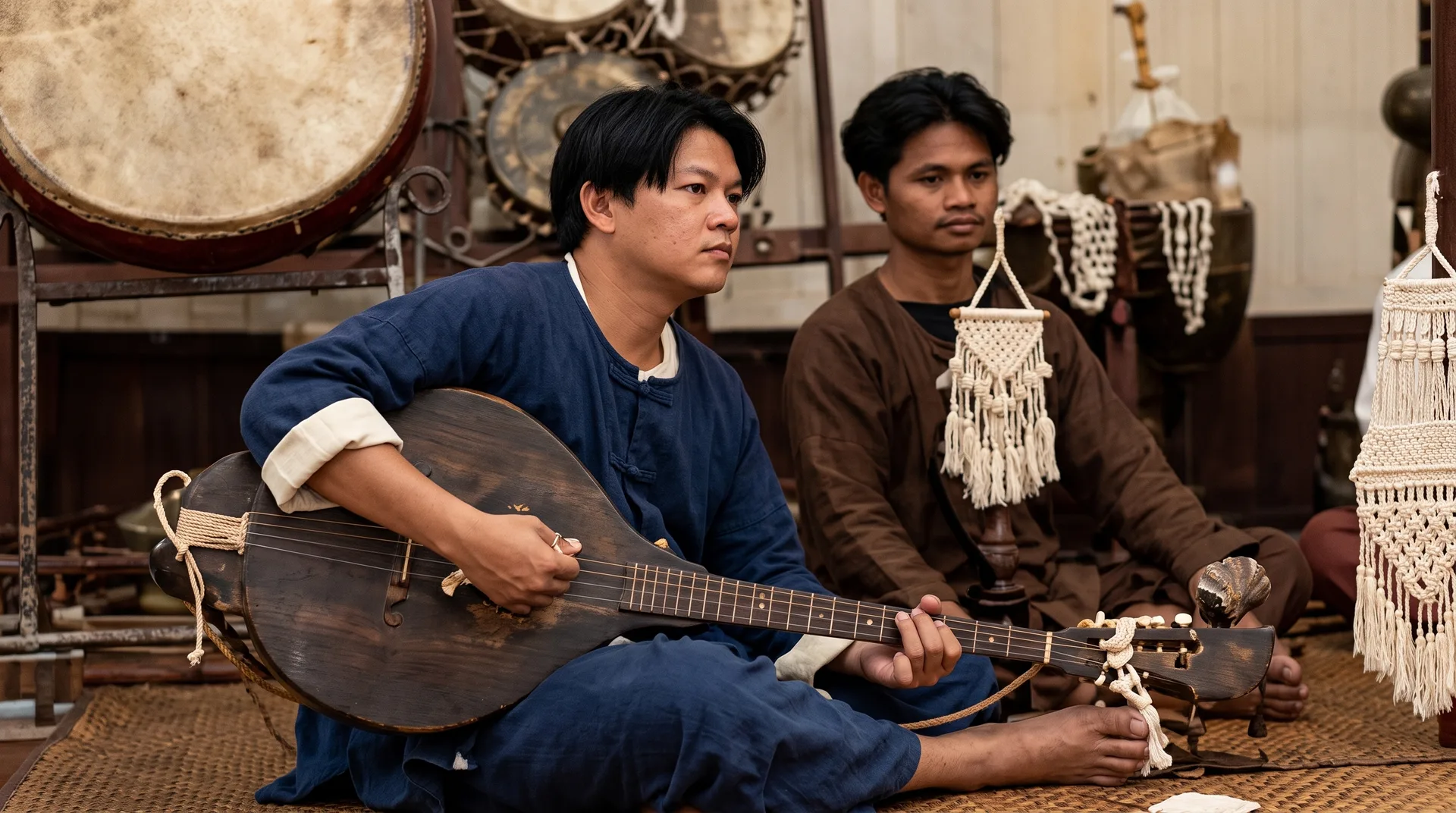
Folk ensembles, including the salo-sueng ensemble. The salo-sueng ensemble is a renowned string ensemble, accompanied by percussion instruments to keep time — namely drums and cymbals, and in some ensembles also gongs and clappers. Originally, the salo-sueng was nothing elaborate — simply, whoever possessed whichever instrument would carry it along whenever meeting others, such as when going courting, or might bring an instrument to play in mourning ["euan en" — to console those bereaved of a relative who had died], as well as to play at merit-making events at the temple, housewarmings, ordinations, and so on. When musicians met on such occasions, they would commonly tune their instruments together and play in ensemble, a practice villagers call "kum kan" ("kum" meaning to join or combine together); once this joining together became a frequent occurrence, it became well known, and musicians would be sought out to play together. The manner of performance in such gatherings was simple, the pieces played being folk tunes remembered by heart; percussion instruments to keep time might or might not be included, with no strict requirement either way. Later, as the influence of central-Thai classical music grew, the manner of performance began to follow more fixed conventions, taking the standards of central-Thai music as a point of reference.
The period generally regarded as marking the beginning of the move toward central-Thai musical standards is agreed by many knowledgeable persons to be the era of the Princess Consort Dara Rasami, since she played a highly significant role in the performing arts and music of Lanna. The salo-sueng ensemble took on an increased role, particularly in accompanying sung and chanted verse.
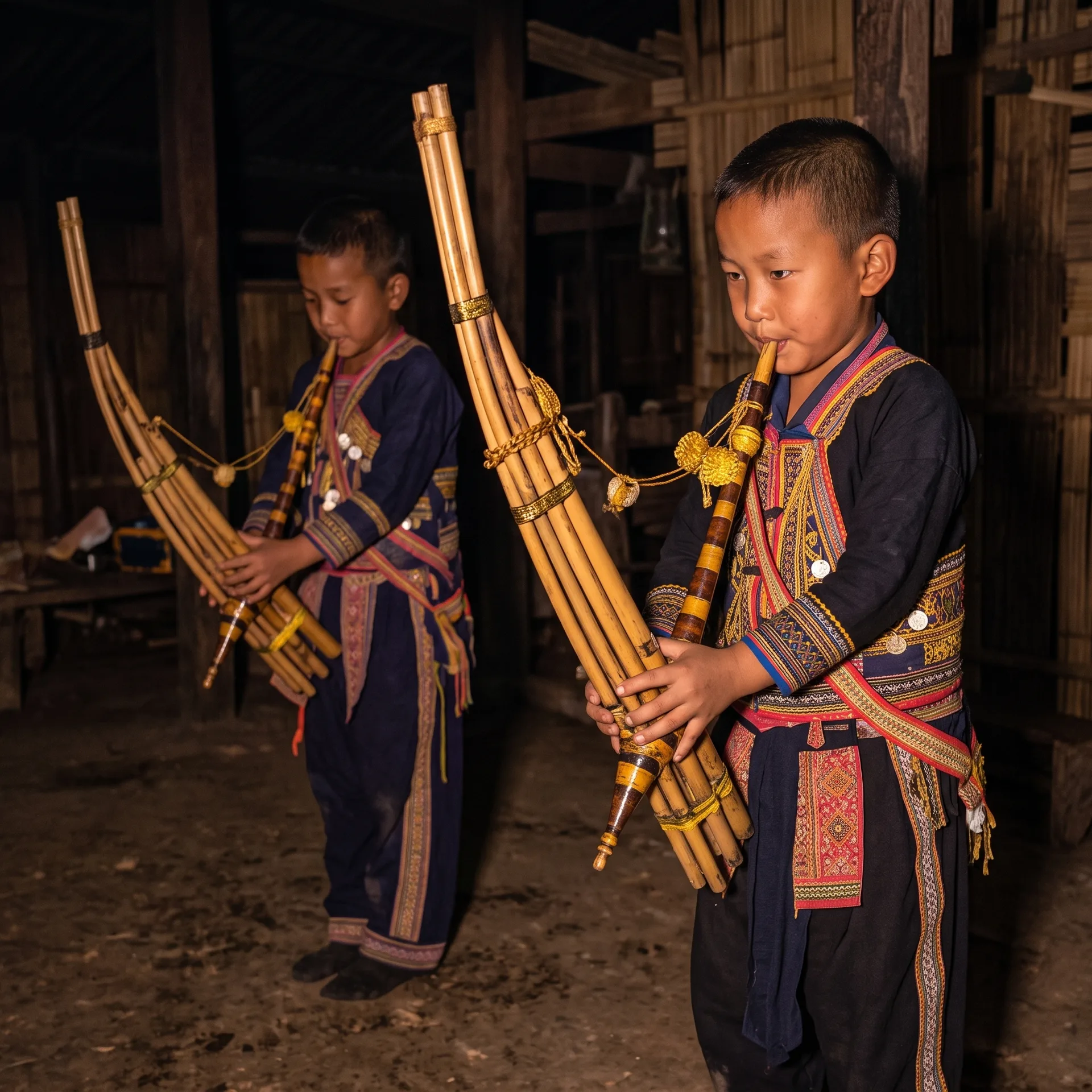
The pi chum ensemble (read: pi-joom) — the name given to a set of pi (reed pipes) played together as a group, so called because the word "chum" means to gather together as a set, comprising from three pipes upward, classified by their differing sizes as: pi mae (the "mother" pipe), pi klang (the middle pipe), pi koi, and pi tat (in some places called pi lek) — the pi mae being the largest and longest, with the pi koi and pi tat progressively smaller and shorter. The pi chum ensemble is combined in three configurations:
Pi chum sam (three-pipe ensemble), using three pipes: pi mae, pi klang, and pi koi. Pi chum si (four-pipe ensemble), using four pipes: pi mae, pi klang, pi koi, and pi tat. Pi chum ha (five-pipe ensemble), using five pipes: pi mae, pi klang, pi koi (in two pipes), and pi tat. Originally the five-pipe ensemble was the preferred configuration; when it was recognised that a second pi koi was not strictly necessary, the ensemble was reduced to four pipes, called pi chum si; later, further unnecessary elements were removed, leaving only three pipes — pi chum sam — while at the same time the sueng, a plucked-lute instrument, was added to the ensemble; the tone of the sueng is considered to tighten the rhythm. The principal function of the pi chum ensemble is to accompany the singing of the Lanna people, particularly the practice of "saw khao pi" [saw-singing accompanied by pi], which is especially popular in the provinces of Chiang Mai, Lamphun, Lampang, Chiang Rai, and Phayao.
"Khap saw," or "saw" (saw-singing). This is a form of vocal performance carried out as an exchange between a male and a female "chang saw" (saw singer). The content of saw commonly relates to the ritual occasion at hand: at a funeral, it would speak of the merit of the deceased and offer blessings to the hosts; at a housewarming, it would commonly speak of the construction of the new householder's house, and so on. Besides saw performed for the enjoyment demanded by social occasions, it has also been adapted for radio and television broadcast, among other media.
The role of the pi chum ensemble is clearly seen in the music that accompanies saw performances whose content, beyond simple entertainment, is also connected with ritual and belief associated with particular occasions [passage partly unclear in source] connected with monastic ceremonies within the principal religion of Lanna; even the substance of the Buddha's word as preserved by the teaching monks, together with the various scriptures, continues to be maintained within the tradition of musical performance. [The remainder of this paragraph in the source repeats, evidently in error, a passage on the types of Chiang Mai "ho tham" scripture-repository buildings already given in the architecture section above, and is not translated again here.]
Various drum ensembles: "Teung nong" is an ensemble comprising wind and percussion instruments. The wind instruments are the "nae" (shawm/oboe), of which there are two — the small nae and the great nae; the percussion instruments include a large gong (called "kong ui"), a medium gong (called "kong hoyng"), a large pair of cymbals (called "sawa"), and a small drum whose sound supports the "teung" tone, matching the "nong" tone of the gong; used to accompany merit-making occasions at temples, ordination ceremonies, and to accompany the fingernail dance (fon lep).
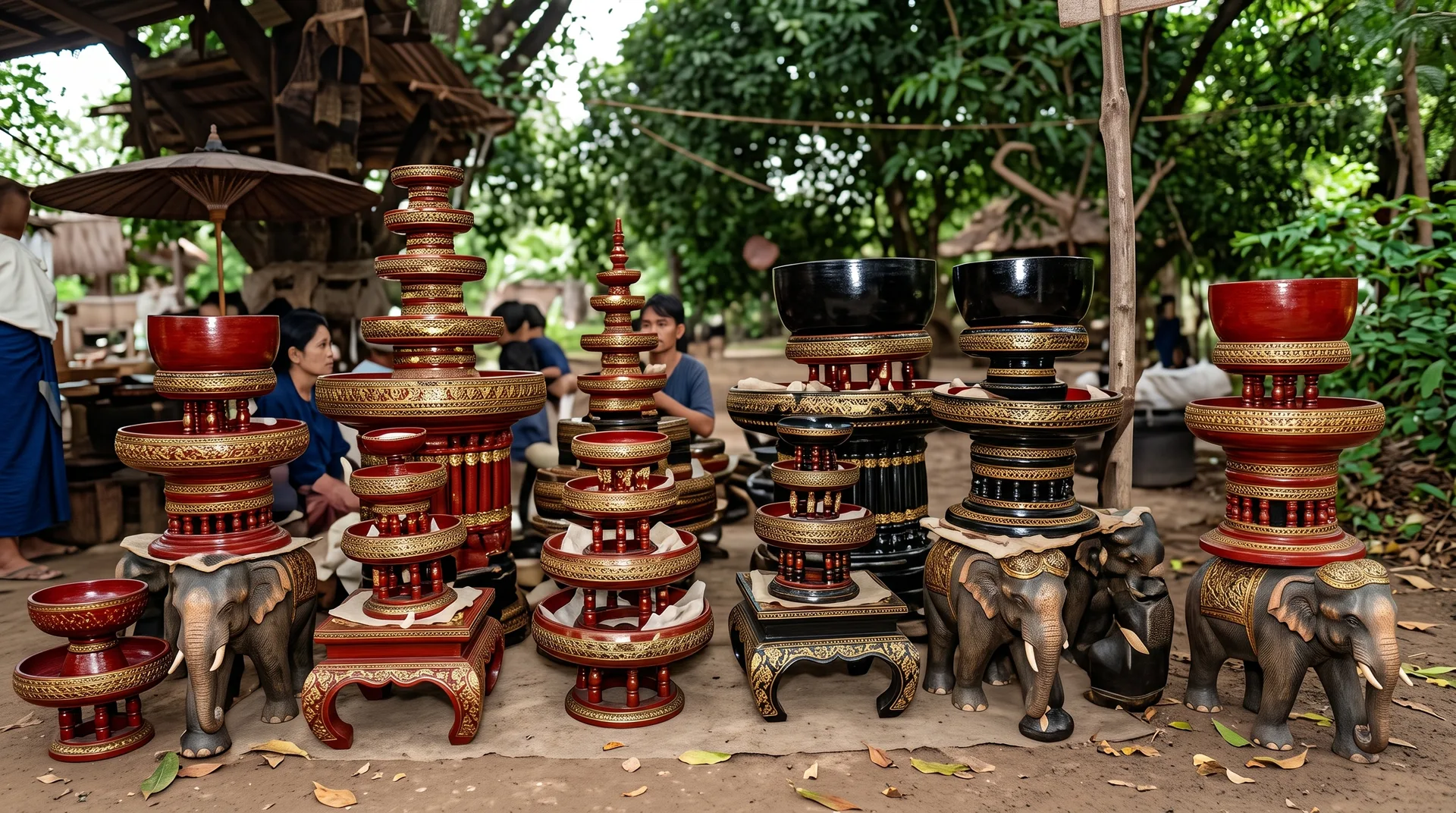
"Mong seng" is a folk drum ensemble of the Tai Yai (Shan) people, especially popular in Mae Hong Son, Chiang Mai, and Lampang provinces. The word "mong" means gong, and "seng" means a set; "mong seng," therefore, refers to a set of five to nine gongs, of large size, used as accompaniment; the drum used is a double-headed drum, not fixed/tacked, resembling the Mon "taphon" drum but lighter in weight. The mong seng ensemble is used to accompany merit-making occasions at temples and the procession of offering trays known as "luk kaeo" — called by the Tai Yai "sang long" [novice-to-be] — used to accompany the offering procession and to accompany the vernacular fingernail dance.
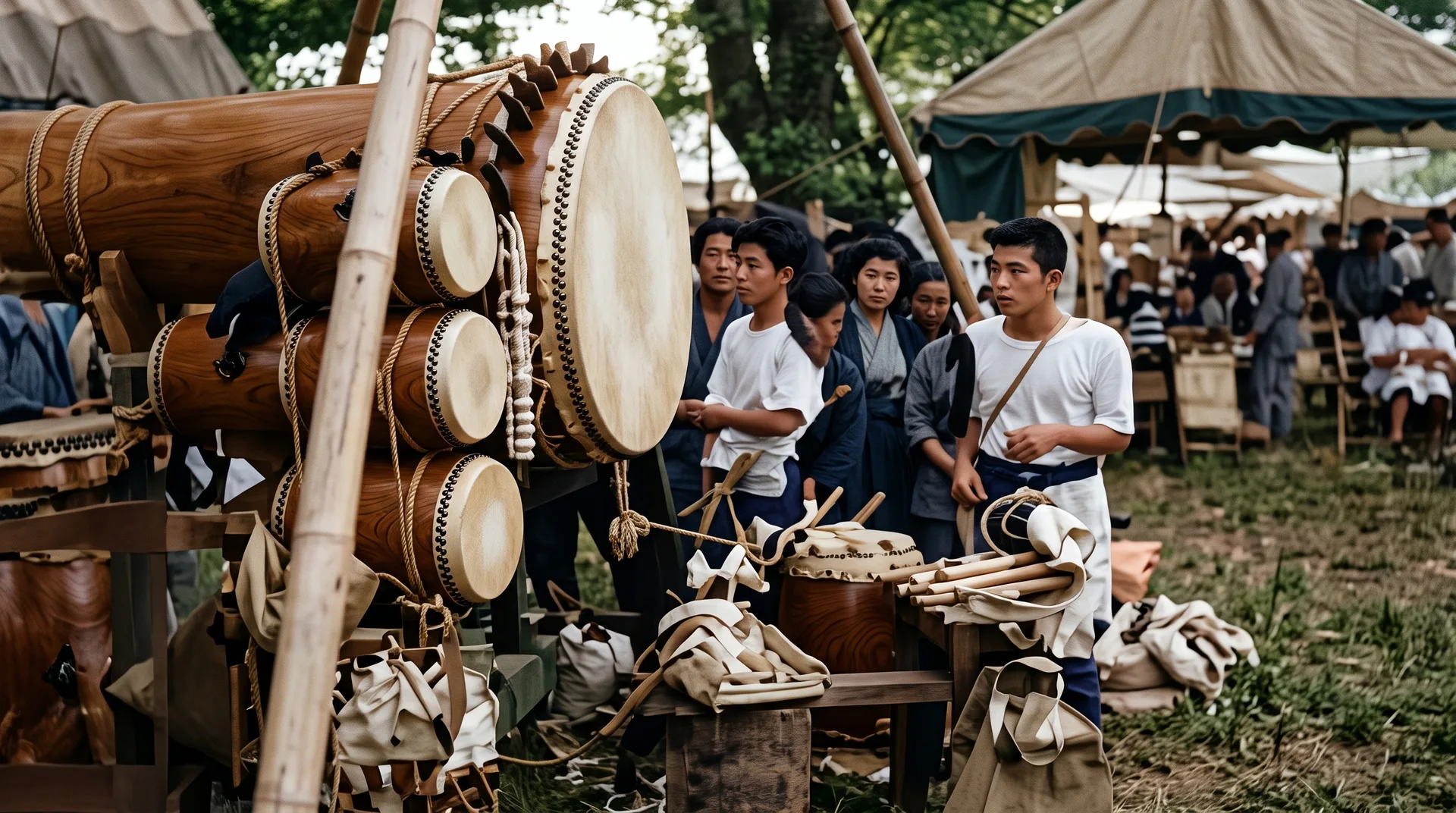
"Sabat chai" is the name of a type of drum. Originally used as a signal drum to announce events — a signal to attack the enemy, and beaten upon achieving victory in battle — it later came to be used as an act of Buddhist devotion and to accompany merit-making occasions at temples. In addition, there is also "rabat chai," the name given to a melody, called "rabam," played on the "pucha" drum (pronounced "pu-ja") [used in devotional rites].
The sabat chai drum with a carrying yoke, as found today, developed from a reduced version of the pucha drum, made to reduce its weight for ease of carrying. In this initial reduction, the ensemble still resembled the original, comprising, in addition, two or three small drums called "luk tup," and a distinctive type of bamboo clapper used to keep rhythm, called "mai sae." Later, when martial dance elements and combat display were introduced — the dancers wielding weapons as part of the performance — the "luk tup" drums and "mai sae" clappers were dropped.
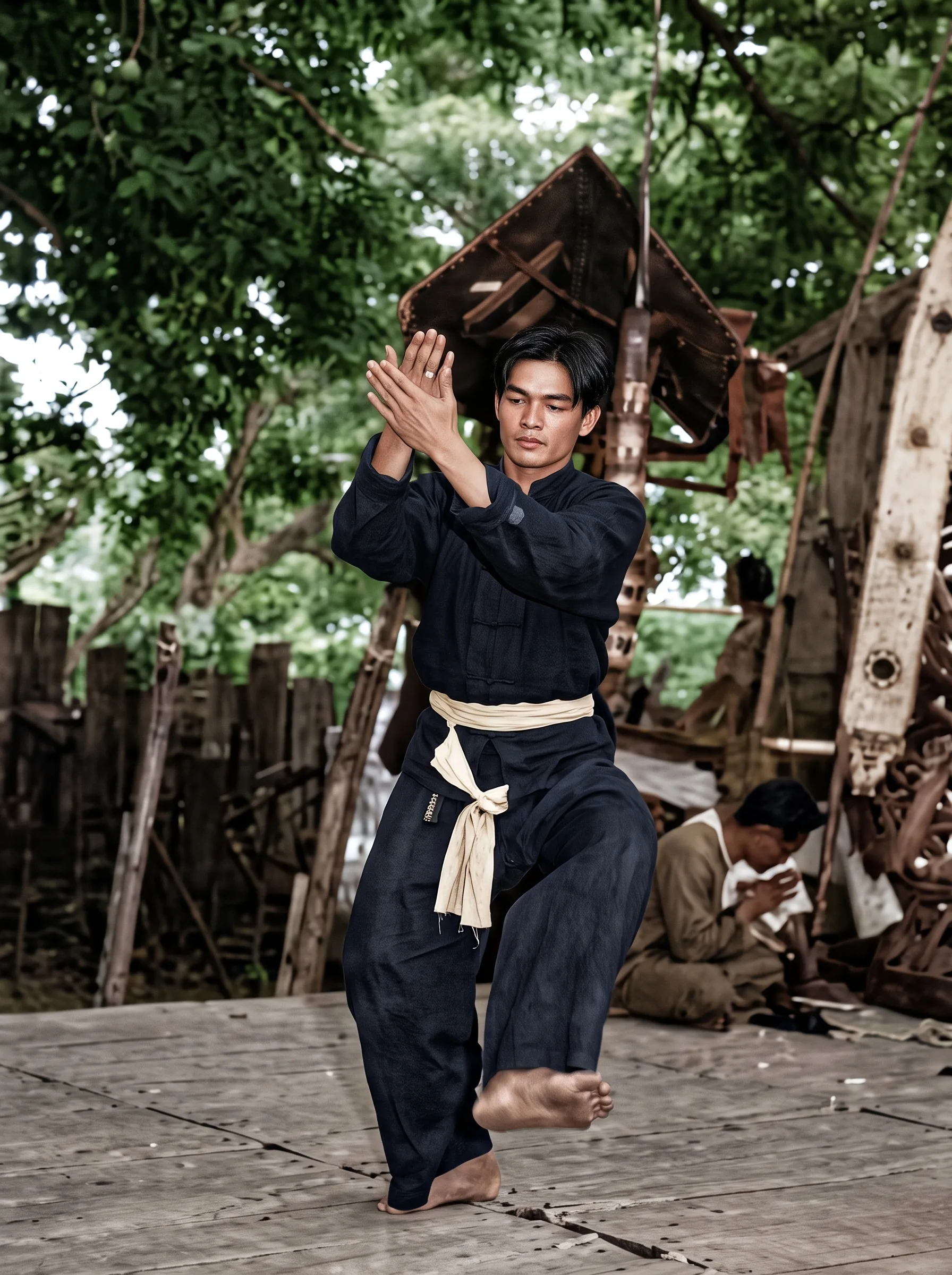
The performance of the sabat chai drum today uses one large drum of a size that can be carried [on a pole by two bearers], medium-sized cymbals, and two to four gongs. The performance style incorporates martial dance postures and combat display, showing the use of parts of the body as weapons — elbow, knee, foot, fist — performed to mark grand occasions, generally played in processions.
"Sing mong" is the name given to a type of drum ensemble with a simple, uncomplicated performance style. The instruments comprise the sing-mong drum and one to three medium-sized cymbals; used to play in offering processions and to accompany dance at general festival occasions.
Performing Arts — Fon Dance
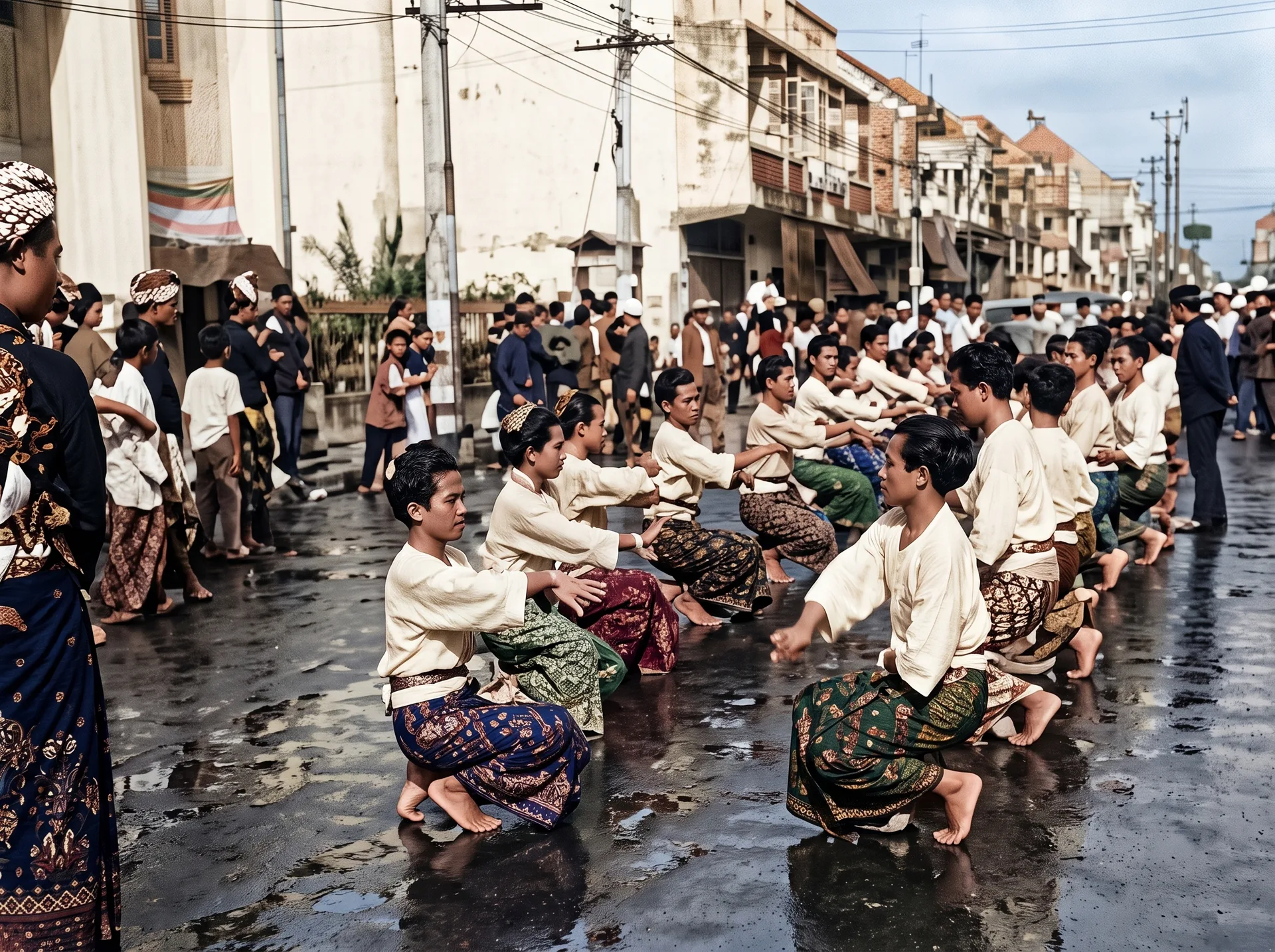
"Fon mueang" refers to the ancient dance of the Khon Mueang (Lanna) people, regarded as the emblematic dance of the Lanna people. Fon mueang comprises several types, such as fon lep (the fingernail dance), fon thian (the candle dance), and fon mueang kai lai [title as given]; today, however, the term "fon mueang" is commonly used to refer specifically to the fingernail dance and the candle dance.
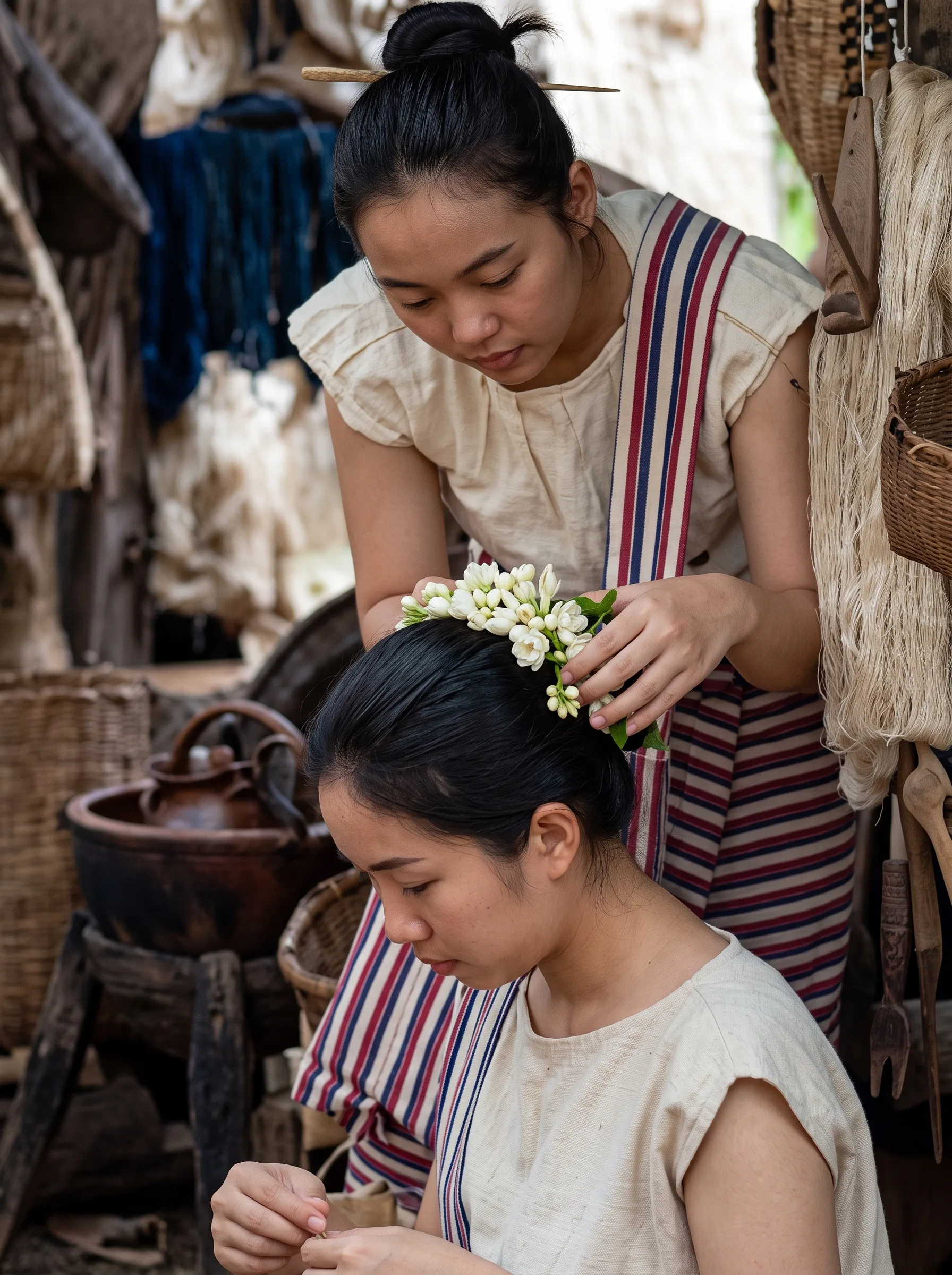
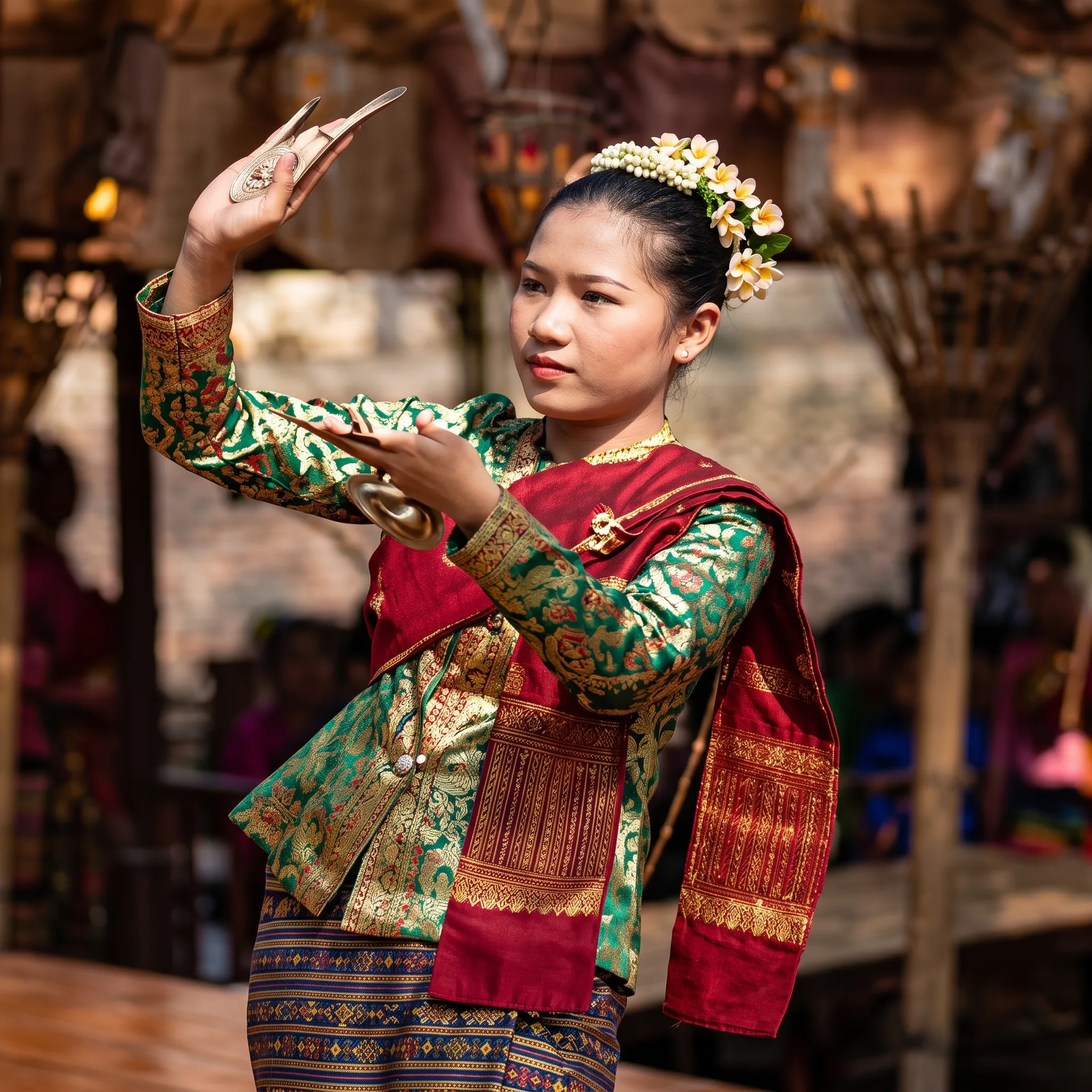
Fon lep (the fingernail dance). This dance differs somewhat from locality to locality within the Lanna region, in the details of dance postures, costume, rhythm, and so on. The fingernail dance is performed by a troupe of female dancers, in groups of six, eight, or twelve, and sometimes numbering in the hundreds. The costume is of the vernacular style: a fitted long-sleeved blouse, a wrapped sarong (sin), and a sash draped over the blouse; brass fingernail extensions are worn, slender and curved, tapering to a point, about three inches long, worn on the little finger held against the thumb; the hair is worn in a bun, decorated with flowers. The music used to accompany the dance is the teung-nong drum ensemble.
Fon thian (the candle dance). The dance postures resemble those of the fingernail dance, but candles are held in the hands in place of the fingernail extensions, and the dance is performed at night at various kinds of celebratory gatherings.
Fon Man Mui Chiang Ta is a dance whose choreography blends elements of Burmese dance with Lanna dance, its movements incorporating both fast and slow rhythms, with the formation shifting into paired lines at points. Today it is not commonly performed except on important occasions or in special cases, preserved by certain organisations or private groups — such as the Chiang Mai College of Dramatic Arts, the Chiang Mai Cultural Centre (a private organisation), and the youth group of Wat Pa Pao, Mueang District, among others.
Its history: the Princess Consort Dara Rasami had a Burmese female dancer named Sala Notoi [name as given] trained as a dance instructor within the palace, and adapted Burmese dance postures into the "fon thep thao" dance (also called "wo cha [t]lat leua" [title unclear]). This Burmese-style dance, in its original form, retained the character of Burmese dance, including Burmese-style costume. Later, when His Majesty King Prajadhipok, Rama VII, made a royal tour of inspection of the Payap (Northern) region, he was entertained with a dance performance while dining at the residence of the Princess Consort Dara Rasami; the Princess Consort arranged for the "man wian sian tam" [title as given] dance to be performed before the royal presence, having the dancers' costumes changed from the original to a more modest form [with men and women dressed in imitation of Burmese male and female dress respectively, in separate rows — passage garbled in source].
Costume. The Fon Man Mui Chiang Ta dance today is performed by an all-female cast, numbering approximately 10–16 dancers, dressed in Burmese style: a Burmese-style wrapped skirt reaching to the ankles, a round-necked long-sleeved blouse, a coloured silk sash draped around the neck with its ends hanging down to the waist, the hair gathered into a bun at the crown of the head with a loose lock left hanging beside the cheek, decorated with flowers and hanging ornaments attached near the loose lock of hair.
Music accompanying the dance. A pi phat ensemble is used, rather than a string ensemble; the melody sung and played is commonly known as "Phleng Man" (the Burmese melody). [The source notes some confusion in the tradition regarding this melody's origin: some accounts state that when Thai musicians play it in the Burmese style, the Burmese themselves call this melody "Phleng Yodia" (the "Ayutthaya melody"), so that its true origin cannot be conclusively traced; the dance itself, originally called the "fon thep thao," came to be called "Fon Man Mui Chiang Ta," the name apparently deriving from its place of origin.]
Fon Sao Mai (the Silk-Reeling Dance). This dance was created approximately 40 years ago by Mr. Kusonphawasit [name as given], originally a native of Doi Saket, Chiang Mai Province, who later moved to Chiang Rai Province, adapting dance postures from the "soeng sao mai san dan" [silk-reeling folk dance, title as given], which imitates the steps of silk-reeling, into the Fon Sao Mai dance, for his daughter, Nang Bua Reow (Suphawasit) Rattanamanikorn [name as given], who in turn has passed the dance down to the present day. In addition, the Fine Arts Department has adopted it into the curriculum taught at the College of Dramatic Arts, with minor modifications made for suitability and to achieve a standardised form.
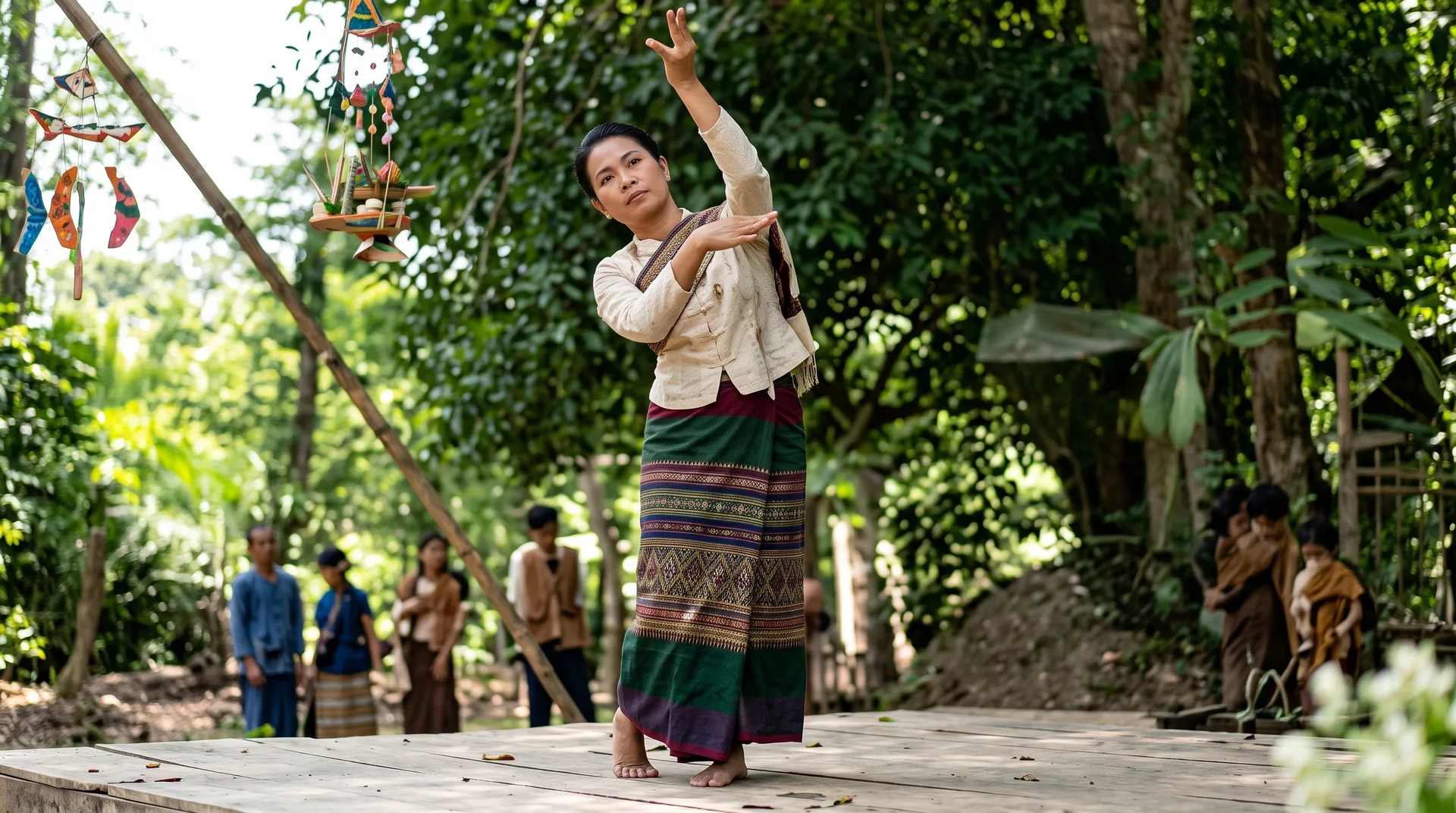
The music used to accompany the dance is the song "Sao Mai" or "Sao Mai Fai," or other local tunes of a fitting rhythm, performed by the salo-sueng ensemble. The dance may be performed solo or by more than one dancer. The costume is of the vernacular style: a wrapped sarong, a fitted long-sleeved blouse, a sash worn over it, and the hair gathered in a bun decorated with flowers. The dance uses several postures, such as "closing the house," "reeling silk into the basket," and "winding silk into a skein," among others.
The Fon Sao Mai dance is mostly performed at merit-making festivals, such as the Poi Luang festival; it is also popularly performed at events held for hospitality and entertainment, such as khantoke dinners.
Fon Choeng (read: choeng — "Fon Jeng") is a dance with martial dance postures, its choreography deriving from combat; the dancers are male. The music originally used to accompany it was the "teung thing" [drum ensemble], playing boxing tunes; today the pu-cha drum ensemble is used.
Fon Dap (the Sword Dance) is a dance performed with swords as part of the choreography, resembling a sword-fighting dance. The music originally used to accompany it was likewise the "teung thing" ensemble playing boxing tunes; today the pu-cha drum ensemble is likewise commonly used.
Fon Mueang Kai Lai. "Kai" means adaptation or transformation (of choreography, dance posture), corresponding to the word "klai" in Central Thai; "lai," meanwhile, carries a meaning similar to the word "choeng" here, referring to dance movement, which forms one component of the Lanna martial art of self-defence. "Fon mueang kai lai," therefore, likely means a vernacular dance whose postures have been adapted by incorporating "choeng" (martial) movements.
Its history: Fon Mueang Kai Lai was devised by Mr. Suchat Kanchai and Mr. Sanan Thamma-i [names as given], former members of the Lanna Folk Club, Chiang Mai University Student Union, around the end of B.E. 2531 (1988 C.E.), in the Tai Lue community of Ban Saen Dok, Tambon Samoeng Tai, Amphoe Samoeng, Chiang Mai Province — [it is unclear in the source whether the dance in fact originated with the Tai Lue people of Ban Saen Dok]; as far as is known among the dancers still living today, the dance can be traced back at least 110 years, to a dancer remembered from that era [name and surname unknown], who taught this dance to the descendants of Ban Saen Dok villagers, continuing down to the present (at present, fewer than ten people remain who can perform this dance).
Dance postures. In the past, the Fon Mueang Kai Lai dance had no fixed sequence dictating which posture should be performed before another (each dancer might perform the postures in whatever order they chose); however, when dancing together with other performers, the dancers would adjust their postures to match one another, though without strict competition over this. As for the dance postures themselves, the Lanna Folk Club of Chiang Mai University, in interviewing local practitioners, recorded a total of 20 postures; each posture has its own name and origin, many deriving from the arts of this same locality, and named according to the character of the movement; the Lanna Folk Club gave some postures new names resembling the dance movement itself, for ease of reference and practice.
Costume. In the past, dancers' costume followed no fixed form; for performances by the Lanna Folk Club, dancers wear either student uniform or any costume as appropriate.
In the past, the sing-mong drum was used in procession together with lanterns to accompany the fon mueang dance (sometimes called "klong laew" [term as given]); today, the mong-seng drum is used together with a lantern procession to accompany the dance, a practice that began approximately 40 years ago.
Today, Fon Mueang Kai Lai has become accepted and widespread within Amphoe Samoeng, though this remains a spread limited to the local level only, not yet widely known more broadly. However, when the teacher Chaloemsi Phromsuwan [name as given] brought this dance tradition from Amphoe Samoeng to the Payap region [for wider instruction], it received support and promotion until it became known, [being taught] at Wat Photharam School, and became recognised within Chiang Mai Province.
Terra Lanna Travel was founded out of a love for Lanna history and culture. We believe the stories of the northern land — its legends, traditions, temples, and the way of life of those who came before us — are a precious heritage worth recording, preserving, and passing on to future generations. That is why the core content of this website is centered on travel, history, and culture articles about Lanna.
Hotels & Tours: A Supporting Role
The hotel accommodations and tour programs featured on this site are a supplementary source of income, used to develop and maintain the website so it can continue in the long run — they are not our primary purpose.
Our Role
Our main role is to tell stories and share knowledge about Lanna history, so this cultural heritage can be preserved, protected, and passed on to future generations. We also translate our content into multiple languages so that international readers with an interest in Lanna culture can access and learn these stories too.
About Our Images
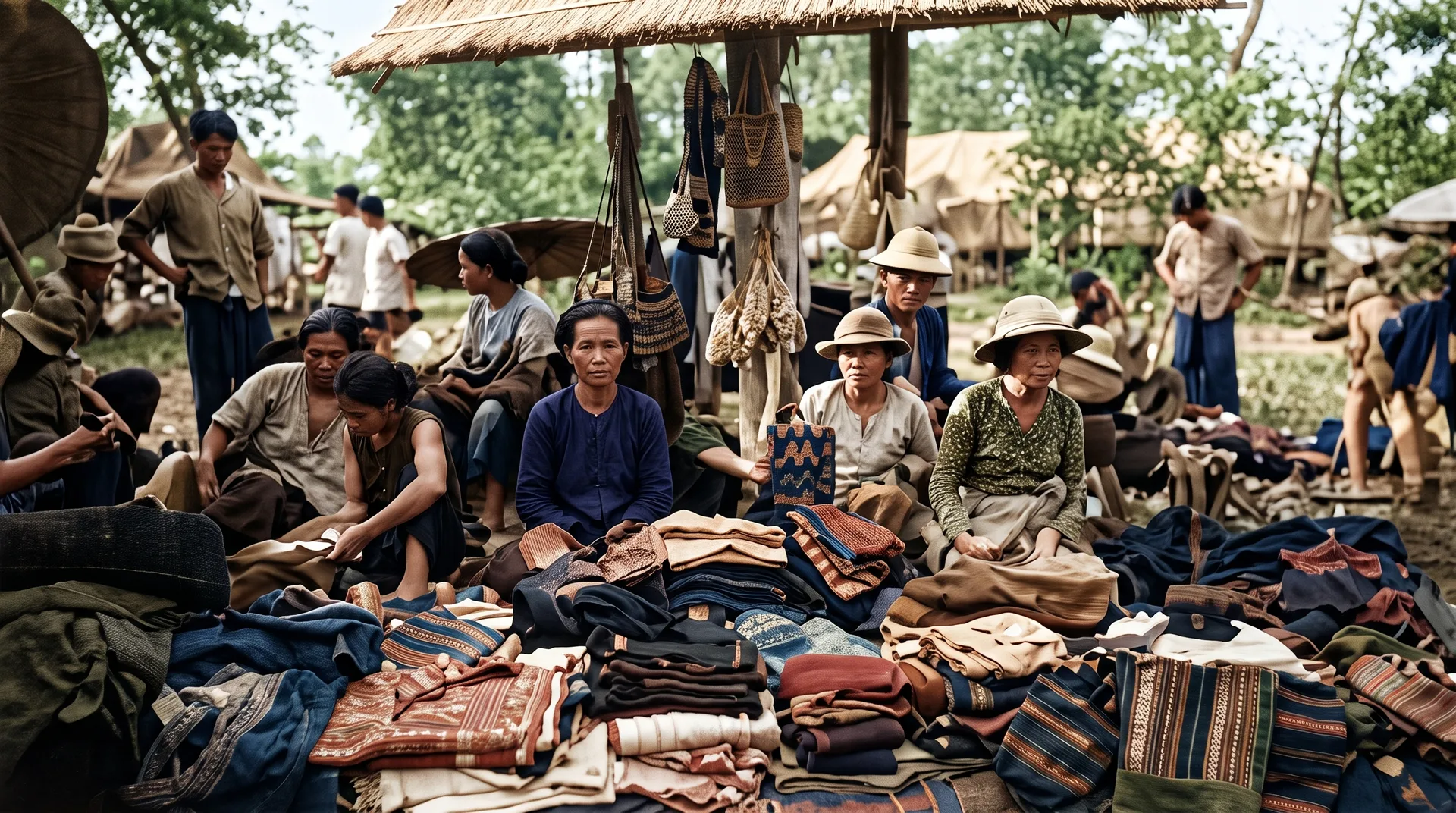
The images on this website include both genuine photographs and images restored using AI technology from old black-and-white photographs, so readers can see the atmosphere of those eras more clearly and vividly.
Privacy Policy / นโยบายความเป็นส่วนตัว
Last updated: 26 April 2026 | อัปเดตล่าสุด: 26 เมษายน 2569
This site contains affiliate links to Agoda, Viator, and Trip.com. When you click these links and make a booking, we may earn a commission at no extra cost to you. Hotel prices (Agoda) and tour prices (Viator) shown on this site are live prices pulled directly from our partners; Trip.com prices require clicking through to the partner's own site. Affiliate cookies are only set when you click these links directly.
คุกกี้สถิติและการวิเคราะห์ (Analytics Cookies): วิเคราะห์แนวโน้มการเข้าชมหน้าเว็บเพื่อปรับปรุงคุณภาพเนื้อหา ผ่าน Google Analytics (G-CSV1H77PY8)
We use cookies and similar technologies to enhance your browsing experience:
Preference Cookies: Remember your selected language and cookie banner consent status.
Analytics Cookies: Help us understand audience engagement and improve article quality via Google Analytics.
5. นโยบายโฆษณา Google AdSense / Google AdSense Advertising Disclosures
เว็บไซต์นี้ใช้บริการโฆษณาจาก Google AdSense เพื่อสนับสนุนการดำเนินงานและการผลิตเนื้อหาคุณภาพ เพื่อให้เป็นไปตามข้อกำหนดและนโยบายความเป็นส่วนตัวของ Google เราขอแจ้งให้ผู้ใช้ทราบดังนี้:
ผู้ให้บริการภายนอก ซึ่งรวมถึง Google ใช้คุกกี้ (รวมถึง DoubleClick cookie) เพื่อแสดงโฆษณาตามประวัติการเข้าชมเว็บไซต์นี้หรือเว็บไซต์อื่นๆ ในอินเทอร์เน็ตของผู้ใช้ในอดีต
การใช้คุกกี้เพื่อการโฆษณาช่วยให้ Google และพาร์ทเนอร์สามารถแสดงโฆษณาที่เกี่ยวข้องและตรงกับความสนใจของผู้ใช้ อิงตามประวัติการเข้าชมเว็บไซต์ของเราและ/หรือเว็บไซต์อื่นๆ ในเครือข่ายอินเทอร์เน็ต
ผู้ใช้มีสิทธิ์เลือกปิดการใช้งาน (Opt-out) โฆษณาที่ปรับแต่งตามโปรไฟล์ความสนใจส่วนบุคคลได้ทุกเวลา โดยเข้าไปที่ Google Ads Settings หรือเข้าไปที่เว็บไซต์ www.aboutads.info เพื่อปิดการใช้คุกกี้ของผู้ให้บริการภายนอกสำหรับการโฆษณาตามความสนใจ
This website partners with Google AdSense to display advertisements. In strict accordance with Google AdSense Publisher Policies, please be advised:
Third-party vendors, including Google, use cookies (including the DoubleClick cookie) to serve ads based on a user's prior visits to this website or other websites across the Internet.
Google's use of advertising cookies enables it and its partners to serve personalized ads to users based on their visits to our site and/or other sites on the Internet.
Users may opt out of personalized advertising at any time by visiting Google Ads Settings. Alternatively, users can opt out of a third-party vendor's use of cookies for personalized advertising by visiting www.aboutads.info.
Terra Lanna Travel Chiang Mai — เชียงใหม่, ประเทศไทย
Terms of Service / ข้อกำหนดการใช้งาน
Last updated: 25 September 2026 | อัปเดตล่าสุด: 25 กันยายน 2569
1. เกี่ยวกับบริการของเรา / About Our Service
Terra Lanna Travel Chiang Mai ("เรา", "Terra Lanna") ให้บริการเว็บไซต์ที่รวมหลายส่วนเข้าด้วยกัน ได้แก่ ที่พัก Nampiangdin Boutique Hotel ทัวร์ฟาร์มออร์แกนิกที่ลำพูน โปรแกรมทัวร์คัดสรร ไดเรกทอรีโรงแรมพร้อมราคาสดจากพาร์ทเนอร์ บล็อกเรื่องราวเชิงวัฒนธรรมล้านนา และ "ห้องสมุดล้านนา" ซึ่งเป็นคลังหนังสือประวัติศาสตร์/วัฒนธรรมล้านนาที่แปลและเรียบเรียงขึ้นใหม่ การใช้งานเว็บไซต์นี้ถือว่าคุณยอมรับข้อกำหนดฉบับนี้
Terra Lanna Travel Chiang Mai ("we", "Terra Lanna") operates a website combining several parts: Nampiangdin Boutique Hotel accommodation, organic farm tours in Lamphun, curated tour programs, a hotel directory with live partner pricing, a Lanna culture blog, and the "Lanna Library" (ห้องสมุดล้านนา) — a collection of translated and re-edited Lanna history and culture books. By using this website, you agree to these Terms.
2. เนื้อหาบล็อกและห้องสมุดล้านนา / Blog & Lanna Library Content
บทความบล็อกและหนังสือใน "ห้องสมุดล้านนา" เป็นผลงานที่เรียบเรียง แปล และดัดแปลงขึ้นโดย Terra Lanna จากแหล่งข้อมูลประวัติศาสตร์/วรรณกรรมล้านนาสาธารณะ โดยมีเจตนาเพื่อการสานต่อและอนุรักษ์วัฒนธรรมล้านนาให้เข้าถึงได้ในหลายภาษา เนื้อหาที่แปล/เรียบเรียงใหม่นี้เป็นลิขสิทธิ์ของ Terra Lanna ส่วนผลงานต้นฉบับยังคงเป็นของผู้ประพันธ์/สำนักพิมพ์เดิมตามที่ระบุไว้ในแต่ละเล่ม รูปภาพประกอบบางส่วนเป็นภาพถ่ายจริง และบางส่วนสร้าง/บูรณะขึ้นด้วยเทคโนโลยี AI จากภาพถ่ายเก่าขาวดำ (ดูรายละเอียดที่หน้า About Us) เนื้อหาทั้งหมดจัดทำขึ้นเพื่อวัตถุประสงค์ด้านการศึกษาและวัฒนธรรม ห้ามคัดลอกหรือนำไปเผยแพร่ซ้ำเพื่อการค้าโดยไม่ได้รับอนุญาตเป็นลายลักษณ์อักษร
Blog articles and books in the "Lanna Library" are compiled, translated, and adapted by Terra Lanna from public Lanna historical/literary sources, with the intent of continuing and preserving Lanna culture in multiple languages. This translated/re-edited content is copyrighted by Terra Lanna; original source works remain the property of their original authors/publishers as credited within each volume. Some accompanying images are genuine photographs, while others are AI-restored or AI-generated from old black-and-white photographs (see the About Us page for details). All content is produced for educational and cultural purposes. Copying or commercial redistribution without written permission is prohibited.
3. การจองผ่านลิงก์พาร์ทเนอร์ / Bookings via Partner Links
Hotel (Agoda) and tour (Viator) prices shown on this site are pulled live from our partners, but the actual booking is completed on the partner's own website and is governed by that partner's own terms and cancellation/refund policy — not Terra Lanna's. We act only as an affiliate referrer and are not a party to that booking contract, and are not responsible for service issues, cancellations, or disputes arising from the partner. (See Privacy Policy for affiliate commission details.)
You may not use this website to: violate Thai or applicable law, scrape or bulk-extract content without permission, or attempt unauthorized system access.
We provide information on this website "as is" and make reasonable efforts to keep it accurate and current, but do not guarantee that content, prices, or availability are correct, complete, or error-free at all times. To the maximum extent permitted by law, Terra Lanna is not liable for indirect, incidental damages, or loss of profit arising from use of this website or our partners' services.























 ภูมิปัญญาดินอินทรีย์ · 4 นาที