











Chapter 2: Prolonging City, Village, and Mortal Lifespans: King Kaew's 500-Year-Old Civic Mandala and Lanna Renewal Rites
Unveil King Kaew's 500-year-old mandala for Chiang Mai's civic renewal, the simultaneous chanting of 6 scriptures, and Lanna's tripod longevity rites.
The 500-Year-Old Manuscript: King Kaew's State Renewal Mandala
Longevity rituals in classical Lanna were far more than private superstitious observances; they represented vital state spiritual strategies designed to guarantee the geopolitical survival of the realm. Sanguan Chotisukharat retrieved an extraordinarily rare 500-year-old palm-leaf chronicle from Khamfu Khunkaew, an ordained scholar of Mae Rim, documenting the municipal renewal liturgy (Sueb Chata Mueang) executed during the reign of King Kaew (Phra Mueang Kaew, r. 1495–1525 CE), the eleventh sovereign of the Mangrai Dynasty.
During historical emergencies—such as prolonged droughts, military sieges, or bad celestial omens—the monarchy mobilized nobles, astrologers, and Buddhist prelates to re-consecrate Chiang Mai. The rite transformed the moated, walled citadel into a living cosmic mandala, stationing specific high ministers (Saen) and exact sacrificial offerings across critical defense nodes:
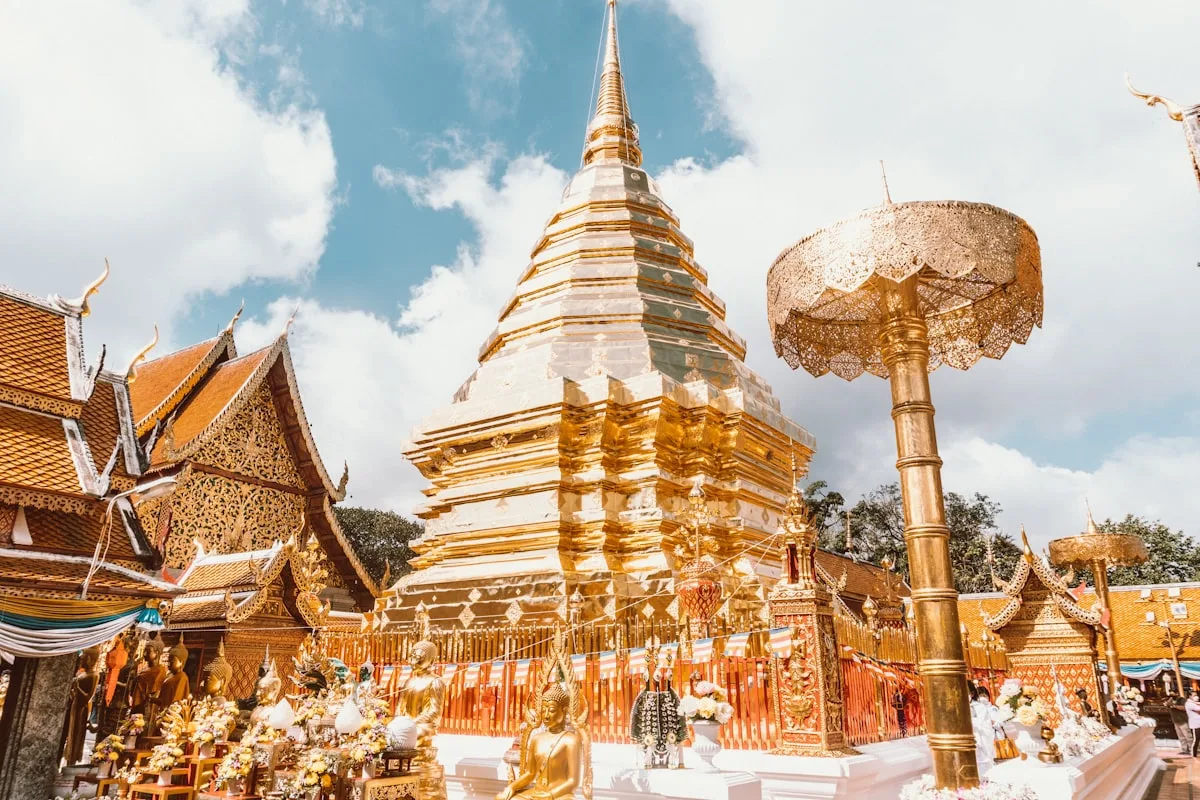
- The Navel of the Earth (Sadue Mueang): Minister Saen Thong directed rites at the cosmological epicenter (the city center); Minister Saen Nangsue conducted offerings at the Inthakhin City Pillar (originally at Wat Sadue Mueang); while Thip Suan Hae commanded the veneration of the Eight Guardian Elephants surrounding the monumental Chedi Luang.
- High Mountains and the Ancestral Founder: Minister Saen Non was dispatched with offerings to the summit of Doi Luang Chiang Dao to propitiate the supreme territorial spirits, while Saen Sahli venerated the ancestral soul of King Mangrai the Great.
- The Four Fortified Bastions (Chaeng Mueang): Chaeng Sri Phum (Minister Saen Mueang invoked urban prosperity); Chaeng Kha-tam (Saen Kwan invoked economic industry); Chaeng Ku Rueang (Phraya Dek Chai bound and neutralized the demonic city-infortunes, Kalakini); and Chaeng Hua Rin (the Royal Swordsmen invoked civic longevity).
- The Five City Gates and Celestial Sentinels: The Northern White Elephant Gate (Thao Kwan venerated the deva Khandharakkhito); the Eastern Tha Phae Gate (Tor Wee venerated the deva Surakkhito); the Southern Chiang Mai and Suan Prung Gates (Tor Or venerated the deva Chaibhummo); and the Western Suan Dok Gate (Tor Na Luang venerated the deva Surachato).
Canonical Polyphony: Simultaneous City-Wide Chanting
The supreme cosmological brilliance of the city-extension rite lay in its synthesis of indigenous territorial cults with pristine Theravāda power. The royal court brought the ancient palladia, Phra Sae Tang Khamanee (the White Quartz Crystal Buddha) from Wat Chiang Man, to serve as the spiritual nucleus at the city center. Simultaneously, senior monks residing in temples bearing phonetically auspicious names chanted six foundational scriptures concurrently across the city:
- Wat Chiang Yuen (The Enduring City): Chanted the Salavali (3 palm-leaf fascicles).
- Wat Duang Dee (Good Fortune): Chanted the Mangalatthadipani (3 fascicles).
- Wat Chai Phra Kiat (Glorious Victory): Chanted the Nakaratthana (1 fascicle).
- Wat Phra Singh (Lion Monarch): Chanted the Barami (1 fascicle).
- Wat Chai Sathan (Victorious Sanctuary): Chanted the Unhassavichai (1 fascicle).
- Wat Chotikaram (Wat Chedi Luang): Chanted the Nakarathana (1 fascicle).
A continuous white sacred thread (Sai Sin) radiated from the crystal Buddha, circumambulating the city walls, ramparts, and all 27 defensive bastions, physically binding Chiang Mai in a web of sacred protection before holy water was sprinkled over the populace.
Village Life-Extension (Sueb Chata Ban): The Village Spirit Shrine and Communal Pooling
Scaling down from the imperial court to agrarian reality, the Village Extension Rite (Sueb Chata Ban) was observed annually at crossroad shrines known as Ho Suea Ban (the Shrine of the Village Shirt/Soul).
The profound civic genius of the village rite resided in "Hom Khrua" (Communal Pooling). On the eve of the ceremony, every household—regardless of socioeconomic rank—contributed rice, salt, chilies, banana shoots, tobacco, and currency to a collective central store. This pooled wealth underwrote the monastic alms feasts and ancestral spirit banquets, obliterating village wealth disparities. Families brought bundles of their own clothing to be washed in consecrated lustral waters, reaffirming collective solidarity.
Individual Longevity (Sueb Chata Khon): The Tripod and the Bridge of Salvation
At the personal level, Individual Extension Rites were staged upon the open-air wooden floorboards (Teun) of village homes during milestones, illness recovery, or when village seers (Mo Mue) diagnosed astrological decline.
The symbolic apparatus preserved the ancient macrocosmic template:
- The Tripod Pavilion: Three stout branches of equivalent height to the supplicant were lashed into a tent-like cone; the individual sat beneath the apex, physically linked by sacred cotton cords to the monk's lustral water bowl.
- The Bamboo Bridges (Khua Taek): Miniature ladders woven of gold and silver wire bridged the struts, symbolizing walkways spanning infernal crevasses.
- Age-Matched Paraphernalia: Split wooden forks (Mai Chi) cut to one cubit in length, matching the supplicant's chronological age plus one, complemented by tubes of river sand, river water, paddy, cowrie shells, and new sleeping mats.
- The Four World Regents: Before prolonging the future, the past had to be cleansed via offerings to the Four Heavenly Kings (Khan Thao Thang Si), excising negative residue before receiving precepts, listening to the Dhamma, and receiving the wrist-binding cotton chords of rebirth.