












Chapter 8: Saw Mueang: Oral Rhapsodies, the Pi Jum-Salaw-Seung Ensemble, Nine Melodic Schools, and the Tragic Dirge of Wiang Chet Lin
Explore Lanna's Saw Mueang oral poetry: the tragic dirge of Queen Umpakang, the Pi Jum-Salaw-Seung ensemble, and the 9 master melodic schools.
Mythological Genesis: The Death of Phraya Maen Ta Tok and Queen Umpakang's Dirge
In the esoteric pages of the Tamnan Suwanna Kham Daeng, the origin of Northern Thai vocal music (Saw Mueang) is traced to an ancient tragedy predating the foundation of Chiang Mai: At the foot of Mount Doi Suthep lay the archaic citadel of Wiang Chet Lin (Setthaburi), ruled by King Phraya Maen Ta Tok. The monarch mobilized his army to repel the "Phi" (identified ethnohistorically as indigenous Austroasiatic Khom or Lawa tribes). Pursuing the enemy into the dense mountain jungles, the king was struck down by a poisoned arrow. His ministers carried the royal corpse back, laying it in state outside the citadel gates.
When his chief consort, Queen Umpakang, arrived and gazed upon her husband's remains, she was overcome by grief, breaking into a rhythmic, melancholic, wailing lament: "Oh, my beloved master! Oh, my precious husband!..." The cadenced weeping and vocal modulations of Queen Umpakang established the primordial sonic prototype of "Saw." Originally deployed exclusively as a funeral dirge to mourn the dead (Huean Yen), the form gradually evolved over centuries into complex courting dialogues, epic historical ballets, and vibrant celebratory poetry across the Tai world.
Instrumental Architecture and the Dramatic Art of the "Chang Saw"
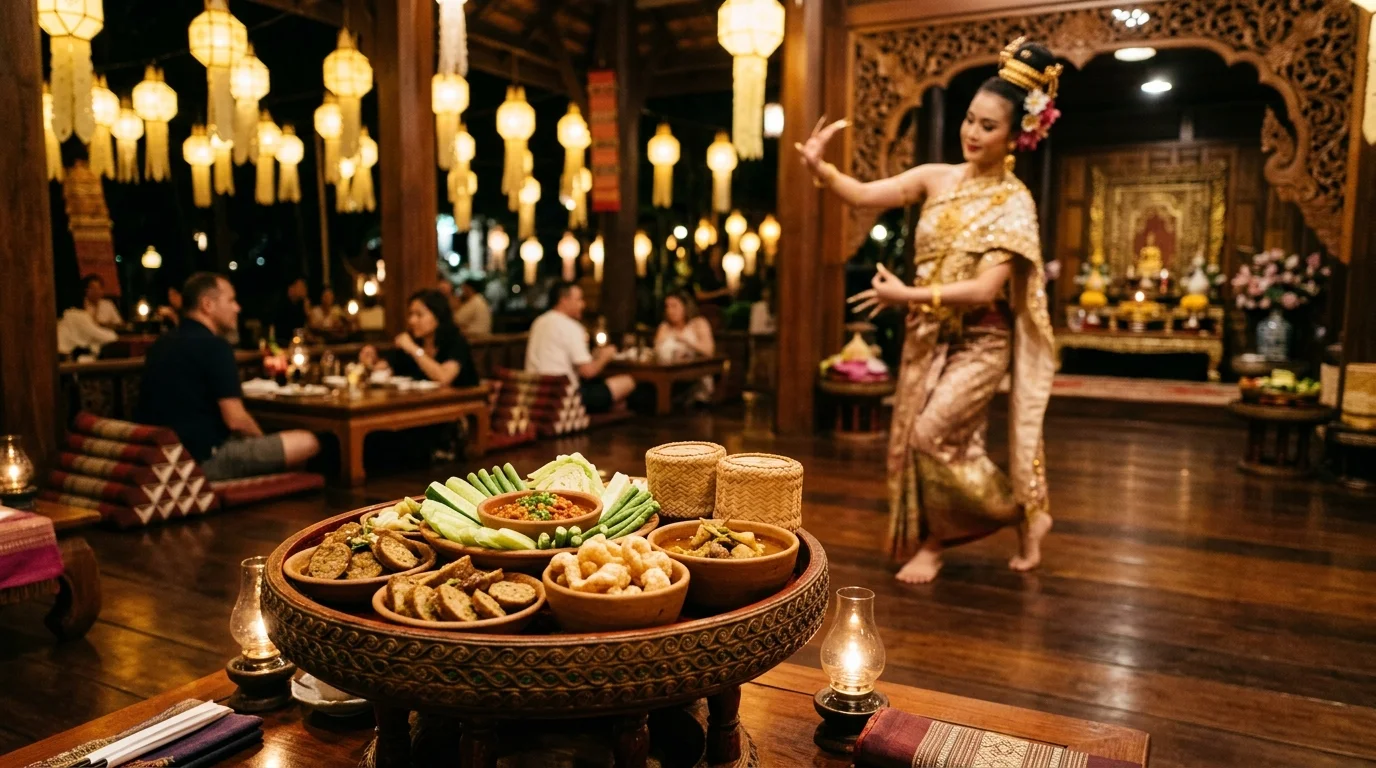
Far more than simple folk singing, Saw Mueang is an arena of competitive linguistic combat and poetic improvisation staged between a male and a female troubadour (Chang Saw). The duo sits cross-legged on woven mats atop an elevated pavilion (Pham) or the open wooden veranda (Teun), surrounded by the acoustic resonance of an authentic Lanna chamber ensemble:
- Woodwinds: The "Pi Jum" (an ensemble of transverse bamboo pipes), configured as Pi Jum Sam (three pipes) or Pi Jum Ha (five pipes), encompassing the Pi Kao (bass-baritone), Pi Klang (tenor), and Pi Koy (soprano).
- String Section: Anchored by the "Seung" (a four-stringed plucked wooden lute played in double courses) and the "Salaw" (a two- or three-stringed bowed spike fiddle whose resonator is sculpted from seasoned coconut shell capped with hardwood).
- Rhythm Section: Punctured by brass finger-cymbals (Ching) and a small double-faced drum (Klong Lek Song Na).
The performing pair must possess lightning-fast poetic agility, improvising rhymed Lanna verse on the spot. The performance moves through defined psychological movements: commencing with subtle courtship, evolving into domestic affection, and escalating into heated, comical marital squabbles. The performance typically spans from 10:00 AM until nightfall, concluding with "Saw Kep Nok" (Gathering the Birds)—a lyrical movement detailing the evening forest canopy, returning wildlife, and formal eulogies praising the sponsors.
The Nine Canonical Melodic Schools of Lanna
Sanguan Chotisukharat codifies the nine master vocal traditions (Thamnong Saw) preserved across Northern Thailand:
- Saw Phleng Oo: Archaic lullabies defined by guttural humming ("Oo... Humm...") embedded with moral aphorisms.
- Saw Phleng Phama: A staccato rhythm adapted from the Burmese court, frequently used to dramatize Jataka epics like Nang Bua Kham.
- Thamnong Chiang Mai: A dynamic, fast-paced cadence culminating in elongated, sweet melismatic vocal trails, termed the Rabaam Nam Tok Tat (Waterfall Melody).
- Thamnong Chiang Saen: An archaic, meditative mode sung in a soaring, piercing soprano, utilizing floral and botanical riddles to mask romantic longings.
- Thamnong Cha-pu: A stately, aristocratic court melody characterized by slow, grave cadences, historically performed within royal compounds (Khum Luang) to welcome sovereign monarchs, such as during King Rama VII's state visit to Chiang Mai in 1926.
- Saw Phleng Ngiew (Se-le-mao): A lively festive mode adopted from the highland Tai Yai (Shan) diaspora.
- Saw Phleng Khao (Kalong Mueang): The peak of high classical literature, sung using the complex rhymed quatrains of Lanna's national laureate, Phraya Phromwohan.
- Saw Phleng Phra Lor: A lyrical adaptation of the tragic epic of Prince Lor, celebrating unshakeable romantic devotion, adapted under the patronage of Princess Dara Rasmi.
- Saw Phleng Noi Chaiya: The northern musical masterpiece composed by royal scribe Thao Sunthorn (Boonma Sukonthakul), chronicling the doomed romance between the scholar Noi Chaiya and the maiden Waen-kaew.
"Lao Khao" and the Print Revolution of Rong Phim Charoen Mueang
Beyond musical performance lay the tradition of "Lao Khao"—the unaccompanied melodic reading of palm-leaf verse novels, performed around evening hearths or during funerary wakes. Historically locked within fragile palm-leaf bundles, these epics entered modernity around the 1920s when Pho Liang Mueangjai Chainilaphan, proprietor of Charoen Mueang Printing House in Chiang Mai, began casting type in both Northern Tua Mueang script and standard Thai. Mass-printed chapbooks (Khao Hong Hin, Chao Suwat Nang Bua Kham, Phraya Phrom) flooded northern markets, preserving Lanna's oral soul as far south as the Chiang Saen diaspora enclave of Sao Hai in Saraburi Province.