

















Chapter 3: King Tilokaraj: The Righteous Emperor, the Wars with Ayutthaya, and the 8th World Buddhist Council
Chapter 3: King Tilokaraj: The imperial campaigns against Ayutthaya, founding of Wat Chet Yot, and the 1477 Eighth World Buddhist Council.
From Prince Thao Lok to Sovereign of the Mangrai Line
Among the ten royal sons of King Samfangkaen, Prince Thao Lok, born in 1409 CE (B.E. 1952 / C.S. 771), distinguished himself through extraordinary strategic acuity from an early age. In 1442 CE (B.E. 1985 / C.S. 804), at age 34, Thao Lok seized the throne from his father (who was peacefully interned in Chiang Saen) and was formally anointed as the monarch of Chiang Mai, adopting the imperial reign title "Phra Maha Si Thammatilokaraj" (universally known as King Tilokaraj).
His early reign was tested by civil strife when his younger brother, Prince Soi of Fang, conspired with Muen Han Tae Thong, the lord of Lampang, and dispatched an appeal for military intervention to King Borommarachathirat II (Chao Sam Phraya) of Ayutthaya. Tilokaraj's trusted general, Muen Lok Sam Lan, decisively crushed the insurrection, repelling the southern armies and cementing Tilokaraj's absolute domestic authority.
The Epic Lanna-Ayutthaya Wars and Regional Expansion
Tilokaraj's 45-year reign was defined by an epic geopolitical duel with the southern powerhouse of Ayutthaya. Between 1442 and 1460 CE, Tilokaraj fought four to five major campaigns against King Borommatrailokanat of Ayutthaya over the frontier kingdoms of Phitsanulok (Song Khwae), Kamphaeng Phet, Sukhothai, and Si Satchanalai (Chaliang). The northern armies mounted such persistent, deep incursions that Trailokanat was compelled to relocate the functional capital of Ayutthaya north to Phitsanulok for 25 years to personally manage the northern front.
Simultaneously, Tilokaraj extended Lanna's imperial borders in all directions: annexing the rival principalities of Phrae and Nan, subjugating Lan Xang (Luang Prabang), and subduing the Shan domains of Mueang Nai and Hsipaw, as well as the Tai Lue heartland of Sipsongpanna (Mueang Yawng and Chiang Rung). For the first time in history, the entirety of the Northern Tai cultural sphere was united under the centralized command of Chiang Mai.
Founding of Wat Photharam (Wat Chet Yot) and the 8th World Buddhist Council (1477 CE)
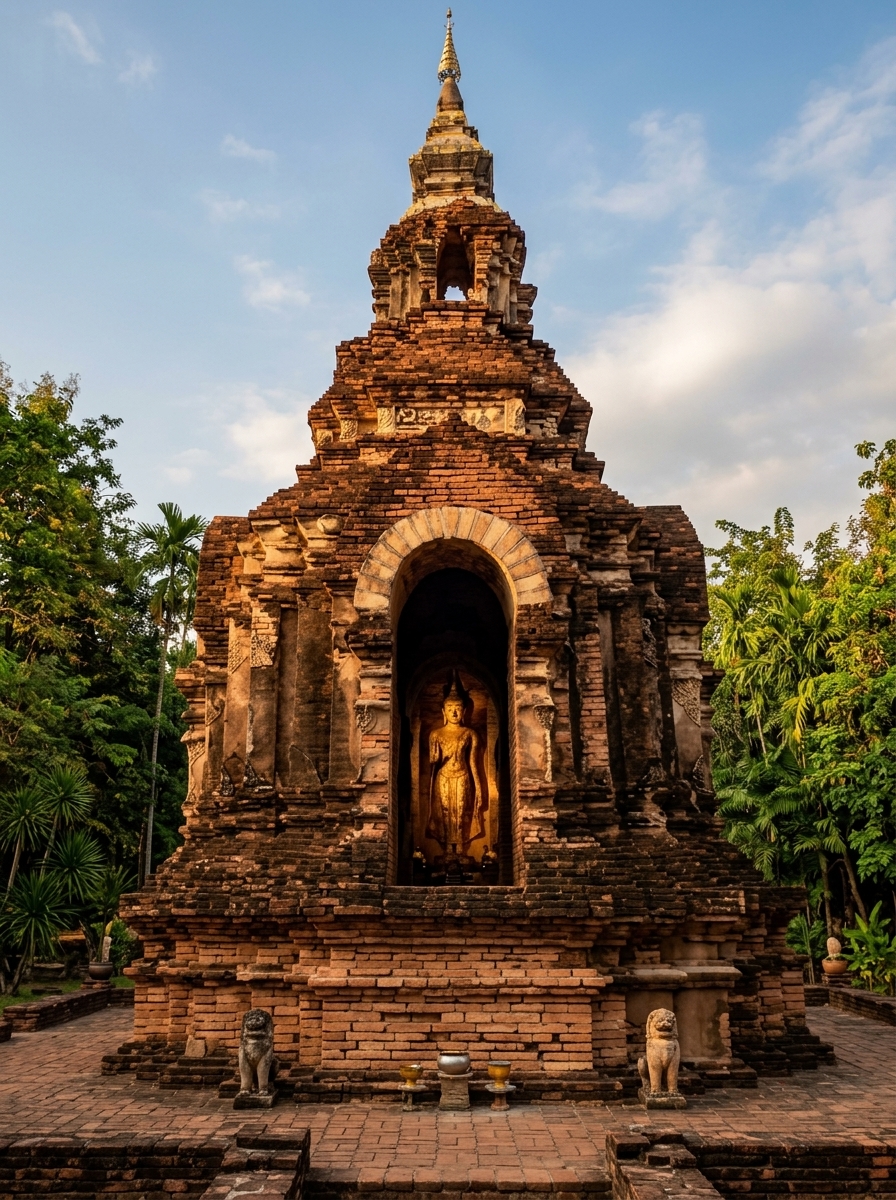
Despite his fierce military reputation, Tilokaraj was an enlightened patron of the Buddhist Sasana. In 1447 CE, he temporarily renounced worldly power to be ordained as a Buddhist monk at Wat Pa Daeng Luang alongside 500 noble youths. In 1455 CE (B.E. 1998 / C.S. 817), he planted a sapling of the sacred Mahabodhi tree brought directly from Sri Lanka northwest of Chiang Mai, consecrating the grand forest monastery Wat Photharam Mahavihara (popularly known today as Wat Chet Yot).
The zenith of Tilokaraj's religious legacy was achieved in 1477 CE (B.E. 2020 / C.S. 839), marking 2,020 years of the Buddhist era. Tilokaraj convened the 8th World Buddhist Council (Eighth Council of the Theravada Tradition) at Wat Chet Yot. Presided over by Phra Dhammadinnathera of Wat Pa Tan and attended by over a hundred master scholars, the council spent an entire year meticulously reviewing, standardizing, and inscribing the complete Tipitaka onto palm-leaf manuscripts. This historic assembly was the first formal Buddhist Council conducted on the soil of present-day Thailand.
Furthermore, in 1478 CE, he rebuilt the towering spire of Wat Chedi Luang in the center of Chiang Mai—expanding its dimensions to a massive 45 by 45 meters—to enshrine the sacred Emerald Buddha (Phra Kaew Morakot).
King Tilokaraj passed away peacefully on a Sunday in 1487 CE (B.E. 2030) at the age of 78, concluding a monumental 45-year reign. His cremated remains were deposited in a royal stupa within the grounds of Wat Chet Yot, standing to this day as an eternal monument to the Emperor of Lanna.