















Chapter 2: Nop Buri Si Nakhon Ping Chiang Mai: The Tripartite Royal Alliance, Sacred Urban Geomancy, and the Mangrai Dynastic Lineage
Explore the 1296 founding of Chiang Mai: The Tripartite Alliance of Three Kings, sacred urban geomancy, and the secret etymology of Nop Buri.
The Tripartite Alliance and Geomantic Foundation
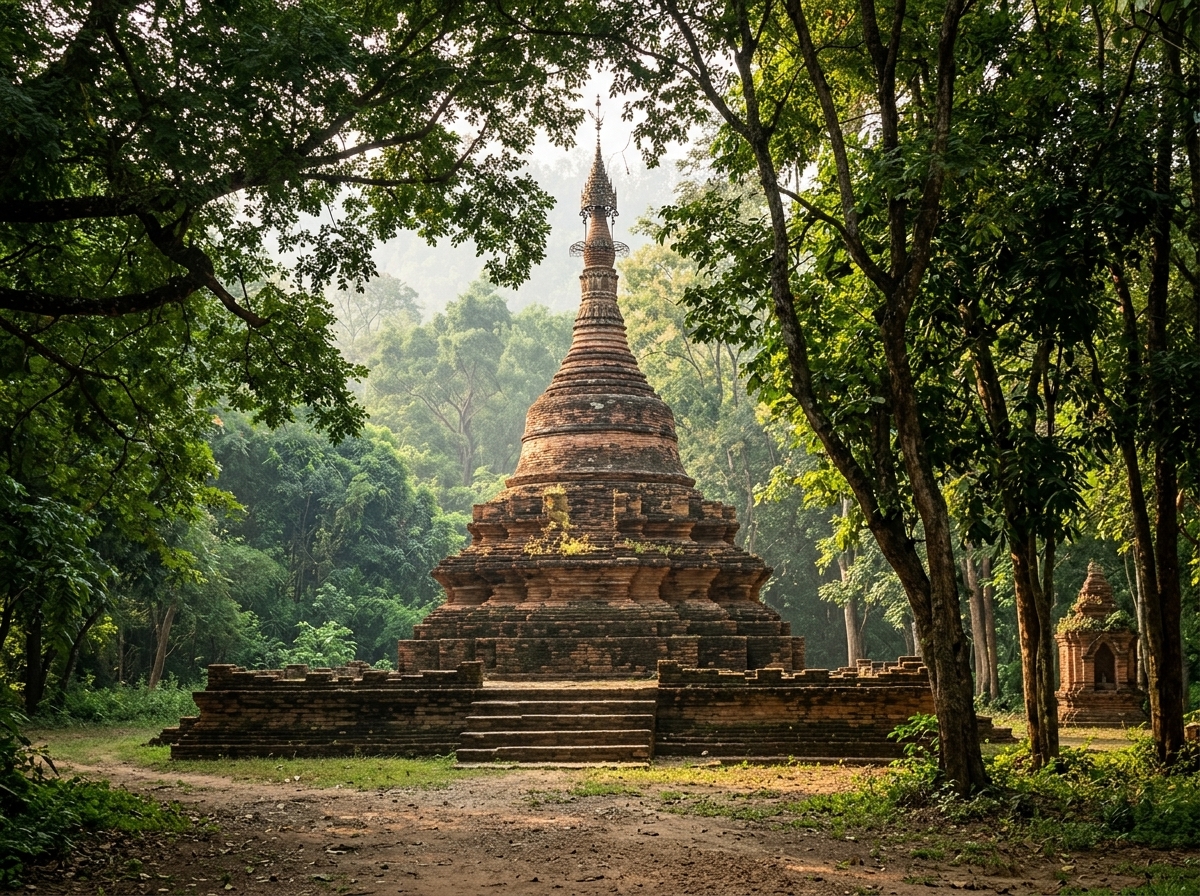
The birth of Chiang Mai was not the unilateral undertaking of a single autocrat; it was the triumph of an extraordinary geopolitical partnership known as the "Tripartite Royal Alliance". King Mangrai the Great—descended from the ancient ancestral line of Pu Chao Lao Chok of Hiranya Nakhon Ngoen Yang—summoned his two sworn blood brothers: King Ramkhamhaeng the Great of Sukhothai and King Ngam Mueang of Phayao. Convening on the pristine western floodplains of the Ping River beneath the protective shade of Mount Suthep, the three sovereigns jointly analyzed the landscape, identifying the "Seven Auspicious Omens" (Supphanimit Mongkol) that presaged an unconquerable seat of empire.
The Phongsawadan Yonok and the Chiang Mai Chronicles record the foundational astrological configuration with chronological precision: the first boundary stakes were driven into the soil at dawn on Thursday, the 8th waxing day of the 6th lunar month (8th northern month), Year of the Monkey, C.S. 658, corresponding to 1296 CE (B.E. 1839). Mobilizing a massive labor corps, the moats, earthen ramparts, fortified brick gates, royal palaces, and market grids were constructed concurrently across all four cardinal directions, achieving full architectural completion in a remarkable four months. Following three days and nights of consecration festivals, the capital was formally invested with its ceremonial title: "Nop Buri Si Nakhon Ping Chiang Mai".
Decoding the Triple Toponym
The full ceremonial name represents a multifaceted historical, mythological, and geographic synthesis:
"Nop Buri" (City of the Nine Clans): The Tamnan Suvanna Kham Daeng preserves an indigenous substrate memory predating Tai hegemony. The supreme deity Sakka instructed the ancient Lawa (Lua) rulers to uphold the Five Precepts to ward off ecological and moral decay, entrusting three subterranean wells of miraculous wealth—the Silver Well, the Gold Well, and the Crystal/Gem Well—to nine ancestral Lawa clans. Thus, the settlement was immortalized as "Nop Buri" (Nop = Nine).
"Nakhon Ping": Linguistic evidence demonstrates that "Ping" (the perennial river artery) was phonetically aspirated in formal classical orthography to "Phing", reflecting regional dialectal shifts where labial stops "P" and "Ph" interchange.
"Chiang Mai" (The New City): King Mangrai was a relentless city-builder throughout his expansive career: founding Chiang Rai (1262 CE), consolidating Fang, subjugating Hariphunchai (1281 CE), and constructing Wiang Kum Kam. Because seasonal floods of the Ping River repeatedly devastated Wiang Kum Kam, Mangrai abandoned the lowland floodplain, establishing a flood-proof urban center on elevated alluvial terraces beneath Mount Suthep. The populace naturally christened it Mueang Mai or Chiang Mai ("The New Walled City").
The Dynastic Continuum of the House of Mangrai (1296–1558 CE)
Following its consecration, Chiang Mai became the undisputed military, political, and cultural hub of mainland Southeast Asia. The House of Mangrai occupied the golden throne across 262 continuous years, spanning between 15 and 18 dynasts (reflecting slight historiographical variances between the Pali Jinakalamali and vernacular chronicles).
The lineage flowed from King Mangrai through Chaiyasongkhram, Saenphu, Khamfu, Phayu, Kuena (who consecrated Wat Suan Dok), Saenmueangma, and Samfangkaen, culminating in the imperial zenith of King Tilokaraj—the emperor who commissioned Wat Chet Yot and convened the 8th World Buddhist Council—before the dynasty finally succumbed to the Burmese armies of King Bayinnaung during the reign of Queen Wisutthithewi in 1558 CE.