











Chapter 4: The Miracle of the Twin Relics: The Mottama Embassy, the Consecration of Wat Suan Dok, and the Genesis of Doi Suthep
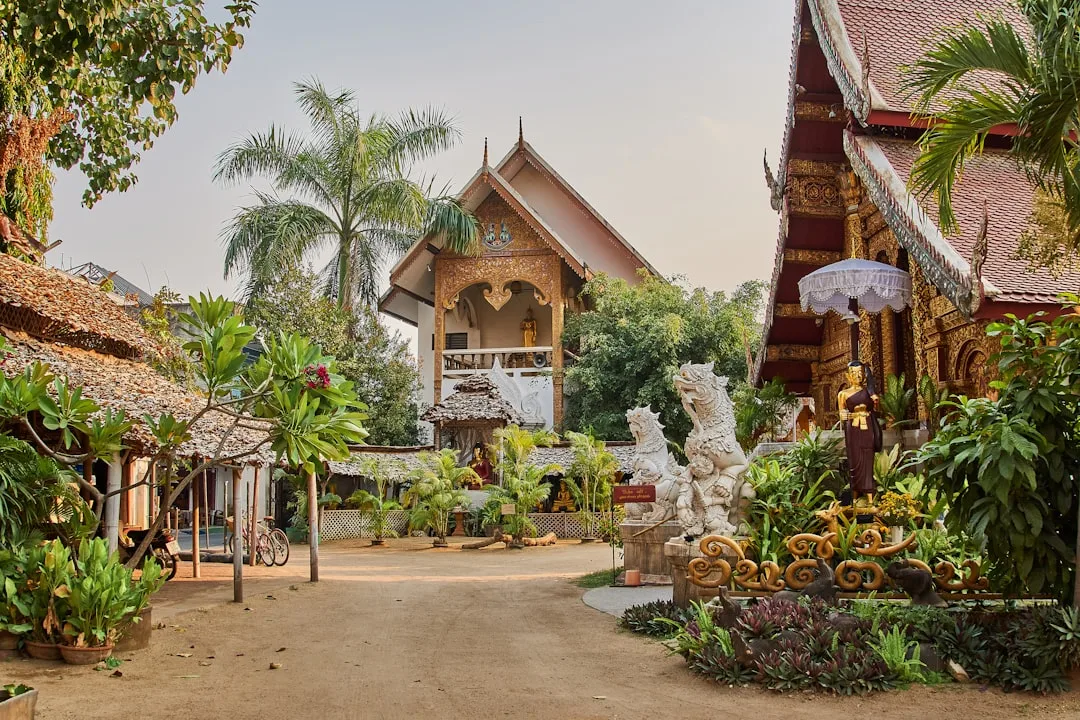
Wat Suan Dok Ch. 4: The Mottama embassy, the spontaneous division of the twin relic, and the sacred foundations of Wat Suan Dok and Doi Suthep.
1. The Royal Embassy to Mottama and the Invitation of Sumana Thera
Driven by an unyielding determination to establish an authentic, purified monastic order in his realm, King Kue Na Dhammikaraja of Chiang Mai received reports regarding the profound spiritual authority of Phra Udumbara Puppha Mahaswami, the supreme prelate of the reformed Lankavamsa forest tradition residing at Mottama (Martaban) in Lower Burma. Resolving to import this uncorrupted lineage, King Kue Na dispatched a high-ranking ministerial envoy, Muen Ngoen Kong, accompanied by the devout, white-robed lay ascetics Pa Khao Rot and Pa Khao Sai. Carrying royal credentials and formal tribute, the embassy crossed perilous mountain ranges to petition the Mahaswami to establish his order in the northern capital.
Upon receiving the mission, the aging Udumbara Puppha Mahaswami explained that his advanced years precluded an arduous overland expedition. Instead, he delegated a delegation of ten fully qualified Mon monks headed by Phra Ananda, accompanied by several novices and attendants, to travel to Lanna. When the Mon mission arrived in Chiang Mai, King Kue Na received them with imperial honors, accommodating the delegation at Wat Lokamoli—then an abandoned monastic enclave situated outside the northern city moat.
However, when King Kue Na formally invited the Mon elders to establish a consecrated boundary (sīmā) and perform higher ordinations (upasampadā) for northern novices, the Mon monks revealed a remarkable truth: "May the Great King be informed: our prelate, Udumbara Puppha Mahaswami, has already authorized Phra Maha Sumana Thera—the venerable scholar from Sukhothai who received re-ordination in our sea-girt monastery—to lead and establish the Lankavamsa order in this land. The ten of us were sent merely to ascertain the depth of Your Majesty's royal faith. If Your Majesty desires canonically valid ordinations, dispatch an embassy to Sukhothai and invite Phra Sumana to preside as preceptor!"
Enlightened by their declaration, King Kue Na immediately re-commissioned Muen Ngoen Kong, Pa Khao Rot, and Pa Khao Sai to journey south to the royal court of Sukhothai. The embassy carried diplomatic missives to King Li Thai (Mahathammaracha I), invoking the ancestral alliance forged between King Mangrai and King Ram Khamhaeng. King Li Thai graciously acceded to the request. Entrusting the administration of Wat Ambavarama to his senior disciple Phra Nandaka, Phra Maha Sumana Thera took his nephew, Novice Kassapa, and set forth toward Lanna in 1369 CE (B.E. 1912 / C.S. 731).
2. Riverine Ordinations and the Consecration of Wat Phra Yuen
When the sacred caravan reached the northern frontiers, King Kue Na personally led his retinue to receive the elder at Tambon Saen Khao Ho, escorting Sumana Thera to reside at Wat Phra Yuen (The Monastery of the Standing Buddha), situated east of Hariphunchai (Lamphun).
At Wat Phra Yuen, Sumana Thera and the ten Mon monks established a floating water boundary (udakakkhēpa sīmā) anchored upon the Mae Ping (Rawaming) River near Wat Chanthano. There, Novice Kassapa, having reached the required age of twenty, received the first valid Lankavamsa higher ordination on northern soil, followed by scores of local novices from Lamphun and Chiang Mai. Subsequently, King Kue Na and Sumana Thera renovated Wat Phra Yuen, casting four monumental standing bronze Buddhas to face the four cardinal directions within its sanctuary. In profound gratitude, the king elevated Sumana Thera to the supreme ecclesiastical dignity of Phra Maha Sumana Ratana Puppha Swami.
During this period, Sumana Thera unveiled the sacred relic he had excavated from Pang Cha, presenting it before King Kue Na while narrating the divine vision and the excavation. Overcome with faith, King Kue Na performed a solemn water lustration. The moment the scented water enveloped the coral crystal casket, the relic levitated above the water's surface, emitting a radiant golden luminescence while circumambulating clockwise. The sky darkened, and a miraculous, gentle rain shower descended upon the assembly, prompting thunderous chants of Sadhu from the weeping court.
3. The Vision of the Royal Lotus and the Founding of Wat Buppharam
King Kue Na had initially planned to construct the principal monastery at the sandy banks of the Mae Kha River (Suan Sai Mae Kha). However, a guardian deva appeared in a dream, declaring that the royal Payom flower garden (Suan Dok Mai Phayom)—an ancestral pleasure park preserved since the reign of King Mangrai—provided a far superior sanctuary for contemplative forest monks. The king and Sumana Thera surveyed the fragrant grove; the elder pronounced it an incomparable site for ascetic meditation.
Shortly thereafter, King Kue Na experienced a second auspicious dream: "In the very heart of the Payom flower garden, a colossal royal lotus—vast as the wheel of a royal chariot—burst into full, fragrant bloom, encircled by a retinue of smaller blossoming lotuses."
Interpreting this as a divine mandate, King Kue Na mobilized royal architects and laborers to clear the Payom grove, establishing a vast enclosure measuring 331 wah in length by 311 wah in width, deliberately proportioned after the legendary Jetavana Mahavihara built by Anathapindika for the Buddha in Savatthi. Construction began in 1371 CE (B.E. 1914 / C.S. 733) under the canonical Pali name Wat Buppharam (pupphārāma, "The Flower Garden Monastery"), known colloquially as Wat Suan Dok. A residential kuti was built for Sumana Thera in the northeastern sector, while the main consecration boundary (sīmā) was pegged in the southeastern sector, directly where the giant lotus had appeared in the royal vision.
4. The Miracle of the Twin Relics and the Foundation of Doi Suthep
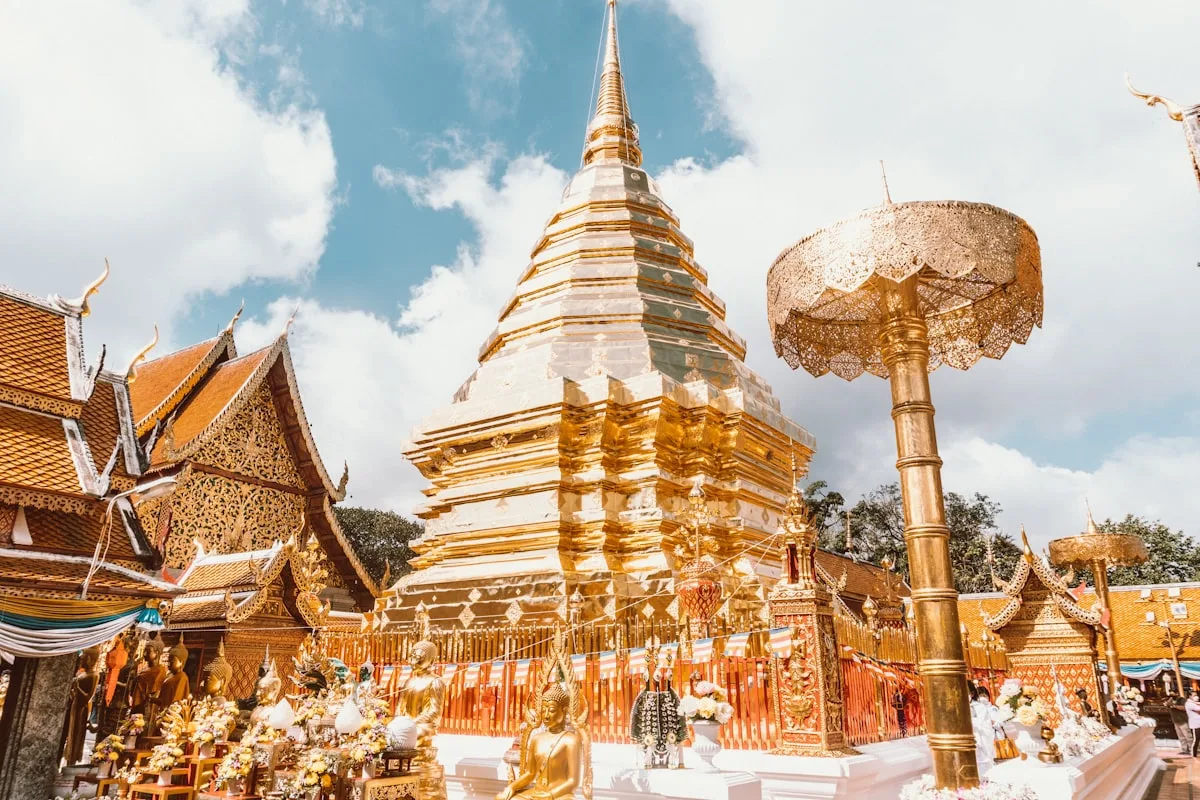
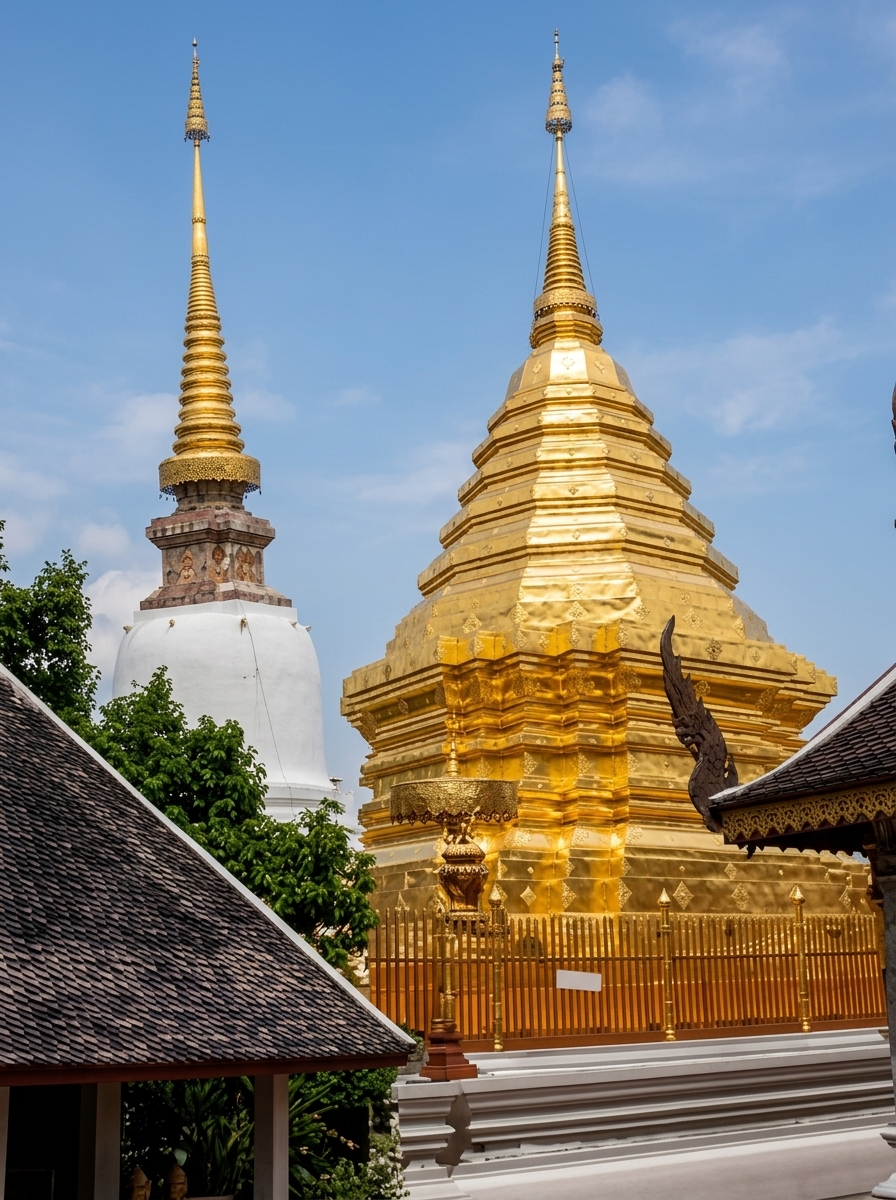
In 1373 CE (B.E. 1916 / C.S. 735), the king and Sumana Thera erected the Great Relic Cetiya, soaring 24 wah (48 meters) in height, its gilded pinnacle shaped like an unopened lotus bud to reflect the monarch's dream.
Prior to the final sealing, the relic was placed within a golden bowl for a final ceremonial lustration. At that instant, an astonishing cosmic wonder occurred: the relic blazed with blinding radiance, floated upon the water, and spontaneously divided into two distinct relics! (Ancient chronicles record that multiple sparks of white, gold, and mother-of-pearl danced upon the surface). When lifted from the water, two fully formed, identical relics lay side by side, matching perfectly in mass, hue, and spherical perfection.
King Kue Na and Sumana Thera enshrined the first relic within the fivefold nested reliquary (coral crystal, gold, silver, brass, and stone), lowering it into the central subterranean crypt of the Great Cetiya at Wat Suan Dok, encircled by seven subsidiary stupas and arched brick enclosures. Furthermore, King Kue Na dismantled his personal timber palace (Ratcha Ruean Luang), utilizing its massive seasoned teak columns to erect the Great Vihara Luang, where he consecrated the monumental life-sized bronze icon, Phra Chao Kha Khing, in 1373 CE.
The second twin relic was retained in the royal palace for veneration until 1384 CE (B.E. 1927 / C.S. 748). On the auspicious Visakha full moon, King Kue Na and Sumana Thera secured the relic inside an ornate howdah strapped to the back of a consecrated royal white elephant (Khotchalak Mangkhala Hatthi). The monarch uttered a solemn vow, releasing the beast to select its own sanctuary. The elephant ascended the untamed slopes of Doi Suthep, reached the mountain crest, circumambulated the summit three times, knelt down, trumpeted three times, and peacefully expired. Over that exact spot, King Kue Na erected the stupa of Wat Phra That Doi Suthep. From that pivotal moment, Wat Suan Dok and Wat Phra That Doi Suthep became venerated as the eternal "Brother and Sister Sanctuaries" of northern Thailand.
5. Sunset of an Era and the Abbatial Legacy
With the completion of Wat Suan Dok and Doi Suthep, the Lankavamsa order became firmly anchored across northern Southeast Asia. Hundreds of scholar-monks from Kengtung, Sipsongpanna, Chiang Saen, Phayao, Lampang, and Nan converged upon Wat Suan Dok to master canonical Pali and vinaya discipline.
King Kue Na Dhammikaraja passed away in 1385 CE (B.E. 1928), succeeded by his son King Saen Mueang Ma and later his grandson King Sam Fang Kaen. Phra Maha Sumana Thera continued his sacred ministry as the First Sangharaja of Lanna, dwelling at Wat Suan Dok for 18 rainy seasons across the reigns of three successive monarchs, until his peaceful demise in 1388 CE (B.E. 1931 / C.S. 750). He left behind a transformed spiritual realm and a pair of twin golden cetiyas whose spires continue to pierce the northern skies.
Learn more: Doi Suthep Complete Guide — Beyond the 309 Steps