












Chapter 5: The Majesty of Phra Chao Kao Tue and the Crucible of War: The Golden Age of Sacred Bronzes, the Red Sandalwood Icon, and Two Centuries under Burmese Shadow
Wat Suan Dok Ch. 5: The casting of the 9-ton Phra Chao Kao Tue bronze, the Pa Daeng monastic schism, and two centuries of war under Burmese conquest.
1. Wat Suan Dok under King Sam Fang Kaen and the Great Lankavamsa Schism
Following the death of Phra Maha Sumana Thera in 1388 CE (B.E. 1931), the monastic line of Wat Buppharam (Suan Dok) governed the northern Sangha into the reign of King Sam Fang Kaen (r. 1402–1441 CE / B.E. 1945–1984). A generous patron of the order, Sam Fang Kaen supported four successive great elders: Sumana Thera, Mahakassapa (an ascetic who retired to the foothills of Doi La-wae to escape the urban noise of the expanding capital), Mahanandapanya (who reconstructed and expanded the consecrated boundary stones of the Ubosot), and Mahabuddhagambhira.
Yet during this very epoch, an ecclesiastical crisis fractured northern Thai Buddhism. Around the 1420s, an elder of Wat Buppharam named Phra Siladanta, accompanied by three disciples, traveled to Sri Lanka to venerate the sacred Tooth Relic. Upon returning to Chiang Mai, Siladanta declared before an assembly at Wat Chedi Luang (Wat Choditaram) that the senior monks of the Mahavihara in Ceylon had examined their northern monastic customs and condemned them as defective and non-compliant with the authentic Vinaya!
This declaration galvanized a brilliant young Chiang Mai aristocrat-monk named Phra Mahayanagambhira (son of Phan Tao Saeng, a chief minister to King Sam Fang Kaen). Mahayanagambhira led a reformist faction to Ceylon to undergo rigorous re-ordination, returning to establish the "New Lankavamsa Order" (commonly known as the Wat Pa Daeng Lineage) at Wat Rattanamahavihara (Wat Pa Daeng Luang). This triggered decades of intense theological dispute between the established "Suan Dok Order" (the original Lankavamsa introduced by Sumana Thera) and the reformist "Pa Daeng Order" over the absolute validity of ordination boundaries (sīmā) and scriptural pronunciation.
2. The Era of Tilokaraj and Yot Chiang Rai: Doctrinal Settlements
When King Tilokaraj (r. 1441–1487 CE) ascended the throne, he acted decisively to maintain Wat Suan Dok's prestige. In 1447 CE (B.E. 1990 / C.S. 808), he invited the celebrated Pali philologist Phra Mahabuddhadicca Thera from Wat Mahawan in Lamphun to assume the abbotship. A fierce debate had erupted within the Sangha: Was it canonically permissible for unordained novices on the threshold of adulthood to study and memorize the Patimokkha rules prior to their higher ordination? While Mahanyanasakhon protested against the practice, Buddhadicca argued that preparatory memorization ensured clerical purity. King Tilokaraj endorsed Buddhadicca's ruling, establishing the definitive northern standard permitting preparatory Patimokkha recitations. Buddhadicca governed Wat Suan Dok for twelve rainy seasons until his death at age 66.
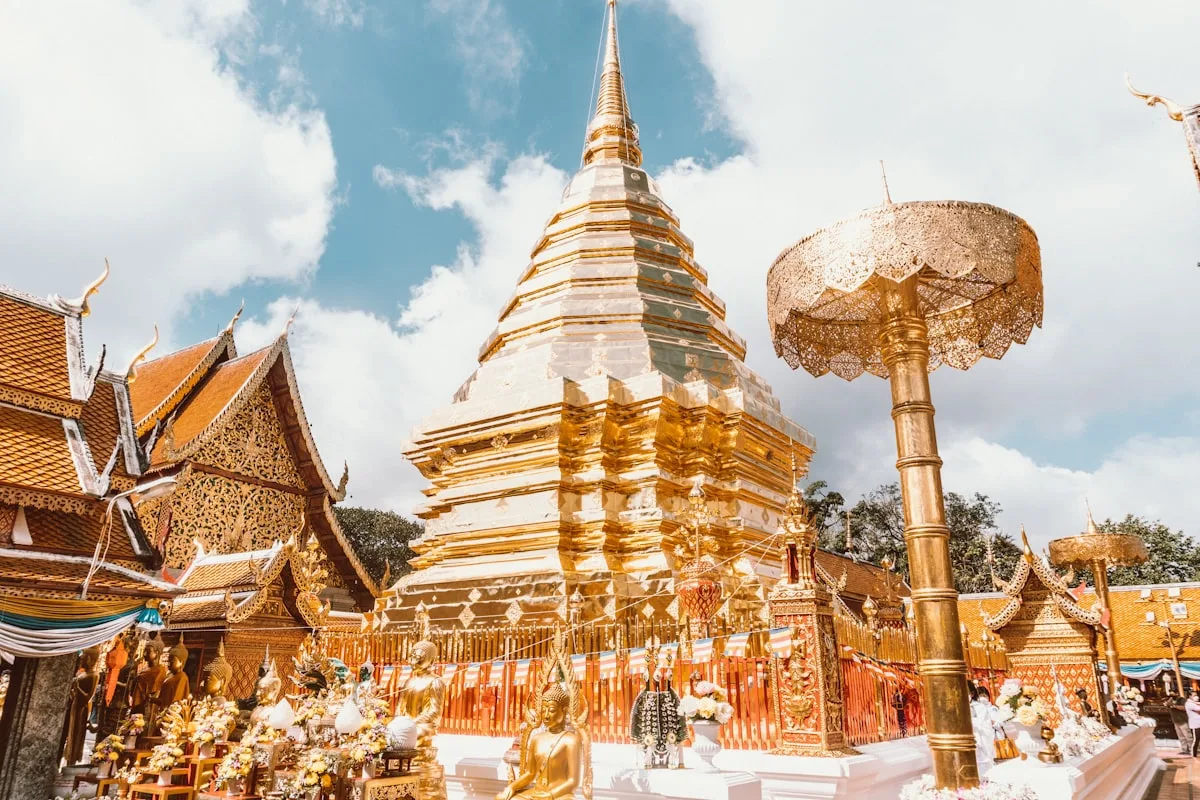
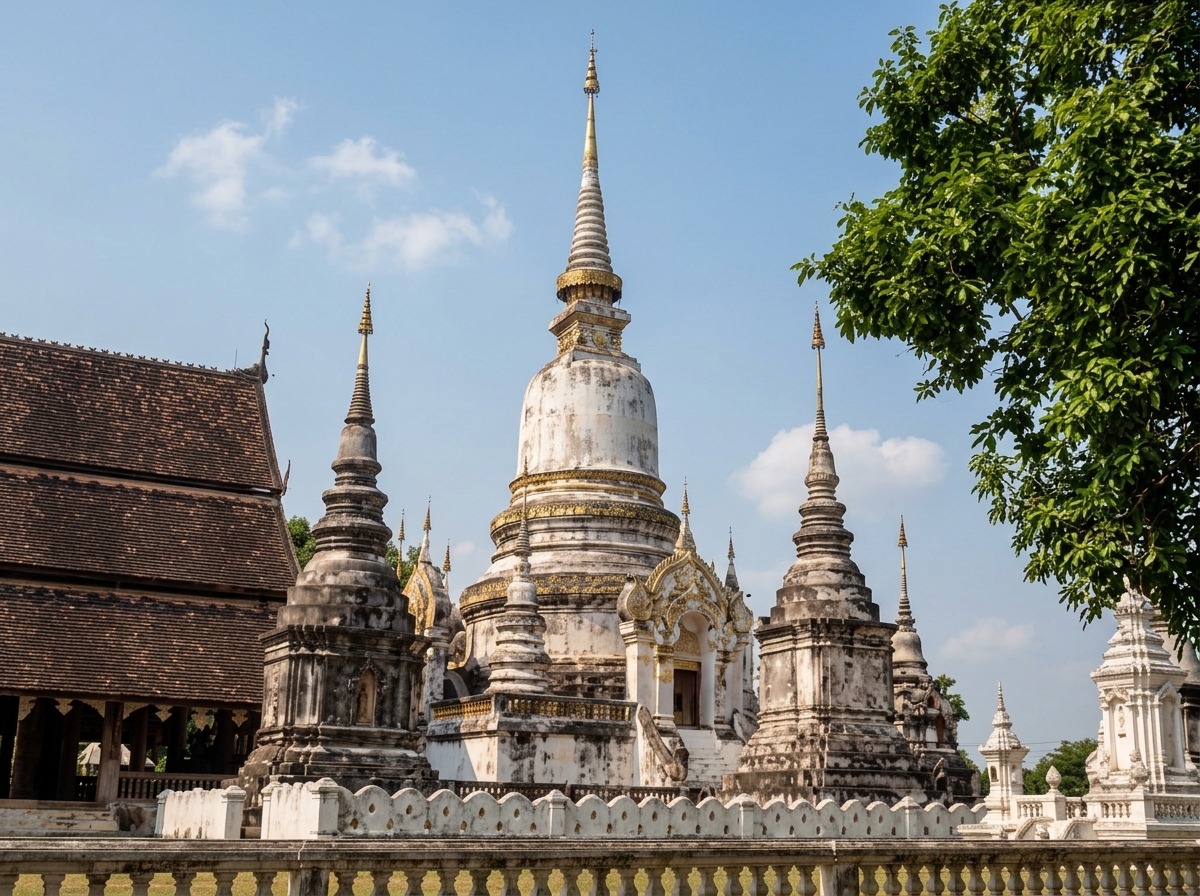
In 1475 CE (B.E. 2018), Tilokaraj appointed Phra Mahanakasena from Wat Saen Fang as abbot. In 1477 CE (B.E. 2020 / C.S. 839), the king demonstrated his imperial devotion by completely encasing the Great Cetiya of Wat Suan Dok in heavy, beaten gold sheeting. Under his successor, King Yot Chiang Rai, the abbotship was entrusted in 1480 CE (B.E. 2023) to Phra Mahakuphamyana Sakhon of Wat Muen San, who governed the monastery for ten years.
3. The Golden Epoch of King Mueang Kaeo: The Casting of Phra Chao Kao Tue
Under King Siri Dhammacakkavatti Tilokaraja (Phra Mueang Kaeo) (r. 1495–1525 CE / B.E. 2038–2068), the eleventh monarch of the Mangrai Dynasty, Wat Suan Dok attained its zenith as a center of bronze metallurgy, architecture, and classical literature. In 1490 CE (B.E. 2033), the king appointed Phra Mahapurithewa (Silathewa), an erudite chronicler who compiled the famous chronicle of 28 Buddha relics across Lanna. In 1498 CE (B.E. 2041), the monarch erected the royal palace of Ho Monthian Tham within the temple grounds to serve as an imperial scriptorium housing the Pali Tripitaka.
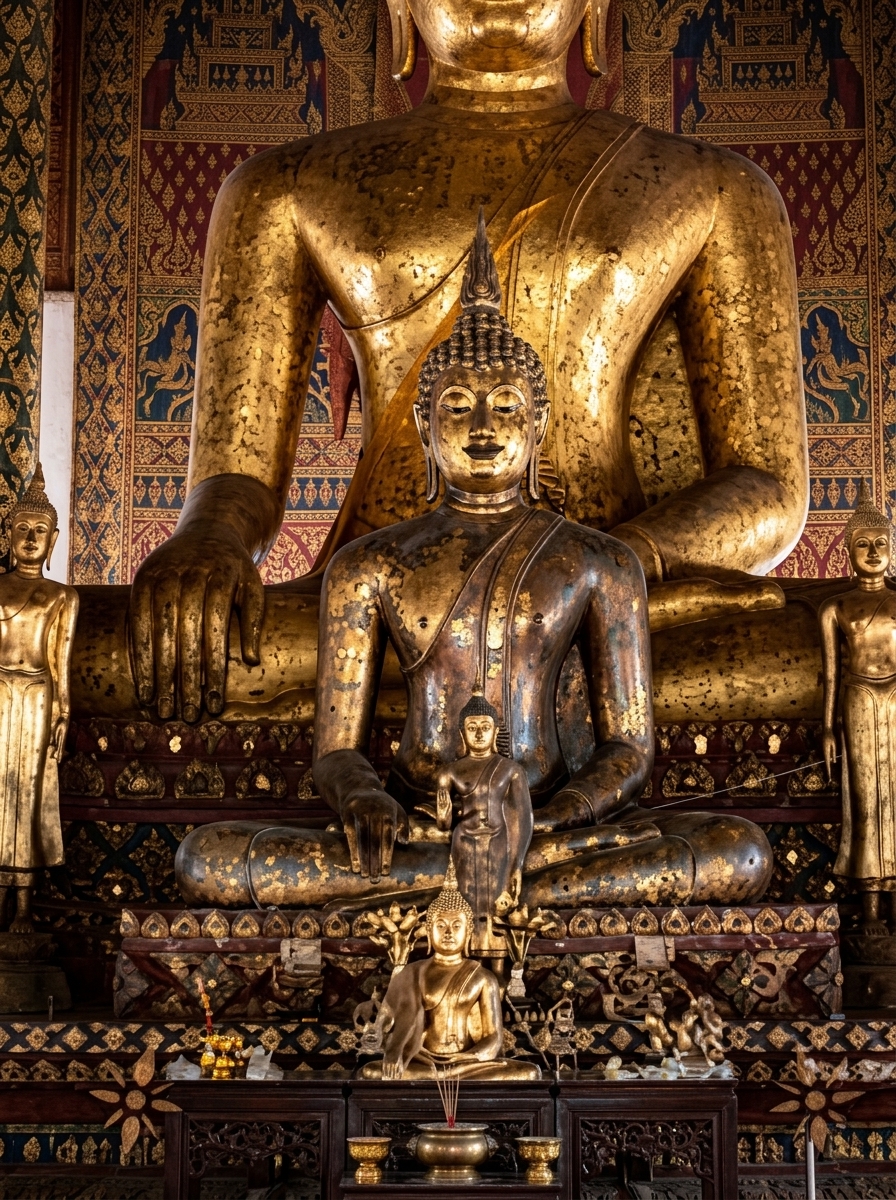
The Casting of Phra Chao Kao Tue (1504–1509 CE): The crowning artistic triumph of northern Thai civilization occurred on Thursday, the 8th waxing day of the 3rd lunar month, 1504 CE (B.E. 2047 / C.S. 866), under the auspicious Punnavasu lunar mansion. King Mueang Kaeo presided over the casting of a colossal bronze Maravijaya Buddha image using nine tue of refined alloy (in classical Lanna metrology, one tue represents 10,000 muen / 10,000,000 weight units, translating to roughly nine metric tons of solid bronze). Measuring 3.0 meters across the lap and 4.70 meters in height, the statue synthesized the regal fullness of the Chiang Saen school with the fluid lines of classical Sukhothai. Cast in nine interlocking sections, master goldsmiths and polishers labored for five continuous years to burnish its surface until its completion in 1509 CE (B.E. 2052).
Originally, King Mueang Kaeo intended to enshrine this monumental icon as the presiding image of Wat Phra Singh within the walled capital. However, when the time came to transport the colossal sculpture, its immense width and tonnage made it physically impossible to navigate through the gates of Chiang Mai's city walls! Royal astrologers and ministers interpreted this impasse as a divine sign that the icon had chosen its own sanctuary outside the ramparts. The king consequently enthroned it inside the grand Ubosot of Wat Suan Dok. A lavish consecration ceremony was attended by 1,000 senior monastics, who formally bestowed upon King Mueang Kaeo the imperial title Phra Chao Siri Song Tham Chakkraphatdiraj (The Universal Sovereign Upholder of the Sacred Law).
In 1521 CE (B.E. 2064), when diplomatic envoys from the Siamese Kingdom of Ayutthaya arrived in Chiang Mai, King Mueang Kaeo ordered the legendary Phra Kaen Chan Daeng (The Red Sandalwood Buddha, an antique image sculpted from sacred fragrant wood) brought from Phayao to Wat Suan Dok so the Ayutthayan emissaries could pay homage, before it was transferred in 1526 to Wat Chet Yot.
4. The Crucible of War: Two Centuries of Burmese Rule and the Deserted City
The artistic and religious renaissance of Lanna was shattered in 1558 CE (B.E. 2101 / C.S. 920) when the imperial armies of the Taungoo Empire, led by the Burmese conqueror King Bayinnaung, captured Chiang Mai. The independent sovereignty of the Mangrai Dynasty was extinguished; Lanna was transformed into a militarized tributary buffer state torn by unending rebellions.
While enlightened Burmese sovereigns such as King Thalun (Sado Dhammaraja) of Ava visited Chiang Mai in 1644 CE (B.E. 2187) to sponsor the ordination of 1,000 monks and consult with the 80-year-old Supreme Patriarch of Wat Suan Dok, Phra Sangkhati Pale, regarding ancient Lanna administrative customs, the monastery steadily decayed amidst the crossfire between Burma, Siam, and regional warlords.
The final catastrophe unfolded in 1778 CE (B.E. 2321 / C.S. 1140). Following a brief uprising in which local patriot Chao Thepsing expelled the Burmese garrison from Chiang Mai, a faction of 300 Burmese and Mon soldiers conspired to overthrow him. They approached Chao Ong Kham (Ong Nok), an exiled prince of the Luang Prabang royal dynasty who was living as an ordained monk at Wat Suan Dok. Persuading him to disrobe and take command, Ong Kham seized power, driving out Thepsing and ruling Chiang Mai for 31 years before ultimately resubmitting to Burmese overlordship.
Decades of relentless warfare scorched the Chiang Mai basin. Monasteries were pillaged, sacred palm-leaf manuscripts burned, and the civilian population dispersed or carried away into captivity. Wat Suan Dok—once the radiant royal flower garden monastery—collapsed into an overgrown jungle ruin. The Great Cetiya and the colossal bronze of Phra Chao Kao Tue stood abandoned amidst dense elephant grass and creeping banyan vines, while the entire city of Chiang Mai was officially abandoned as a silent, depopulated "Deserted City" (Mueang Rang) for more than twenty years!