★ 9.4/10 EXCEPTIONAL ON AGODA & BOOKING.COM • ROYAL FLORA RATCHAPHRUEK CERTIFIED
Overnight Nature Farmstay • KAS Farmstay
KAS Farmstay (Private Farmstay Tent & Campfire)
Experience a peaceful private farmstay amidst our organic orchards in Lamphun. Cozy tent glamping, evening campfires under starry skies, and organic garden-fresh mookata BBQ. Official online booking is now live.
A collection of translated rare books on Lanna history and culture
Terra Lanna is gathering and translating rare books on Lanna history, beliefs, and way of life — preserving these stories and sharing them with readers everywhere.
Sort by:
Listen to Lanna Stories
Translating and gathering books — coming soon
Contact Us
Talk to us, or share your feedback to help us improve and grow.
Our Hotel
NampiangdinBoutique Hotel
4-Star Lanna Boutique Hotel in the Heart of Chiang Mai
★★★★ 4-Star Boutique46 Rooms15 Min from AirportFree Airport Transfer
Nampiangdin Boutique Hotel is a 4-star boutique property blending ancient Lanna architecture with modern comfort. Located in central Chiang Mai, 15 minutes from the airport, with a warm atmosphere, heartfelt service, a lush garden, outdoor pool, and a restaurant featuring local ingredients.
Rooms
Choose the ExperienceThat's Right for You
All rooms feature a private balcony, pool view, AC, free WiFi, minibar, and breakfast included
Sorted by guest review score — prices updated daily
Active & Available in Chiang Mai
Your Eyes, Ears & Boots on the Ground in Chiang Mai
Moving, investing, or sourcing in Northern Thailand? We provide what no remote tool or overseas agency can ever match: genuine local presence, native northern dialect negotiation, and zero-bias on-site execution.
Why Technology Cannot Replace Local Boots on the Ground
Overseas expats, digital nomads, and remote investors face significant friction when managing property or sourcing in Northern Thailand. Having trusted on-the-ground representation eliminates risks, protects your budget, and gives you total peace of mind.
Common Pitfalls of Managing Remotely
Misleading Listings: Online photos are frequently edited or years out of date. In reality, properties may have hidden mold, weak water pressure, noisy air-conditioning, or loud construction right outside your window.
Unwarranted Price Markups: Without local Thai and Northern dialect negotiation skills, foreigners often face inflated quotes—paying 20%–40% above true local market rates for rent, contractor labor, and artisan craft manufacturing.
Unreliable Wi-Fi Claims: Landlords routinely advertise 'high-speed internet' that turns out to be congested shared building Wi-Fi with high latency, dropping client Zoom calls and disrupting remote work.
Zero On-Site Emergency Recourse: When an air conditioner leaks, plumbing bursts, or a guest locks themselves out late at night, remote coordination across time zones is stressful and ineffective.
The Terra Lanna Advantage
Objective High-Definition Video Inspections: We physically inspect every corner of the property, testing plumbing pressure, air-con odor, noise decibels, and surrounding neighborhood conditions without bias.
Direct Native & Northern Dialect Negotiation: We speak fluent Thai and Kam Mueang directly with landlords, technicians, and workshop owners—securing authentic, fair local terms and lease conditions.
Certified On-Site Speedtests: We plug in directly to run certified Ookla Speedtests (measuring ping latency, jitter, download, and upload speeds) before you commit to any rental deposit.
Trusted Keyholding & Urgent Dispatch: Permanently stationed in Chiang Mai, ready to handle emergency lockout rescues, supervise contractors, and deliver structured photo/video reports directly to you.
Our 4 Core Capabilities
What Overseas Clients Hire Us to Do
Four specialized on-the-ground services tailored for expats, remote entrepreneurs, Airbnb owners, and international media agencies.
For Nomads & Expats
Local Fixer & Personal Assistant
Your personal problem solver in Chiang Mai. Whether you are landing soon or already living here, we eliminate bureaucratic stress, rental headaches, and language barriers.
Core Focus
Condo pre-lease walk-throughs, Wi-Fi stability tests, lease negotiation to kill farang markups, parcel reception, and initial government/immigration logistics guidance.
Key Deliverables
Detailed video walkthrough & timestamped photo inspection
Live Ookla Wi-Fi speedtest (latency, download/upload speeds)
Lease contract review & direct Thai landlord negotiation
Urgent parcel pickup, mail forwarding & local errands
Overseas retailers and interior designers import handcrafted furniture, teakwood, ceramics, and textiles from Chiang Mai artisan hubs. We are your dedicated QC eyes on the workshop floor.
Geographical Advantage
We know the back alleys of Baan Tawai, San Kamphaeng, Bo Sang, Hang Dong, and Mae Rim. We talk directly to carvers and weavers in local dialect, preventing communication errors.
Key Deliverables
In-person workshop & factory visits across Chiang Mai & Lamphun
Foreign investors who own condos or pool villas in Chiang Mai for Airbnb need trustworthy local oversight. We inspect rooms after cleaning, hold emergency keys, and dispatch trusted tradesmen.
Timezone Synergy
We chat and report to you during your evening hours overseas, then execute daytime on-site checkups and maintenance across Chiang Mai during local business hours.
Commercial film crews, YouTube creators, and high-end travelers demand secret, authentic locations away from mass tourist traps. We scout hidden temple grounds, mountain overlooks, and private chef tables.
Exclusive Synergy
Seamlessly paired with Terra Lanna's private farmstead: organic orchard walks, botanical craft liquor workshops, and private campfire dinners in Lamphun.
Key Deliverables
On-site location scouting with lighting notes, acoustics & GPS coords
From initial inquiry to completed mission in 4 simple steps.
01
1. Send Your Brief
Share your requirements, links, or address via email or the booking form below.
02
2. Action Plan in 2 Hours
We confirm feasibility, provide an exact upfront quote, and schedule the on-site mission.
03
3. On-The-Ground Execution
We drive directly to the property, factory, or location with our equipment and live status updates.
04
4. Comprehensive Report
You receive comprehensive video walkthroughs, speedtest stats, defect photos, and our honest local recommendations.
Request a Fixer or Property Inspection
Tell us what you need done on the ground in Chiang Mai. We reply within 2 hours during active daytime hours.
Frequently Asked Questions
Everything You Need to Know
Online listings in Thailand frequently feature stale photos, hidden structural/mold defects, or inflated 'Farang' prices (20%–40% above local rates). Without speaking northern Thai or being physically present to smell the room, test the water pressure, and check for noisy construction, you risk getting trapped in an inflexible 12-month lease. We serve as your unbiased on-site representative.
We cover all major expat and residential districts: Old City (Sri Phum, Phra Sing), Nimmanhaemin, Santitham, Jed Yod, Chang Phueak, Chang Khlan / Night Bazaar, Wat Gate / Riverside, Mae Hia, Hang Dong, San Kamphaeng, Doi Saket, and Mae Rim. We also travel to Lamphun artisan workshops upon request.
Standard requests are completed within 24–48 hours. Urgent same-day emergency callouts can often be accommodated depending on current schedule. Contact us via email (terralanna67@gmail.com) for rapid dispatch.
We bring a laptop and mobile testing kit directly to the unit. We connect to the actual in-room router and run certified Ookla Speedtests measuring ping latency, jitter, download Mbps, and upload Mbps. We also check 4G/5G mobile signal backup coverage inside the room.
Never. Terra Lanna maintains a zero-kickback, zero-commission policy. When negotiating rent or product costs, 100% of the discount goes directly to you. You pay us solely for our time, expertise, and transparent on-the-ground service.
We accept Wise (formerly TransferWise), standard international bank wire transfer, Thai PromptPay / QR bank transfer, and major credit cards via Stripe.
Ministry of Education and Ministry of Interior, via the Fine Arts Department, with Chiang Mai Province · 1999 CE (B.E. 2542) · Chiang Mai
Chapter 3 (I): Natural Heritage & Temples
Chiang Mai's forests, flora, fauna, and minerals, plus the first set of temples in the province's heritage catalog.
Natural Heritage
Chiang Mai is a city richly endowed with forests and mountains, a location well suited to ancient settlement — a broad plain with the Ping River flowing through it, ringed by steep mountains abundant in many varieties of trees.
The Mae Ping watershed covers an area of approximately 9,262,95 rai and comprises nine major waterways: the Mae Ping, Mae Daeng, Mae Khan, Mae Wang, Mae Klang, and Mae Chaem streams, while to the east lie the Mae Kuang and Mae Ngat streams. Most of the significant mountainous areas consist of tropical forest, which can be classified as follows.
Forests
Classified as follows:
Deciduous forest consists mainly of tree species that shed their leaves entirely in the dry season and put out new leaves at the start of the rainy season. It occurs at elevations not exceeding 1,000 meters above sea level, in a fairly dry climate with rainfall of approximately 800–1,500 millimeters, on sandy loam, gravelly, or lateritic soil. It divides into two types:
- Mixed deciduous forest covering approximately 9,554.63 square kilometers, or 6,221,637.50 rai — deciduous forest in which nearly every species sheds all its leaves, leaving only bare branches, in order to reduce water loss. - Dry dipterocarp forest (also called red forest, pa phae, or pa khok) covering approximately 2,249.77 square kilometers, or 1,423,543.20 rai — open forest in which the trees are generally small and short, found throughout both lowland and upland areas; the soil in general is not very fertile.
Chiang Mai province has 25 national reserved forests covering 9,555.83 square kilometers, or 16,222,954.78 rai, within which 6 national parks, 3 wildlife sanctuaries, 2 non-hunting areas, 3 botanical gardens, and 2 arboretums have now been designated, as detailed in Tables 1–6.
Table 1: Forest Area Remaining in Chiang Mai Province by Year
| No. | Garden | Location | Area (rai) | |---|---|---|---| | 1 | Queen Sirikit Botanic Garden | Mae Rim District | 6,500 | | 2 | Northern Literature Botanical Garden | Mueang District | 1,000 | | 3 | 60th Anniversary of Her Majesty the Queen Northern Forest Species Garden | Mueang District | 160 | | 4 | Huai Kaeo Arboretum | Mueang District | 50 | | 5 | Cold-Climate Species Arboretum | Hot District | 50 |
Table 3: National Reserved Forests in Chiang Mai Province (25 forests, covering districts throughout the province — Mae Ping, Mae Taeng, Mae Ngat, Chiang Dao, Samoeng, Phrao, Mae Rim, Doi Saket, Chom Thong, Fang, Mae Ai, Mae Chaem, Om Koi, and others — each listed with its area under the relevant Ministerial Regulation, regulation number, and Royal Gazette announcement date. Total reserved forest area: 9,554.882 square kilometers, or 16,229,945.87 rai.)
Table 4: National Parks in Chiang Mai Province
| No. | National Park | District | Approximate Area (sq. km) | |---|---|---|---| | 1 | Doi Inthanon | Mae Chaem, Chom Thong | 482.40 | | 2 | Doi Suthep–Pui | Mueang, Mae Rim | 262.50 | | 3 | Mae Ping | Li (Lamphun Province) | 1,000 (including area in another province) | | 4 | Sri Lanna | Chiang Dao, Phrao, Mae Taeng | 614.00 | | 5 | Op Luang | Chom Thong, Hot | 76.50 | | 6 | Huai Nam Dang | Wiang Haeng, Mae Taeng | 7,000 (not yet officially announced at that time) |
Table 5: Wildlife Sanctuaries in Chiang Mai Province
| No. | Wildlife Sanctuary | District | Approximate Area (sq. km) | |---|---|---|---| | 1 | Doi Chiang Dao | Chiang Dao | 521 | | 2 | Omkoi | Omkoi, Doi Tao, Sam Ngao (Tak Province) | 785 | | 3 | Mae Lao–Mae Sae | Mae Taeng | 321 |
Table 6: Non-Hunting Areas in Chiang Mai Province
| No. | Non-Hunting Area | District | Approximate Area (sq. km) | |---|---|---|---| | 1 | Doi Suthep | Mueang | 18.5 | | 2 | Samoeng | Samoeng | 19.5 (in the process of being elevated to wildlife sanctuary status) |
Plant Species
Classified by forest type, important tree species are found at every layer of the forest canopy, from the uppermost canopy trees (such as those of the genera Dipterocarpus and Hopea, and wild champa) through the mid-canopy trees (miang luang, miang doi), to the lower shrub layer (khlong khleng, chang daeng), down to ferns and orchids. Plant communities can also be classified by their dominant species, such as the Dipterocarpus tuberculatus–two-needle pine community, the low Dipterocarpus tuberculatus community, the low Shorea obtusa community, and the low two-needle pine community.
Among the important timbers of Chiang Mai province that are well known as products both within the country and abroad are teak, yang (dipterocarp), and rak, as follows.
Teak is a large deciduous tree with a straight, unbranching trunk, often buttressed at the base, and a round crown, reaching heights of 20 meters or more. Teak heartwood ranges from golden-brown (called "sak thong," golden teak) to dark brown. Teak generally grows on hillside soils or on well-drained lowland ground. Teak wood can be put to use in nearly every form according to the age and size of the tree — for house and building construction, furniture, parquet flooring, plywood, carved shipbuilding timber — and it is also used to make attractive, durable mosaic paneling, door frames, and window frames. Teak is classified by the character of its wood into: sak thong (golden teak), sak khi khwai (buffalo-dung teak), sak lai dam (black-streaked teak), sak hin (stone teak), sak khai (waxy teak), and sak yuak (banana-stem teak).
Yang na (Dipterocarpus alatus) is a tree of major economic value to Thailand, widely used in house construction and plywood production, and also exported abroad. Its resin is used to make varnish and wood finish, as well as medicine. Yang na is a large, non-deciduous perennial tree, 30–40 meters tall, with a straight trunk, smooth thick bark, and reddish-brown heartwood.
Rak (Gluta usitata) is found in dry mixed deciduous forest and dry evergreen forest at elevations between 300–1,000 meters above sea level. It is a medium-sized tree, 15–25 meters tall, with a fairly straight trunk and a dense, round, lush green crown; the bark is grayish-brown and fissured. The leaves are simple; the flowers are bisexual, borne in large clusters at the leaf axils near the branch tips; the fruit is round and hard. Rak's useful, dense wood is used for agricultural tool handles and fence posts and house posts; its leaves and roots are used medicinally to treat wounds.
Wildlife
Classified by habitat, as follows:
Upper hill evergreen forest is home to large resident mammals including sambar deer, wild boar, and serow, along with the goral, a mammal characteristic of this forest type. Important birds of this plant community include the rufous-necked hornbill, Mrs. Hume's pheasant, grey peacock-pheasant, black-breasted partridge, and mrs. Hume's pheasant's associated species [translator's note: source text repeats/garbles some bird names here]. Reptiles include the Asian giant tortoise (pulu turtle), impressed tortoise, keeled box turtle, elongated tortoise, and forest gecko.
Dry evergreen forest is an important wildlife habitat nationally, since its environment suits many groups and types of wildlife. Its continuous upper canopy shelters animals that forage well together in the treetops. Important mammals living in this forest type include the white-handed gibbon, pig-tailed macaque, Assamese macaque, stump-tailed macaque, rhesus macaque, northern subspecies of the phayre's leaf monkey (dusky langur), and hog badger, along with the crested gibbon [translator's note: two overlapping gibbon references appear in the source]. Many bird species inhabit dry evergreen forest, both year-round canopy residents and seasonal or occasional visitors; commonly found species include Lady Amherst's pheasant, grey peacock-pheasant, Mrs. Hume's pheasant, red junglefowl, and green peafowl. Reptiles include the elongated tortoise, Malayan snail-eating turtle (or "tao thak"), keeled box turtle, and Asian giant tortoise; amphibians include tree frogs and narrow-mouthed frogs.
Pine forest is home to mammals including the hare and the black-eared giant flying squirrel; birds include red junglefowl, rain quail, great barbet, collared scops owl, and giant nightjar; reptiles include the Asian giant tortoise, high-mountain agamid lizards, and the three-toed mountain skink; amphibians include the crocodile newt and the star-marked narrow-mouthed frog.
Mixed deciduous forest hosts mammals, birds, reptiles, and amphibians, though with less diversity than evergreen forest.
Dry dipterocarp forest, owing to its scarcity of food resources of various kinds, supports less wildlife diversity than other forest types.
Elephants have accompanied Chiang Mai from ancient times to the present. In antiquity elephants were used in warfare; as the kingdom prospered, elephants came to be widely used in logging and other work. The elephant is the largest land animal in the world, with a body-and-head length of 400–600 centimeters, a tail length of 100–150 centimeters, a height of 250–300 centimeters, and a weight of 2,500–5,000 kilograms. Its stout body carries a trunk used for grasping objects; its skin is fairly thick and grey, sparsely covered in fine hairs; its large ears are fanned to help radiate heat. Elephants are male and female: a male with tusks is called a chang phlai; a tuskless male is called a chang si do; a female is called a chang phang; and a female with small, short tusks is called a chang to.
Wild elephants generally travel in herds where grass and water are abundant; where these have historically been scarce, herd numbers may fall to as few as 30–50 animals. The herd is led by the strongest bull, who protects the herd from danger and leads it to feeding grounds. An elephant living apart from the herd is called a "lone bull" (chang thon) and is often more aggressive, preferring mountain areas with streams and watercourses. An elephant drinks roughly 80–100 liters of water a day. Elephants are herbivores, and their daily food intake amounts to about 250 kilograms, consisting of grass, bamboo, and various plants, including bark and mineral licks.
The uses to which Chiang Mai people have put elephants from the past to the present include transportation, warfare, the timber industry, and tourism. In transportation, elephants can travel through forest, across rivers and canals, and up mountains with great agility; when an elephant travels through the forest, a howdah is fitted to its back so a rider can sit and cargo can be loaded, with teak crossbeams no longer than the elephant's own width — around 60 centimeters — carrying roughly 100 kilograms of cargo per animal. An elephant travels at a normal speed of about 4 kilometers per hour, covering roughly 20 kilometers a day.
In the timber industry, foreign logging operations that received teak concessions from the government roughly a hundred-odd years ago typically held concessions of at least two terms of 30 years each per company, with some companies holding three terms of 45 years each. In addition, the government's Forest Industry Organization also logged teak in three forest tracts in Chiang Mai and Lampang provinces, employing thousands of elephants in the work, which provided livelihoods for the people involved and their families. Under forestry management practice, elephants were used to drag logs from areas that were properly spaced apart and had to be reached over long distances; an elephant can walk through the forest without destroying seedlings or saplings, does not compact the soil, and requires no roads to be cut for access. Elephants also have a long working life, up to 40 years, and using elephants to haul logs out of the forest is low-cost, requires no fuel or spare parts, and creates no pollution.
An elephant can work between the ages of 25 and 40 years; after that its strength declines, and it is put to lighter work, such as hauling small logs, until around age 60, when it is retired to graze freely, still monitored by its keeper. An elephant's lifespan is about 100 years, sometimes more. Today, elephants retired from logging work have found new use in tourism — as mounts carrying tourists to view the forest and mountains, and performing demonstrations of elephant work for visitors.
Minerals
Most of Chiang Mai's area is mountainous, composed of many types of rock ranging in age from the Precambrian (roughly 600 million years old) to the Tertiary (roughly 150 million years ago), comprising the following rock types:
- Igneous rock, including granite, basalt, andesite, and other volcanic rock types. - Sedimentary rock, including sandstone, shale, conglomerate, and limestone, among others. - Metamorphic rock, including gneiss, marble, slate, and quartzite, among others.
The formation of these many rock types across multiple geological eras has given rise to deposits of various minerals. Minerals found in Chiang Mai province and already mined for sale include:
- Metallic minerals: tin, scheelite, wolfram, manganese, barite, lead, and antimony. - Non-metallic minerals: fluorite and feldspar. - Natural fuel minerals: coal (lignite) and petroleum. - Industrial rock: construction stone, limestone for lime production, laterite, and sand.
Today it can be said that the people of Chiang Mai draw on nature for benefit in three ways. First, natural resources serve subsistence needs — in the household, wood is used to build houses, make furniture, and craft tools for various activities; wild plants and animals serve as food and as medicine; water is used for household consumption and for agriculture. Commercially, wood and its by-products are used to create local handicrafts such as wood carving, which is one of the important occupations of the people of Chiang Mai.
In recreation and the tourism business, people can travel to enjoy beautiful natural surroundings in both national reserved forests and conservation forests — caves, waterfalls, scenic vistas. Today many tourism operators enjoy great popularity, such as pleasure-boat cruises on the Ping River and Doi Tao Lake, dinner cruises offering views of Chiang Mai city along the Ping River, bamboo rafting on the Mae Taeng River, rubber-raft rafting on the Mae Chaem River, as well as resort-based tourism and resort operations.
In maintaining natural balance and providing water resources for the benefit of the people of Chiang Mai and neighboring provinces, it can be said that this constitutes a heritage that the Chiang Mai people of the past conserved and passed down. The methods by which the people of Chiang Mai today draw on nature — in both subsistence and diverse livelihoods — while the forests and natural resources are vast, will nonetheless dwindle and eventually be exhausted if used beyond nature's capacity to sustain. Beyond what has been said above, the expansion of settlement and cultivated land has increasingly disturbed the natural balance. Today, owing to socioeconomic factors and natural disasters, forest is being destroyed, and wildlife and plant species are declining — some already extinct — and pressure on both plant and animal forest resources is intensifying, along with conflicts over resource use, which will only increase in the future if not addressed.
Therefore, as the people of Chiang Mai come to recognize the importance of preserving this natural heritage for future generations, they must first come to understand the significance of the long use they have made of natural resources, and work together to help conserve these resources — by using the forest area that remains for habitation and single-crop agricultural activity no further, so that it may continue to serve as a source of headwaters; by not exploiting timber without limit; by controlling the natural balance so that it changes no further than it already has; and by preserving it as a food source for both people and wildlife, as well as for agricultural livelihoods. As for resources to be used going forward — whether plant resources such as teak, yang, fragrant woods, and medicinal herbs, which must be replanted to replace what is used, or wildlife such as barking deer, sambar deer, and wild boar, which must be newly bred, with some raised for consumption and some released back to the forest — these measures are needed to restore the forest according to nature's own cycle.
Cultural Heritage
Antiquities and Ancient Monuments
Chiang Mai, as already described, is a city with a long history and has enjoyed continuous progress from the past to the present. Religion, too, has flourished and advanced alongside every other sphere of life. Consequently the city possesses a great many antiquities and ancient monuments connected with religion, of which the following are offered as illustrative examples.
Wat Ket Karam (Tambon Wat Ket, Mueang Chiang Mai District)
History No evidence survives to indicate exactly when the temple was built. The earliest evidence appears in the Shan (Ngiao) chronicle for the year B.E. 2121 (1578 CE), and Chao Fa Sutho, then ruler of Chiang Mai, ordered it rebuilt, completing the work in B.E. 2124 (1581 CE). Because the temple stands on the bank of the Ping River, later documents repeatedly mention it as a river landing used for transport as well.
Important features within the temple 1. The vihara, whose ground plan projects to the sides in the manner of older-style viharas, though its decorative ornament appears to have been restored around the late 25th Buddhist century (mid-20th century CE). 2. The scripture repository (ho trai), a two-story open building with gilded ornamentation on the upper-story walls. 3. The monks' quarters (kuti), built in a Lanna style mixed with European influence. 4. Glazed terracotta lion sculptures adorning the front of the ordination hall, reflecting ties with the nearby Chinese community.
Registration as an ancient monument Registered in the Royal Gazette, Volume 94, Part 117, dated 27 October 2524 (1981).
Wat Ku Tao (Tambon Si Phum, Mueang Chiang Mai District)
History The name first appears in records from the reign of Phraya Yot Chiang Rai, in B.E. 2038 (1495 CE). It also appears as "Wat Weluwan Ku Tao" in the Chiang Mai chronicles, at the time the Burmese laid siege to Chiang Mai in B.E. 2318 (1775 CE), when Burmese forces made camp at this temple. Around B.E. 2490 (1947 CE), Wat Ku Tao appears to have become a temple where Tai Yai (Shan) monks predominantly resided, as both its abbot and deputy abbot were Tai Yai monks.
(Photo: the chedi of Wat Ku Tao)
Wat Chet Yot (Tambon Chang Phueak, Mueang Chiang Mai District)
History In B.E. 1998 (1455 CE), King Tilokarat, having heard a sermon on the merit of planting a Bodhi tree, wished to plant one himself. He selected a site and had a monastery built there to house a learned senior monk — this was Wat Maha Photharam — and planted a Bodhi tree within it as the sole such tree in the monastery. Once planted, the site was arranged to resemble the place of the Buddha's own enlightenment, where he overcame Mara and the seven stations of contemplation after enlightenment (satta-maha-sathan) were built. Later, in B.E. 2020 (1477 CE), Wat Maha Photharam was used to hold the Eighth World Buddhist Council for the recitation of the Tripitaka, and the temple continued to receive patronage from the kings of the Mangrai dynasty throughout, as shown by the abundant documentary record of its construction and the important events that took place there — such as the stupa built to house King Tilokarat's remains in B.E. 2031 (1488 CE); the ordination hall built for the cremation of King Yot Chiang Rai in B.E. 2041 (1498 CE); the abbot of Wat Maha Photharam being elevated to Sangharaja (supreme patriarch) in B.E. 2045 (1502 CE); and the enshrinement of the Phra Kaen Chan (sandalwood) Buddha image within the monastery's ordination hall in B.E. 2064 (1521 CE). Owing to this continuous patronage, Wat Maha Photharam retains a number of significant surviving features, namely:
Important features within the temple 1. The chedi-vihara — known today as the "Seven-Spired Vihara" (Wihan Chet Yot) after the seven spires atop the building, which combine both sikhara-style and bell-shaped chedi spires. This chedi is believed to date from the reign of King Tilokarat, though opinion is divided on the origin of its form: one school holds that it reflects influence from Bodh Gaya in India mixed with Pagan (Bagan) and Sri Lankan styles, while another holds that the stucco relief figures of celestial beings likely derive from the form of the Mahabodhi Vihara at Pagan. The vihara's exterior walls are also adorned with stucco figures of celestial beings showing Sukhothai influence mixed with Pagan style, while the stucco floral motifs are thought to be predominantly Chinese in influence.
2. The chedi containing King Tilokarat's relics — a large palace-style (prasat) chedi with a bell-shaped spire, believed built around B.E. 2031 (1488 CE). It consists of a stepped square spire supported on lotus-petal and cockscomb moldings characteristic of Lanna architecture; the central body is a tapering reliquary chamber housing Buddha images on all four sides, topped by a large sloping roof supporting the tiered spire and bell-shaped finial.
3. The reliquary (ku) housing the Phra Kaen Chan (sandalwood Buddha image) — possibly the mondop mentioned in the B.E. 2064 (1521 CE) document as enshrining the sandalwood Buddha, since its present location lies at the center of the ordination hall grounds, and its architectural style and decorative motifs can be dated to around the mid-21st Buddhist century (16th century CE).
4. The Animit Chedi — so named because its location roughly corresponds to one of the seven stations of post-enlightenment contemplation (satta-maha-sathan) described in the records. The Animit Chedi is octagonal in form, with an octagonal reliquary chamber, each face crowned with a bell-shaped spire.
5. The gateway arch (chum pratu khong), on the east side of the temple, originally structured with an arched vault supporting a tiered spire similar to that of the sandalwood-Buddha chedi. From the character of its stucco ornamentation, it is thought to have been built around the 21st Buddhist century (16th century CE).
Registration as an ancient monument 1. Registered in the Royal Gazette, Volume 42, Part 95, dated 4 March 2478 (1935). 2. Boundary announced in the Royal Gazette, Volume 96, Part 168, dated 25 September 2522 (1979).
(Photo: stucco relief of a standing celestial figure with hands folded in reverence, chedi of Wat Chet Yot)
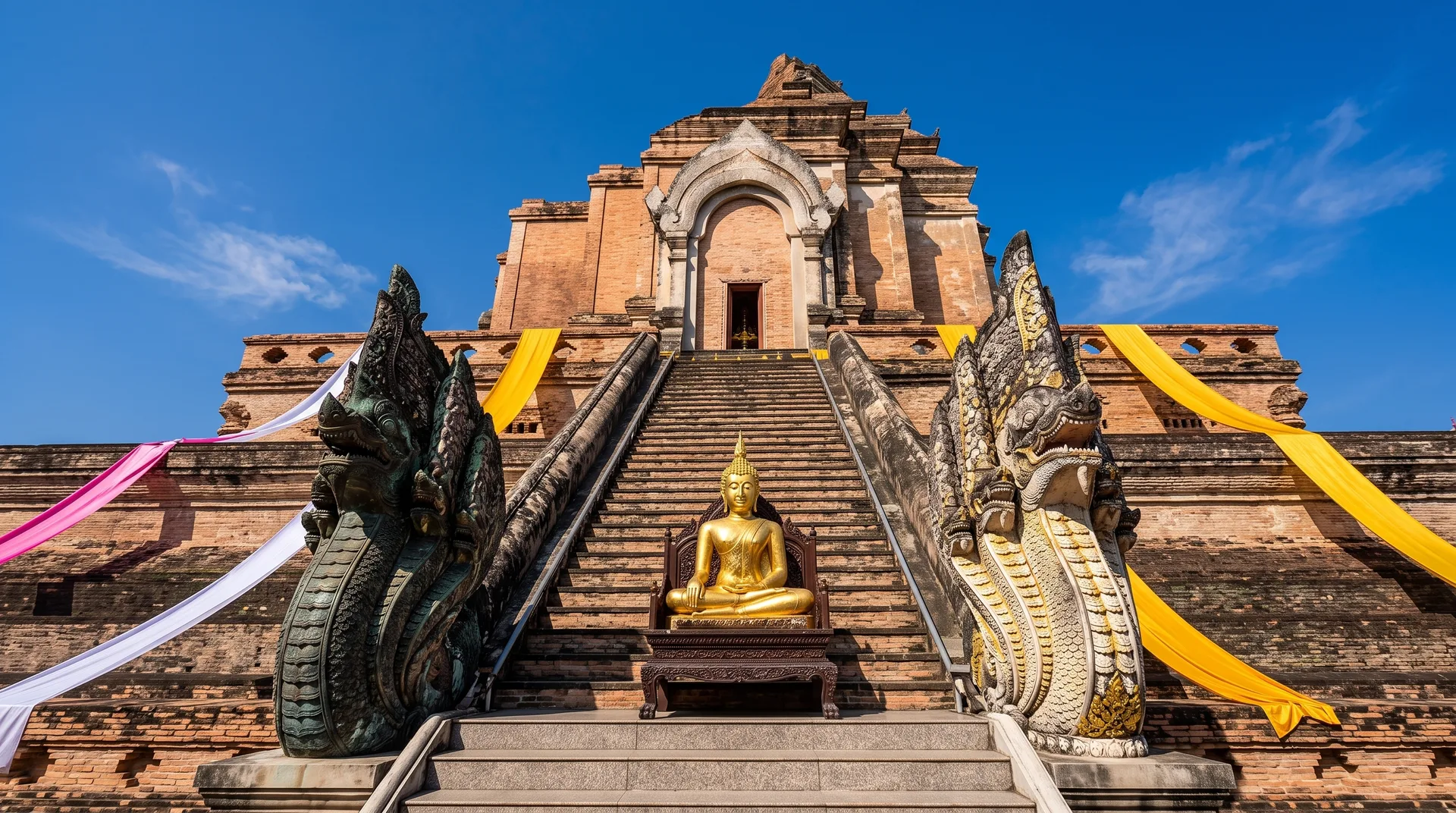
Wat Chedi Luang Woraviharn (Tambon Phra Singh, Mueang Chiang Mai District)
History According to legend, the temple originally belonged to Burmese monks who traveled here to pay homage and, moved by faith, offered their possessions in devotion — from which the temple took the name "Chok Ti Aram Viharn." Later, the great chedi (Chedi Luang) was built over an earlier chedi by King Kaeo Mueang Ma, in dedication of merit to his father, King Tilokarat, completed in B.E. 1991 (1448 CE) [translator's note: source date appears inconsistent with the historical timeline]. Later, in B.E. 2020 (1477 CE), the Chedi Luang was renovated, its base widened and heightened, with the restoration completed by B.E. 2065 (1522 CE). In the reign of Phra Mueang Kaeo the chedi was capped with a golden spire, and in B.E. 2088 (1545 CE) a severe earthquake struck, causing the top of the chedi to collapse, leaving only the truncated form seen today. Nevertheless it remains one of the great and important temples of the Kamavasi (town-dwelling) monastic order in Chiang Mai, having served as the residence of the Maha Svami (supreme elder monk), with a continuous history connected to the antiquities kept there; today it also remains the administrative center of the Northern Dhammayutika monastic order.
Important features within the temple 1. The Chedi Luang, most recently restored by the Fine Arts Department. Its architecture comprises: a square platform base supporting a lotus-molding base with corner projections, adorned with 28 elephant figures; stairways on all four sides leading up to the circumambulatory terrace of the reliquary chamber; a central chamber, square in plan with added corner projections, with Buddha images enshrined facing all four directions (the east-facing image in particular representing the "subduing Mara" gesture); and above the reliquary chamber, an octagonal tier stepping upward, adorned with 28 octagonal columns — this upper portion collapsed in the B.E. 2088 (1545 CE) earthquake.
2. The vihara, with a history of construction recorded on several occasions: after the Chedi Luang was completed, King Tilokarat's mother had a vihara built alongside it; later, around B.E. 2017 (1474 CE), King Tilokarat had it demolished and rebuilt; around B.E. 2086 (1543 CE), during the reign of Phra Mueang Kaeo, the vihara burned down and was rebuilt anew; then around B.E. 2163 (1620 CE) construction of another vihara began (though some documents place this rebuilding in B.E. 2211 [1668 CE] instead). In any case, the present vihara's construction is generally dated to its final and most recent building in B.E. 2471 (1928 CE), undertaken by Phra Ubali Khunupamachan (Chan Sirichantho) with the approval of Chao Kaeo Nawarat, in an adapted architectural style.
3. Two subsidiary chedis, for which no historical record survives, but which on stylistic grounds may date to the late 21st Buddhist century (16th century CE); it is also possible that they are more recent reproductions.
4. The Phra Atthalos, the principal Buddha image in the vihara, cast around the 20th Buddhist century (15th century CE), showing Sukhothai artistic influence.
Registration as an ancient monument 1. Registered in the Royal Gazette, Volume 42, Part 95, dated 4 March 2478 (1935). 2. Boundary announced in the Royal Gazette, Volume 96, Part 168, dated 25 September 2522 (1979).
Wat Chomphu (Tambon Si Phum, Mueang Chiang Mai District)
History One of Chiang Mai's ancient temples, with no clear record of who built it or when. Tradition holds only that it was originally called "Wat Mai Phimpha," associated with Phra Nang Phimpha, consort of Phraya Suraritchai (Nan Thip Chang), grandmother of King Kawila.
Important features within the temple 1. The chedi, bell-shaped in the Chiang Mai style, similar to the chedi of Wat Phra That Doi Suthep, likely dating to the late 21st Buddhist century (16th century CE) — though this dating rests on stylistic grounds alone. 2. The gateway arch (chum pratu khong), with numerous corner-recess mouldings and a tiered spire modeled on the Chiang Mai chedi form, thought to imitate the Lampang school of craftsmanship of the late 22nd to early 23rd Buddhist century (17th–18th century CE) — possibly further evidence bearing on the Phimpha legend. 3. A small ordination hall in local Lanna style.
Registration as an ancient monument Not yet registered as an ancient monument.
Wat Chiang Man (Tambon Si Phum, Mueang Chiang Mai District)
History According to the Chiang Mai chronicles, King Mangrai established a stronghold called "Chiang Man" in B.E. 1839 (1296 CE). After King Mangrai moved into the new city, he had houses both small and large built there, in what came to be called the "high village" (ban tambon sung), the place where King Mangrai had encamped. A temple was later built there named Wat Chiang Man, understood to be the first temple of Chiang Mai.
Important features within the temple 4. The Sao Inthakhin (Inthakhin pillar), moved here from Wat Inthakhin; tradition holds the pillar was relocated on the order of King Kawila, who held that founding a new city required a ceremony to plant a new city pillar. 6. A group of Buddha images enshrined on the pedestal (chukchi) within the vihara, mostly bronze images in the "subduing Mara" gesture, in Lanna art of the Chiang Mai school, dating to around the 21st Buddhist century (16th century CE); some bear inscriptions recording the year of their casting — one such image bears an inscription corresponding to B.E. 2025 (1482 CE), of bronze, with a lap width of 17 centimeters, a total height including base of 110 centimeters, and a base width of 45 centimeters. 7. A carved ivory Buddha image, carved from the tusk of an elephant named Prap Mueang Ma; after the elephant's death, Mae Chao Kham Phaen, Chao Noi Maha Phrom, and Chao Nan Maha Thep had the tusk carved.
Registration as an ancient monument 1. Registered in the Royal Gazette, Volume 47, Part 131, dated 19 April 2483 (1940). 2. Boundary announced in the Royal Gazette, Volume 97, Part 41, dated 14 March 2523 (1980).
Wat Chomphu — additional note
Wat Chiang Yuen (Thikachiwa Asoram) (Tambon Si Phum, Mueang Chiang Mai District)
History No record of its founding survives, but documents mention it as already existing before B.E. 1945 (1402 CE), referring to Maha Sami Buddhayana. Wat Chiang Yuen was once an important temple in its own right, as reigning kings would come here to pay homage — for example, in B.E. 2048 (1505 CE), when Phraya Kaeo journeyed from Lan Xang to take the throne of Chiang Mai, or on the occasions when King Kawila observed the tradition of paying homage to the Phra Buddha Sihing image in the Wat Chiang Yuen vihara.
Important features within the temple 1. The chedi, believed to have been built by Phra Mueang Kaeo in B.E. 2061 (1518 CE), with the finial-raising ceremony held in B.E. 2064 (1521 CE). It was originally bell-shaped, but its present form has been heavily restored, particularly the base, which has been considerably enlarged and altered to a contemporary Burmese style. 2. The vihara, which likely already existed around the 21st Buddhist century (16th century CE), as it housed the Phra Buddha Sihing image; the present vihara structure may retain the original frame built by Phra Mueang Kaeo in B.E. 2062 (1519 CE), though it has since been restored on several occasions. 3. An octagonal image hall (ho phra), in Burmese style, recognizable from the stucco ornament on its windows and entrance archway.
Registration as an ancient monument Registered and its boundary announced in the Royal Gazette, Volume 96, Part 145, dated 21 August 2522 (1979).
Wat Duang Di (Tambon Si Phum, Mueang Chiang Mai District)
History First appears in documentary evidence in B.E. 2304 (1761 CE), when Chao Ai, son of Chao Ai Kham Man Si, came to govern Chiang Mai. Wat Duang Di is mentioned on several further occasions, particularly in connection with Khruba Kesorn Panyo, a senior monk who took part in a number of major Chiang Mai ceremonies, as well as in education, since several palm-leaf manuscripts bearing his name as author have been found there.
Important features within the temple 1. The chedi, understood from its form to be a bell-shaped chedi on an octagonal tiered base, dating to around the mid-to-late 21st Buddhist century (16th century CE). 2. The ordination hall, which records indicate was consecrated in B.E. 2377 (1834 CE); its present condition has been repaired, though apparently without major change to its main structure, while its decorative motifs are certainly the work of a later period than the original construction. 3. The scripture repository (ho trai), square in plan, showing evidence of mondop-style architecture; its upper story is a distinctive form among Chiang Mai scripture repositories, with exterior stucco relief ornament that, from its style, appears to be original work contemporary with the repository's completion in B.E. 2377 (1834 CE). 4. Several stone Buddha images are kept at the temple, the most significant being a stone image in the "subduing Mara" gesture bearing an inscription referring to "Duang Dan Mak Nuea," which raises the question of whether this was in fact originally Wat Duang Di.
Registration as an ancient monument Registered and its boundary announced in the Royal Gazette, Volume 94, Part 117, dated 27 October 2520 (1977).
Wat Nantharam (Tambon Hai Ya, Mueang Chiang Mai District)
History Originally a major temple predating B.E. 1960 (1417 CE), where monks came from various places to study Buddhism, including of the Hin (?) sect [translator's note: source text is uncertain/garbled here]. Even members of the royal family passing through the city would pay respects here. Historical records show that by B.E. 2008 (1465 CE) [translator's note: date uncertain in source] the temple had fallen into decline, and around B.E. 2480 (1937 CE) it came under the Chin monastic order, subordinate to Wat Muen San, though it was never abandoned for any extended period.
Important features within the temple 1. The chedi, with no surviving record of its construction history, but from its form — a bell-shaped chedi in the local Lanna style — it is estimated on stylistic grounds to date to around the mid-to-late 20th Buddhist century (15th century CE). 2. The vihara, although records mention its construction at Wat Nantharam in B.E. 2507 (1964 CE) [translator's note: date likely garbled in source], it has since undergone some alteration, particularly the decorative gable ornament.
Registration as an ancient monument Not yet registered as an ancient monument.
Wat Buak Khrok Luang (Tambon Tha Sala, Mueang Chiang Mai District)
History No record survives in the chronicles or annals of Chiang Mai; on stylistic grounds it likely dates to the 24th Buddhist century (19th century CE) or later.
Important features within the temple 1. The vihara, in local Lanna style; old photographs show it originally had a projecting front porch covering a naga-baluster staircase with stucco naga figures. 2. Mural paintings within the vihara, in distemper, depicting the Ten Birth Tales (Thotsachat) and the life of the Buddha, though only certain episodes were painted, and even these appear out of sequence.
Registration as an ancient monument Registered and its boundary announced in the Royal Gazette, Volume 97, Part 41, dated 19 March 2523 (1980).
Wat Buppharam (Tambon Chang Khlan, Mueang Chiang Mai District)
History Wat Buppharam appears in the Chinnakalamalipakon chronicle, which records that in B.E. 2040 (1497 CE) Phra Mueang Kaeo had Wat Buppharam built on land to the east, outside the city of Chiang Mai — the former residence of his grandfather, Thao Sri Boonruang, from the time he served as viceroy of Chiang Mai. Later, by the 25th Buddhist century (20th century CE), the temple had come to be associated with the Ngiao (Tai Yai) community.
Important features within the temple 1. A bell-shaped chedi in later Burmese-Mon style, likely built around the 25th Buddhist century (20th century CE). 2. The vihara: though records place its founding around the 21st Buddhist century (16th century CE), the structure of the present vihara appears to date to the 24th Buddhist century (19th century CE), the records indicating that it was built over the earlier Wat Buppharam vihara; later, the vihara's columns were extended, giving it its present, comparatively low profile relative to its original form. The stucco gable ornament appears to have been restored around the mid-25th Buddhist century (20th century CE) under the patronage of Chao Mae Thip Kesorn.
Registration as an ancient monument Registered and its boundary announced in the Royal Gazette, Volume 96, Part 145, dated 21 August 2522 (1979).
Wat Pa Daeng Luang (Tambon Suthep, Mueang Chiang Mai District)
History Wat Pa Daeng likely predates B.E. 1973 (1430 CE), since records show that the great elder monk Dhammagambhira, returning from Sri Lanka, resided here. Wat Pa Daeng was a center of the new Sri Lankan (Lankavamsa) school of Buddhism, which grew popular from the reign of King Tilokarat onward; many monuments were consequently built here, though only a single chedi survives today.
Important features within the temple 1. The chedi, a round bell-shaped chedi whose base is ringed with elephant figures, understood to reflect the influence of the elephant-ringed chedis of Sukhothai art, likely built around the 20th Buddhist century (15th century CE). Accounts of this chedi's history differ: the Yonok Chronicle states that it enshrines the remains of King Sam Fang Kaen, while contemporary records from Wat Pa Daeng itself make no such claim. 2. The vihara at Wat Pa Daeng (Mai) — only the rear wall foundation of one vihara survives, possibly the vihara that records state was built in the reign of King Dhammalangka in B.E. 2361 (1818 CE), though the gable ornament and interior wall decoration appear to have been renewed around the 25th Buddhist century (20th century CE).
Registration as an ancient monument Registered and its boundary announced in the Royal Gazette, Volume 98, Part 177, dated 27 October 2524 (1981).
Wat Prasat (Tambon Phra Singh, Mueang Chiang Mai District)
History No document or legend records the history of Wat Prasat's founding, but Phra Satthammathiti of Wat Prasat is mentioned in B.E. 2035 (1492 CE) in connection with a joint monastic ceremony held at Wat Ram Poeng.
Important features within the temple 1. A vihara in local Lanna style, with a rear water-drainage channel, enshrining a Buddha image. Although tradition attributes its construction to Phra Satthammathiti Samlan around B.E. 2035 (1492 CE), it has been continuously restored, including work done in B.E. 2368 (1825 CE) under the patronage of Nai Chaiya Poonsiriwong; the stucco gable ornament, however, appears to be work of around the 25th Buddhist century (20th century CE). 2. An inscribed Buddha image, made after Chiang Mai came under Burmese rule — evidence, it may be noted, that matters of religion were not necessarily bound up with politics.
Registration as an ancient monument Registered and its boundary announced in the Royal Gazette, Volume 96, Part 169, dated 25 September 2522 (1979).
Wat Phan Tao (Tambon Phra Singh, Mueang Chiang Mai District)
History No document records when it was built; tradition holds only that the site was once a foundry (tao) casting the Phra Atthalos image for the Wat Chedi Luang vihara, from which the name "Wat Phan Tao" (thousand kilns) derives. Around B.E. 2414 (1871 CE), Wat Phan Tao was elevated to house an ordinary sangharaja (monastic dignitary); from that point the temple grew in importance, standing near the royal residence (khum luang) of the fifth Chiang Mai ruling prince, and Chao Inthawichayanon had an old palace hall dismantled and rebuilt here as the temple's vihara.
Important features within the temple 1. A carved wooden gable pediment above the vihara's entrance door. 2. A wooden preaching throne (thammat) within the vihara.
Registration as an ancient monument Registered and its boundary announced in the Royal Gazette, Volume 97, Part 41, dated 19 March 2523 (1980).
Wat Phra Singh Woramahaviharn (Tambon Phra Singh, Mueang Chiang Mai District)
History Originally named Wat Phra Chiang, founded by King Phayu in B.E. 1888 (1345 CE) as a repository for the remains and ashes of his father, King Kham Fu, inviting the elder monk Phra Aphaya and disciples from Haripunchai to reside here. It subsequently became a continuous center for monks of the older local monastic tradition, and monks of this temple appear several times in Chiang Mai's political and administrative history.
Important features within the temple 1. The principal chedi, a bell-shaped chedi in local style with an elephant-ringed base — possibly reflecting the acceptance of the new Lankavamsa Buddhism arriving from Sukhothai — likely built around the 20th Buddhist century (15th century CE), though continuously repaired since. The palace-style mondop behind it likewise dates from around the 20th Buddhist century but has undergone several major repairs; its present form dates to around the late 24th Buddhist century (19th century CE). The vihara also houses gilded mural paintings depicting the Sang Thong and Suwannahong tales, painted by the artists Chek Seng and Nan Photha — the artist of the Suwannahong episodes drawing heavily on courtly imagery, while the artist of the Sang Thong episodes drew more on scenes of everyday life among the people of Chiang Mai in that era. 3. The ordination hall, according to an inscription completed in B.E. 2345 (1802 CE); its present condition has changed relatively little, apart from replacement of the wooden front porch columns on the north side, trimming of the gable-end finials during a restoration period, and repair of the stucco reliefs on the north gable following the original pattern. Some records state that the hall once hosted joint monastic ceremonies for monks and nuns together, a claim that remains disputed as to its truth. The hall also contains a palace-style mondop built around B.E. 2361 (1818 CE). 4. The scripture repository (ho trai), a two-story building — the lower story of brick and stucco construction, the upper a wooden structure — completed together with the ordination hall in B.E. 2345 (1802 CE), and subsequently restored once during the time of the great elder Khruba Kanchana, with a final restoration in B.E. 2465 (1922 CE), which appears to have replaced the stucco reliefs on the wooden walls and the new front-porch gable ornament, though the celestial-figure sculptures and animal-relief motifs within the mirrored panel frames appear to be original from the time of construction. 5. Several Buddha images are kept at the temple; the most important is the Phra Sing (also called Phra Chao Thip), bearing an inscription dating its creation to B.E. 2160 (1617 CE). Also present are a group of marble alms-bowl-holding Buddha images, a group of marble images in the "opening the world" gesture showing Sukhothai influence, a group of royally-attired images showing Ayutthaya influence, and a group of images whose decorative style can be dated to around the mid-21st Buddhist century (16th century CE).
Registration as an ancient monument 1. Registered in the Royal Gazette, Volume 52, Part 75, dated 8 March 2478 (1935). 2. Boundary announced in the Royal Gazette, Volume 96, Part 47, dated 16 June 2522 (1979).
Wat Phra Chao Mengrai, or Wat Kala Kot (Tambon Phra Singh, Mueang Chiang Mai District)
History Originally named "Wat Tan Kot," a name likely corrupted to "Kala Kot," according to a silver-plate inscription found buried beneath the principal Buddha image in the great vihara when it was repaired in B.E. 2510 (1967 CE), inscribed in Tai Yuan (Lanna) script.
Important features within the temple 1. A Buddha image modeled on the Phra Buddha Sihing, made by Sri Satthamma Halangkarat in B.E. 2012 (1469 CE), enshrined in the great vihara, with a lap width of 130 centimeters, a total height including base of 173 centimeters, and a base width of 195 centimeters. Also present are several bronze images in the "subduing Mara" gesture bearing inscriptions typical of the style of Buddha images from the early 21st Buddhist century (16th century CE). 2. A stone Buddha image, enshrined in the smaller vihara, in Lanna art of the Chiang Mai school, cast in gilded bronze, 21st–22nd Buddhist century (16th–17th century CE).
Registration as an ancient monument Registered in the Royal Gazette, Volume 42, Part 95, dated 8 March 2478 (1935).
Wat Phra That Doi Suthep Ratchaworawihan (Tambon Suthep, Mueang Chiang Mai District)
History According to the legend of Wat Phra That Doi Suthep, the sacred relic that the monk Sumana brought from Sukhothai split into two pieces; after one was enshrined in the chedi of Wat Suan Dok, the other was placed on the back of an elephant and released to wander, so that the elephant might climb to the summit of Doi Suthep — where it knelt and refused to go further, whereupon a stupa was built there to enshrine the relic, in B.E. 1927 (1384 CE). Later, in B.E. 2069 (1526 CE), Phra Mueang Kaeo had the site restored and the chedi enlarged and heightened; further restorations and construction of monuments followed on several later occasions. Phra That Doi Suthep has remained a sacred monument, a guardian symbol of Chiang Mai, to the present day. Later, around B.E. 2478 (1935 CE), Khruba Sriwichai built the road up Doi Suthep, completing the route to Phra That Doi Suthep.
Important features within the temple 1. The chedi, a twelve-sided bell-shaped chedi, whose present form may reflect restoration during the reign of Phra Kaeo (Ketklao) around B.E. 2081 (1538 CE). 2. The vihara, which records say was built in B.E. 2385 (1842 CE) by King Kawila, though continuously restored thereafter; notably, its ceiling panels depict a group of royal donors. 3. The Luang Pho Fon Mueang image, enshrined in a vihara directly north of the Doi Suthep chedi, Lanna art of the Chiang Mai school, 22nd Buddhist century (17th century CE), lap width 54 centimeters, total height including base 75 centimeters, base width 45 centimeters. 4. A group of Buddha images in the "subduing Mara" gesture enshrined in the gallery encircling the Doi Suthep chedi, Lanna art of the Chiang Mai school, 21st–22nd Buddhist century (16th–17th century CE), gilded bronze, lap width 74 centimeters, total height including base 92 centimeters, base width 75 centimeters. 5. Mural paintings around the gallery, painted by Boonpan Phongpradit, in a Western-influenced painting style.
Registration as an ancient monument Registered in the Royal Gazette, Volume 42, Part 95, dated 4 March 2478 (1935).
Wat Ram Poeng (Wat Tapotharam) (Tambon Suthep, Mueang Chiang Mai District)
History An inscription records that King Yot Chiang Rai had Wat Tapotharam built in B.E. 2015 (1472 CE).
Important features within the temple The chedi, a palace-style (prasat) chedi built together with the temple in B.E. 2015 (1472 CE), in a form resembling Chinese chedi style adapted and merged with the local palace-style chedi form, producing a distinctive form of which only three examples are found in Chiang Mai.
Registration as an ancient monument 1. Registered in the Royal Gazette, Volume 42, Part 95, dated 4 March 2478 (1935). 2. Boundary announced in the Royal Gazette, Volume 97, Part 41, dated 14 March 2523 (1980).
Wat Lok Moli (Tambon Si Phum, Mueang Chiang Mai District)
HistoryWat Lok Moli was built in B.E. 2070 (1527 CE), when King Ketklao had the Ban Hua Wiang site elevated to temple status; a chedi and vihara were then built in B.E. 2071 (1528 CE), and when King Ketklao passed away, his remains were enshrined in the temple's chedi as well. Wat Lok Moli is mentioned on several further occasions; around B.E. 2440 (1897 CE) it was still registered as a subsidiary monument of Wat Chedi Luang; after that, it is not known when it fell into disuse.
Important features within the temple 1. The palace-style chedi, which from its stylistic development is likely the chedi built in B.E. 2071 (1528 CE) itself; its most notable feature is the sculpted relief of celestial figures adorning the corner recesses of the reliquary chamber. 2. The ruins of a vihara.
Registration as an ancient monument 1. Registered in the Royal Gazette, Volume 76, Part 104, dated 17 November 2502 (1959). 2. Boundary announced in the Royal Gazette, Volume 96, Part 97, dated 16 June 2522 (1979).
Wat Si Koet (Tambon Phra Singh, Mueang Chiang Mai District)
History No record survives of Wat Si Koet's founding, but its name appears in the "Khlong Nirat Haripunchai" poem, composed around B.E. 2060 (1517 CE); it is thought it may originally have been called "Wat Luang Photirukkhapikharam," as a stone inscription records that a Buddha image called "Phra Chao Saeng Kham" was enshrined in its vihara.
Important features within the temple 1. The vihara, originally built to house the Phra Chao Saeng Kham image, completed in B.E. 2047 (1504 CE), though its present form has been considerably altered through restoration.
Registration as an ancient monument 2. The Phra Chao Saeng Kham image, cast on the order of King Tilokarat at Wat Pa Tan Noi in B.E. 2017 (1474 CE), showing mixed Ayutthaya artistic influence.
Registration as an ancient monument Registered in the Royal Gazette, Volume 46, Part 75, dated 8 March 2478 (1935).
Wat Suan Dok (Tambon Suthep, Mueang Chiang Mai District)
History In B.E. 1914 (1371 CE), King Kue Na donated his own pleasure garden to found a temple named "Wat Suan Dok Mai" (Flower Garden Temple), and further invited the great elder monk Sumana from Wat Phrayuen to reside there in Chiang Mai. Later, around B.E. 2466 (1923 CE) [translator's note: date appears inconsistent — likely a much earlier date in the original chronicle, given Phra Sumana's dates], the elder Sumana built a chedi to enshrine a Buddha relic he had brought with him.
Important features within the temple 1. The principal chedi, bell-shaped in local style, set on a large base that originally would have been ringed with elephant figures; all four sides of the base have circumambulatory platforms projecting to the east, decorated with stucco fruit-and-foliage motifs. The chedi and its surrounding gateways underwent a major restoration under Khruba Sriwichai in B.E. 2470 (1927 CE). 2. The vihara, a large open-sided vihara built during the time of Khruba Sriwichai. 3. Reliquary structures (ku) housing the remains of the lineage of Chiang Mai's ruling princes. 4. The Phra Chao Kadan image, enshrined in the vihara of the former Wat Kao Dan, which has since been merged with Wat Suan Dok; records indicate construction began in B.E. 2419 (1876 CE), and the image was later moved to the Wat Suan Dok ordination hall in B.E. 243 [translator's note: year appears truncated/garbled in source].
Registration as an ancient monument 1. Registered in the Royal Gazette, Volume 42, Part 95, dated 4 March 2478 (1935). 2. Boundary announced in the Royal Gazette, Volume 97, Part 41, dated 19 March 2523 (1980).
Wat Hua Khuang (Tambon Si Phum, Mueang Chiang Mai District)
History No record survives of the temple's founding, but records state that in B.E. 2061 (1518 CE), during the reign of Phra Mueang Kaeo, the large stupa base at Wat Saen Mueang Ma was raised and rebuilt anew, and a Buddha relic was enshrined within it.
Important features within the temple 1. A bell-shaped chedi, twelve-sided in plan from its base up to the moulded ring courses; though records date its construction to B.E. 2061 (1518 CE), its present form appears to reflect a major restoration under Chao Fa Sutho Dhammaracha around B.E. 2197 (1654 CE). 2. A stone Buddha image in the "subduing Mara" gesture, its base bearing an inscription naming its maker and dating its creation to B.E. 2444 (1901 CE) — possibly evidence confirming that Wat Saen Mueang Ma existed before the reign of Phra Mueang Kaeo.
Registration as an ancient monument Registered and its boundary announced in the Royal Gazette, Volume 97, Part 41, dated 25 September 2522 (1979).
Wat Inthakhin (Tambon Si Phum, Mueang Chiang Mai District)
History No record survives of the founding of this "city navel" (sadue mueang) monument group, known as Wat Inthakhin; the surviving structures are thought to date to around the early 20th Buddhist century (15th century CE). Documentary records show that in B.E. 2137 (1594 CE) King Kawila built the vihara of Wat Inthakhin.
Important features within the temple 1. An octagonal chedi, thought built around the early 20th Buddhist century (15th century CE), modeled on Haripunchai style and possibly connected as well to Burmese Pagan art. This chedi appears from its stucco ornament to have been repaired on around two occasions. 2. A bell-shaped chedi in local style, dated to around the mid-20th Buddhist century (15th century CE) or earlier, built over an earlier palace-style chedi that had enshrined a standing Buddha image within.
Registration as an ancient monument Registered and its boundary announced in the Royal Gazette, Volume 97, Part 41, dated 19 March 2523 (1980).
Wat U Mong (Suan Buddhadhamma) (Tambon Suthep, Mueang Chiang Mai District)
History According to tradition, Wat U Mong was built in B.E. 1840 (1297 CE), when King Mangrai had it built in a forest area to house five forest-dwelling (aranyavasi) monks from Sri Lanka, following the Lankavamsa model closely — in the division of the monastic precinct (buddhavasa) from the monks' residential area (sanghavasa), and in the form of the chedi. Later, around B.E. 2063 (1520 CE), King Kue Na enshrined Buddha relics in the great chedi. At that time the temple was called "Wesukatiyaram," meaning "bamboo forest temple," though local people commonly called it "Wat U Mong Thera Chan."
Important features within the temple 1. A round bell-shaped chedi showing influence from Burmese Pagan art; records indicate it was subsequently restored during the reign of Phra Mueang Kaeo, with the most recent restoration reshaping the finial in a later Burmese style. This chedi contains a crypt with mural paintings depicting the life of the Buddha, considered the oldest surviving painting style in Lanna at present. To the north lies a tunnel (u mong) with wall paintings; what survives depicts flowers, foliage, and animals, apparently showing mixed Burmese and Chinese influence, thought to have been painted around the 21st Buddhist century (16th century CE).
Registration as an ancient monument 1. Registered in the Royal Gazette, Volume 42, Part 95, dated 8 March 2478 (1935). 2. Boundary announced in the Royal Gazette, Volume 97, Part 41, dated 19 March 2523 (1980).
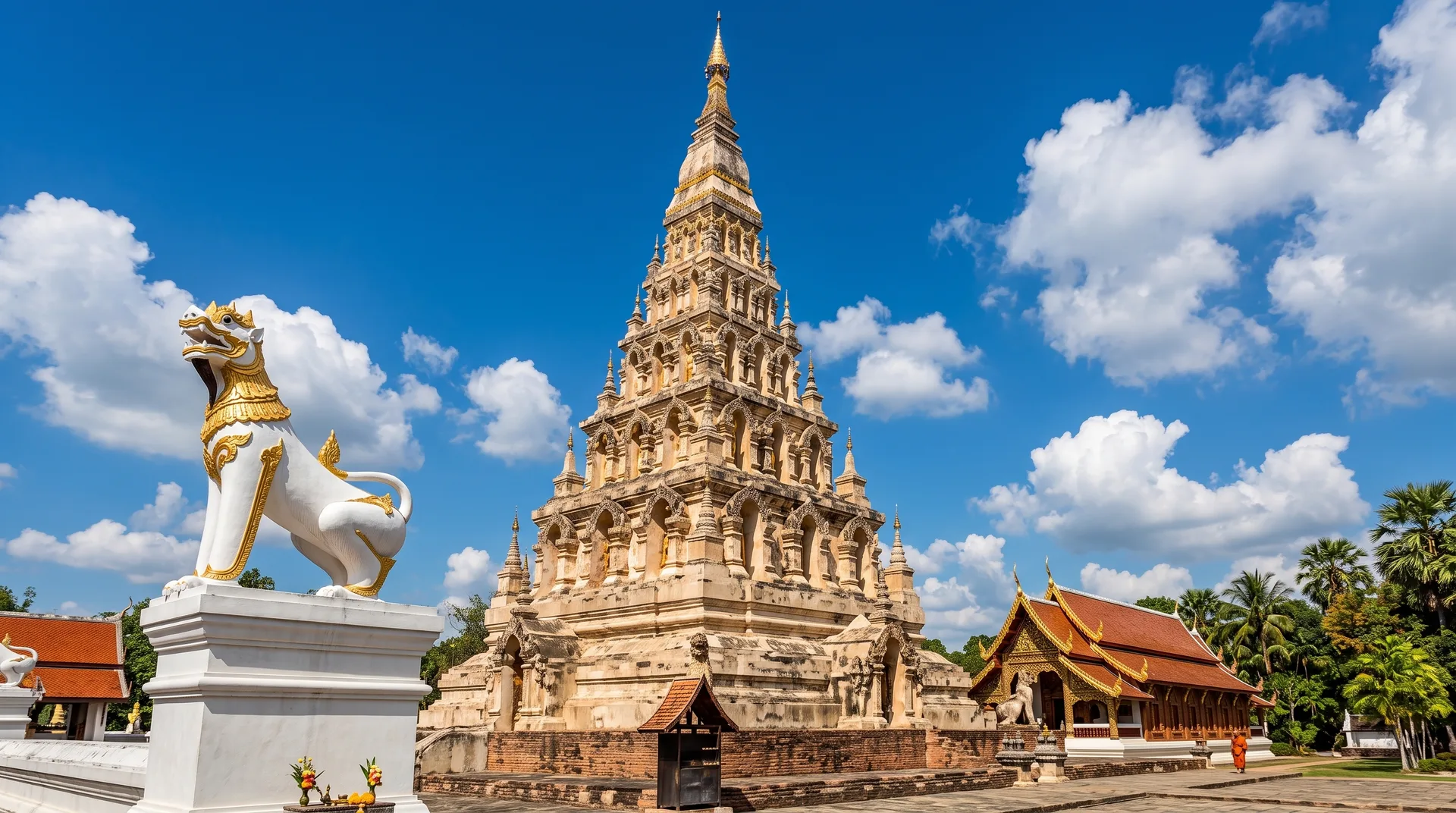
Wat Chedi Liam (Tambon Tha Wang Tan, Saraphi District)
History Wat Chedi Liam has documentary evidence for the construction of its chedi in B.E. 1831 (1288 CE), built by King Mangrai at Wiang Kum Kam. The chedi's form is modeled on the Suwan Chang Kot (or Ku Kut) chedi of Wat Chamadevi in Lamphun province, which had been built long before.
Important features within the temple 1. The chedi, believed to be the same one built by King Mangrai, though evidence of alteration suggests several restorations; the chedi's overall form has not changed from the original, but its decorative motifs and the Buddha images in the niches have — the present state is thought to reflect work from the most recent restoration under Luang Yothanukan, marking the temple's 60th anniversary, in B.E. 2455 (1912 CE). 2. A Buddha image in the "subduing Mara" gesture, enshrined as the principal image in the vihara, Lanna art, 21st Buddhist century (16th century CE), bronze, lap width 105 centimeters, total height including base 146 centimeters.
Registration as an ancient monument Registered and its boundary announced in the Royal Gazette, Volume 97, Part 41, dated 19 March 2523 (1980).
Wat Kan Thom (Chang Kham) (Tambon Tha Wang Tan, Saraphi District)
History This temple's name appears in the chronicles, which record that King Mangrai had the vihara of Wat Kan Thom built around B.E. 1831 (1288 CE), and the chedi built in B.E. 1831 (1288 CE) as well. The temple grounds also contain a Bodhi tree said to have been brought from Sri Lanka in ancient times, and important archaeological evidence has been found here in the form of a red sandstone inscription, its script divided into three types: Mon script, a script contemporary with and transitional between Mon and Thai script, and early Sukhothai/Fakkham script.
Important features within the temple These include the dharma vihara and the chedi.
Registration as an ancient monument Not yet registered as an ancient monument.
Wat Hang Dong (Tambon Hang Dong, Hang Dong District)
History Wat Hang Dong was established as a temple in B.E. 2320 (1777 CE).
Important features within the temple 1. The vihara, whose ground plan projects to the sides, likely reflecting a vihara plan of around the early 25th Buddhist century (20th century CE); the vihara's gable and interior columns are adorned with distinctively-styled stucco reliefs. It also contains mural paintings that were left unfinished. 2. A preaching throne (thammat), of lacquered wood with gilded and glass-inlaid decoration, Lanna art, 25th Buddhist century (20th century CE), 149 centimeters wide, 482 centimeters tall.
Terra Lanna Travel was founded out of a love for Lanna history and culture. We believe the stories of the northern land — its legends, traditions, temples, and the way of life of those who came before us — are a precious heritage worth recording, preserving, and passing on to future generations. That is why the core content of this website is centered on travel, history, and culture articles about Lanna.
Hotels & Tours: A Supporting Role
The hotel accommodations and tour programs featured on this site are a supplementary source of income, used to develop and maintain the website so it can continue in the long run — they are not our primary purpose.
Our Role
Our main role is to tell stories and share knowledge about Lanna history, so this cultural heritage can be preserved, protected, and passed on to future generations. We also translate our content into multiple languages so that international readers with an interest in Lanna culture can access and learn these stories too.
About Our Images
The images on this website include both genuine photographs and images restored using AI technology from old black-and-white photographs, so readers can see the atmosphere of those eras more clearly and vividly.
Privacy Policy / นโยบายความเป็นส่วนตัว
Last updated: 26 April 2026 | อัปเดตล่าสุด: 26 เมษายน 2569
This site contains affiliate links to Agoda, Viator, and Trip.com. When you click these links and make a booking, we may earn a commission at no extra cost to you. Hotel prices (Agoda) and tour prices (Viator) shown on this site are live prices pulled directly from our partners; Trip.com prices require clicking through to the partner's own site. Affiliate cookies are only set when you click these links directly.
คุกกี้สถิติและการวิเคราะห์ (Analytics Cookies): วิเคราะห์แนวโน้มการเข้าชมหน้าเว็บเพื่อปรับปรุงคุณภาพเนื้อหา ผ่าน Google Analytics (G-CSV1H77PY8)
We use cookies and similar technologies to enhance your browsing experience:
Preference Cookies: Remember your selected language and cookie banner consent status.
Analytics Cookies: Help us understand audience engagement and improve article quality via Google Analytics.
5. นโยบายโฆษณา Google AdSense / Google AdSense Advertising Disclosures
เว็บไซต์นี้ใช้บริการโฆษณาจาก Google AdSense เพื่อสนับสนุนการดำเนินงานและการผลิตเนื้อหาคุณภาพ เพื่อให้เป็นไปตามข้อกำหนดและนโยบายความเป็นส่วนตัวของ Google เราขอแจ้งให้ผู้ใช้ทราบดังนี้:
ผู้ให้บริการภายนอก ซึ่งรวมถึง Google ใช้คุกกี้ (รวมถึง DoubleClick cookie) เพื่อแสดงโฆษณาตามประวัติการเข้าชมเว็บไซต์นี้หรือเว็บไซต์อื่นๆ ในอินเทอร์เน็ตของผู้ใช้ในอดีต
การใช้คุกกี้เพื่อการโฆษณาช่วยให้ Google และพาร์ทเนอร์สามารถแสดงโฆษณาที่เกี่ยวข้องและตรงกับความสนใจของผู้ใช้ อิงตามประวัติการเข้าชมเว็บไซต์ของเราและ/หรือเว็บไซต์อื่นๆ ในเครือข่ายอินเทอร์เน็ต
ผู้ใช้มีสิทธิ์เลือกปิดการใช้งาน (Opt-out) โฆษณาที่ปรับแต่งตามโปรไฟล์ความสนใจส่วนบุคคลได้ทุกเวลา โดยเข้าไปที่ Google Ads Settings หรือเข้าไปที่เว็บไซต์ www.aboutads.info เพื่อปิดการใช้คุกกี้ของผู้ให้บริการภายนอกสำหรับการโฆษณาตามความสนใจ
This website partners with Google AdSense to display advertisements. In strict accordance with Google AdSense Publisher Policies, please be advised:
Third-party vendors, including Google, use cookies (including the DoubleClick cookie) to serve ads based on a user's prior visits to this website or other websites across the Internet.
Google's use of advertising cookies enables it and its partners to serve personalized ads to users based on their visits to our site and/or other sites on the Internet.
Users may opt out of personalized advertising at any time by visiting Google Ads Settings. Alternatively, users can opt out of a third-party vendor's use of cookies for personalized advertising by visiting www.aboutads.info.
Terra Lanna Travel Chiang Mai — เชียงใหม่, ประเทศไทย
Terms of Service / ข้อกำหนดการใช้งาน
Last updated: 25 September 2026 | อัปเดตล่าสุด: 25 กันยายน 2569
1. เกี่ยวกับบริการของเรา / About Our Service
Terra Lanna Travel Chiang Mai ("เรา", "Terra Lanna") ให้บริการเว็บไซต์ที่รวมหลายส่วนเข้าด้วยกัน ได้แก่ ที่พัก Nampiangdin Boutique Hotel ทัวร์ฟาร์มออร์แกนิกที่ลำพูน โปรแกรมทัวร์คัดสรร ไดเรกทอรีโรงแรมพร้อมราคาสดจากพาร์ทเนอร์ บล็อกเรื่องราวเชิงวัฒนธรรมล้านนา และ "ห้องสมุดล้านนา" ซึ่งเป็นคลังหนังสือประวัติศาสตร์/วัฒนธรรมล้านนาที่แปลและเรียบเรียงขึ้นใหม่ การใช้งานเว็บไซต์นี้ถือว่าคุณยอมรับข้อกำหนดฉบับนี้
Terra Lanna Travel Chiang Mai ("we", "Terra Lanna") operates a website combining several parts: Nampiangdin Boutique Hotel accommodation, organic farm tours in Lamphun, curated tour programs, a hotel directory with live partner pricing, a Lanna culture blog, and the "Lanna Library" (ห้องสมุดล้านนา) — a collection of translated and re-edited Lanna history and culture books. By using this website, you agree to these Terms.
2. เนื้อหาบล็อกและห้องสมุดล้านนา / Blog & Lanna Library Content
บทความบล็อกและหนังสือใน "ห้องสมุดล้านนา" เป็นผลงานที่เรียบเรียง แปล และดัดแปลงขึ้นโดย Terra Lanna จากแหล่งข้อมูลประวัติศาสตร์/วรรณกรรมล้านนาสาธารณะ โดยมีเจตนาเพื่อการสานต่อและอนุรักษ์วัฒนธรรมล้านนาให้เข้าถึงได้ในหลายภาษา เนื้อหาที่แปล/เรียบเรียงใหม่นี้เป็นลิขสิทธิ์ของ Terra Lanna ส่วนผลงานต้นฉบับยังคงเป็นของผู้ประพันธ์/สำนักพิมพ์เดิมตามที่ระบุไว้ในแต่ละเล่ม รูปภาพประกอบบางส่วนเป็นภาพถ่ายจริง และบางส่วนสร้าง/บูรณะขึ้นด้วยเทคโนโลยี AI จากภาพถ่ายเก่าขาวดำ (ดูรายละเอียดที่หน้า About Us) เนื้อหาทั้งหมดจัดทำขึ้นเพื่อวัตถุประสงค์ด้านการศึกษาและวัฒนธรรม ห้ามคัดลอกหรือนำไปเผยแพร่ซ้ำเพื่อการค้าโดยไม่ได้รับอนุญาตเป็นลายลักษณ์อักษร
Blog articles and books in the "Lanna Library" are compiled, translated, and adapted by Terra Lanna from public Lanna historical/literary sources, with the intent of continuing and preserving Lanna culture in multiple languages. This translated/re-edited content is copyrighted by Terra Lanna; original source works remain the property of their original authors/publishers as credited within each volume. Some accompanying images are genuine photographs, while others are AI-restored or AI-generated from old black-and-white photographs (see the About Us page for details). All content is produced for educational and cultural purposes. Copying or commercial redistribution without written permission is prohibited.
3. การจองผ่านลิงก์พาร์ทเนอร์ / Bookings via Partner Links
Hotel (Agoda) and tour (Viator) prices shown on this site are pulled live from our partners, but the actual booking is completed on the partner's own website and is governed by that partner's own terms and cancellation/refund policy — not Terra Lanna's. We act only as an affiliate referrer and are not a party to that booking contract, and are not responsible for service issues, cancellations, or disputes arising from the partner. (See Privacy Policy for affiliate commission details.)
You may not use this website to: violate Thai or applicable law, scrape or bulk-extract content without permission, or attempt unauthorized system access.
We provide information on this website "as is" and make reasonable efforts to keep it accurate and current, but do not guarantee that content, prices, or availability are correct, complete, or error-free at all times. To the maximum extent permitted by law, Terra Lanna is not liable for indirect, incidental damages, or loss of profit arising from use of this website or our partners' services.























 ภูมิปัญญาดินอินทรีย์ · 4 นาที