★ 9.4/10 EXCEPTIONAL ON AGODA & BOOKING.COM • ROYAL FLORA RATCHAPHRUEK CERTIFIED
Overnight Nature Farmstay • KAS Farmstay
KAS Farmstay (Private Farmstay Tent & Campfire)
Experience a peaceful private farmstay amidst our organic orchards in Lamphun. Cozy tent glamping, evening campfires under starry skies, and organic garden-fresh mookata BBQ. Official online booking is now live.
A collection of translated rare books on Lanna history and culture
Terra Lanna is gathering and translating rare books on Lanna history, beliefs, and way of life — preserving these stories and sharing them with readers everywhere.
Sort by:
Listen to Lanna Stories
Translating and gathering books — coming soon
Contact Us
Talk to us, or share your feedback to help us improve and grow.
Our Hotel
NampiangdinBoutique Hotel
4-Star Lanna Boutique Hotel in the Heart of Chiang Mai
★★★★ 4-Star Boutique46 Rooms15 Min from AirportFree Airport Transfer
Nampiangdin Boutique Hotel is a 4-star boutique property blending ancient Lanna architecture with modern comfort. Located in central Chiang Mai, 15 minutes from the airport, with a warm atmosphere, heartfelt service, a lush garden, outdoor pool, and a restaurant featuring local ingredients.
Rooms
Choose the ExperienceThat's Right for You
All rooms feature a private balcony, pool view, AC, free WiFi, minibar, and breakfast included
Sorted by guest review score — prices updated daily
Active & Available in Chiang Mai
Your Eyes, Ears & Boots on the Ground in Chiang Mai
Moving, investing, or sourcing in Northern Thailand? We provide what no remote tool or overseas agency can ever match: genuine local presence, native northern dialect negotiation, and zero-bias on-site execution.
Why Technology Cannot Replace Local Boots on the Ground
Overseas expats, digital nomads, and remote investors face significant friction when managing property or sourcing in Northern Thailand. Having trusted on-the-ground representation eliminates risks, protects your budget, and gives you total peace of mind.
Common Pitfalls of Managing Remotely
Misleading Listings: Online photos are frequently edited or years out of date. In reality, properties may have hidden mold, weak water pressure, noisy air-conditioning, or loud construction right outside your window.
Unwarranted Price Markups: Without local Thai and Northern dialect negotiation skills, foreigners often face inflated quotes—paying 20%–40% above true local market rates for rent, contractor labor, and artisan craft manufacturing.
Unreliable Wi-Fi Claims: Landlords routinely advertise 'high-speed internet' that turns out to be congested shared building Wi-Fi with high latency, dropping client Zoom calls and disrupting remote work.
Zero On-Site Emergency Recourse: When an air conditioner leaks, plumbing bursts, or a guest locks themselves out late at night, remote coordination across time zones is stressful and ineffective.
The Terra Lanna Advantage
Objective High-Definition Video Inspections: We physically inspect every corner of the property, testing plumbing pressure, air-con odor, noise decibels, and surrounding neighborhood conditions without bias.
Direct Native & Northern Dialect Negotiation: We speak fluent Thai and Kam Mueang directly with landlords, technicians, and workshop owners—securing authentic, fair local terms and lease conditions.
Certified On-Site Speedtests: We plug in directly to run certified Ookla Speedtests (measuring ping latency, jitter, download, and upload speeds) before you commit to any rental deposit.
Trusted Keyholding & Urgent Dispatch: Permanently stationed in Chiang Mai, ready to handle emergency lockout rescues, supervise contractors, and deliver structured photo/video reports directly to you.
Our 4 Core Capabilities
What Overseas Clients Hire Us to Do
Four specialized on-the-ground services tailored for expats, remote entrepreneurs, Airbnb owners, and international media agencies.
For Nomads & Expats
Local Fixer & Personal Assistant
Your personal problem solver in Chiang Mai. Whether you are landing soon or already living here, we eliminate bureaucratic stress, rental headaches, and language barriers.
Core Focus
Condo pre-lease walk-throughs, Wi-Fi stability tests, lease negotiation to kill farang markups, parcel reception, and initial government/immigration logistics guidance.
Key Deliverables
Detailed video walkthrough & timestamped photo inspection
Live Ookla Wi-Fi speedtest (latency, download/upload speeds)
Lease contract review & direct Thai landlord negotiation
Urgent parcel pickup, mail forwarding & local errands
Overseas retailers and interior designers import handcrafted furniture, teakwood, ceramics, and textiles from Chiang Mai artisan hubs. We are your dedicated QC eyes on the workshop floor.
Geographical Advantage
We know the back alleys of Baan Tawai, San Kamphaeng, Bo Sang, Hang Dong, and Mae Rim. We talk directly to carvers and weavers in local dialect, preventing communication errors.
Key Deliverables
In-person workshop & factory visits across Chiang Mai & Lamphun
Foreign investors who own condos or pool villas in Chiang Mai for Airbnb need trustworthy local oversight. We inspect rooms after cleaning, hold emergency keys, and dispatch trusted tradesmen.
Timezone Synergy
We chat and report to you during your evening hours overseas, then execute daytime on-site checkups and maintenance across Chiang Mai during local business hours.
Commercial film crews, YouTube creators, and high-end travelers demand secret, authentic locations away from mass tourist traps. We scout hidden temple grounds, mountain overlooks, and private chef tables.
Exclusive Synergy
Seamlessly paired with Terra Lanna's private farmstead: organic orchard walks, botanical craft liquor workshops, and private campfire dinners in Lamphun.
Key Deliverables
On-site location scouting with lighting notes, acoustics & GPS coords
From initial inquiry to completed mission in 4 simple steps.
01
1. Send Your Brief
Share your requirements, links, or address via email or the booking form below.
02
2. Action Plan in 2 Hours
We confirm feasibility, provide an exact upfront quote, and schedule the on-site mission.
03
3. On-The-Ground Execution
We drive directly to the property, factory, or location with our equipment and live status updates.
04
4. Comprehensive Report
You receive comprehensive video walkthroughs, speedtest stats, defect photos, and our honest local recommendations.
Request a Fixer or Property Inspection
Tell us what you need done on the ground in Chiang Mai. We reply within 2 hours during active daytime hours.
Frequently Asked Questions
Everything You Need to Know
Online listings in Thailand frequently feature stale photos, hidden structural/mold defects, or inflated 'Farang' prices (20%–40% above local rates). Without speaking northern Thai or being physically present to smell the room, test the water pressure, and check for noisy construction, you risk getting trapped in an inflexible 12-month lease. We serve as your unbiased on-site representative.
We cover all major expat and residential districts: Old City (Sri Phum, Phra Sing), Nimmanhaemin, Santitham, Jed Yod, Chang Phueak, Chang Khlan / Night Bazaar, Wat Gate / Riverside, Mae Hia, Hang Dong, San Kamphaeng, Doi Saket, and Mae Rim. We also travel to Lamphun artisan workshops upon request.
Standard requests are completed within 24–48 hours. Urgent same-day emergency callouts can often be accommodated depending on current schedule. Contact us via email (terralanna67@gmail.com) for rapid dispatch.
We bring a laptop and mobile testing kit directly to the unit. We connect to the actual in-room router and run certified Ookla Speedtests measuring ping latency, jitter, download Mbps, and upload Mbps. We also check 4G/5G mobile signal backup coverage inside the room.
Never. Terra Lanna maintains a zero-kickback, zero-commission policy. When negotiating rent or product costs, 100% of the discount goes directly to you. You pay us solely for our time, expertise, and transparent on-the-ground service.
We accept Wise (formerly TransferWise), standard international bank wire transfer, Thai PromptPay / QR bank transfer, and major credit cards via Stripe.
Ministry of Education and Ministry of Interior, via the Fine Arts Department, with Chiang Mai Province · 1999 CE (B.E. 2542) · Chiang Mai
Chapter 3 (II): More Temples, Sites & Monuments
The second set of temples, ancient kiln and prehistoric archaeological sites, historic districts, and Chiang Mai's major monuments.
Wat Inthrawat (Ton Kwaen) Tambon Nong Khwai, Hang Dong District
History Originally named "Wat Ton Kwaen" after a species of tree that grew at the site of the present vihara; its current name, Wat Inthrawat, derives from the name of the founding abbot, Khruba In.
Important features within the temple 1. A vihara in local Lanna style, built in B.E. 2401 (1858 CE); Tai Yuan script inscriptions survive clearly on the ceiling, and the gable stucco ornament was likely made at the same time. 2. A mondop in local Lanna style, whose front-porch section was built at an uncertain date, though tradition holds it was built around B.E. 2394–2412 (1851–1869 CE) during the reign of King Kawilorot Suriyawong, sixth ruling prince of Chiang Mai, as a resting place for the procession carrying the Phra Borommathat Si Chom Thong relic from Chom Thong district to the city of Chiang Mai, so that the ruling prince and the people of Chiang Mai could bathe and pay homage to it in procession each year.
Registration as an ancient monument Registered in the Royal Gazette, Volume 100, Special Part 36 Ngo, dated 5 March 2526 (1983).
Wat Sai Mun, Tambon Hang Dong, Hang Dong District
History Wat Sai Mun was built in B.E. 2450 (1907 CE); according to tradition, it is not known in whose reign or by whom it was built, only that it has stood for no less than 100 years. The temple grounds originally contained only stone and pits of sand mixed with stones and gravel, at which time it was called "Wat Mongkhon Lum Doi Sai." Later, in B.E. 2367 (1824 CE), the monk Phra Than Thai became abbot and had a large Buddha image built in the vihara together with Saen Wat and Thao Lue Lok, with the support of the faithful of that time; the monastic community of that era then formally designated it "Wat Sai Mun," a name it has held since B.E. 2367 (1824 CE).
Important features within the temple 1. A vihara in local Lanna style; although now considerably deteriorated, its carved decorative motifs remain remarkably beautiful. 2. A wooden garuda figure with outstretched wings, carved and painted wood, Lanna art, 25th Buddhist century (20th century CE), 107 centimeters tall. 3. A Buddha image in the "subduing Mara" gesture, gilded lacquered bronze, Lanna art, 25th Buddhist century (20th century CE), lap width 20 centimeters, base width 13.5 centimeters, height 40 centimeters (bearing an inscription dated Chula Sakarat 1214). 4. A mondop (prasat) housing a Buddha relic, carved and gilded lacquered wood with glass inlay, Lanna art, 25th Buddhist century (20th century CE), base width 45 centimeters, height 300 centimeters (with an inscription on its side).
Registration as an ancient monument Not yet registered as an ancient monument.
Wat Phra That Si Chom Thong, Tambon Ban Luang, Chom Thong District
History Wat Phra That Si Chom Thong was built in B.E. 1995 (1452 CE). According to tradition, a married couple named Nai Soi and Nang Meng discovered the Phra Borommathat Chom Thong relic. Later, in B.E. 2007 (1464 CE), two men built a temporary vihara and invited the elder monk Phra Saributra to serve as abbot; the local people called it "Wat Luang." It received a royal land grant (visungkhamsima) in B.E. 2470 (1927 CE).
Important features within the temple 1. The chedi, bell-shaped in the local Lanna style; though its history is said to be long, its present form appears to reflect a restoration around the 22nd Buddhist century (17th century CE). 2. The vihara, a wooden building in the local Lanna style; according to tradition it was built by Phraya Thammalangka in B.E. 2360 (1817 CE), though the chedi was built over the remains of an earlier vihara, since a mondop within the earlier vihara bore stucco relief decoration with gilt lacquer dating to around the 22nd Buddhist century (17th century CE). 3. A group of Buddha images in the "subduing Mara" gesture, Sri-style, dating to around the 21st Buddhist century (16th century CE), several examples; there is also a Buddha image in the alms-bowl-holding gesture in the vihara of Phra That Chom Thong, built in B.E. 2453 (1910 CE), of sadao wood with gilded surface, 211 centimeters tall, the alms bowl 38 centimeters tall, base width 38.5 centimeters.
Registration as an ancient monument 1. Registered in the Royal Gazette, Volume 52, Part 75, dated 8 March 2478 (1935). 2. Boundary announced in the Royal Gazette, Volume 96, Part 160, dated 18 September 2522 (1979).
Wat Ban Chiang, Tambon Chang Kheng, Mae Chaem District
History Wat Ban Chiang was established as a temple in B.E. 2417 (1874 CE).
Important features within the temple 1. A chedi in Lanna art. 2. A group of Buddha images in the "subduing Mara" gesture, gilded lacquered bronze, Lanna art, bearing an inscription dated Chula Sakarat 1228, three images of varying sizes.
Registration as an ancient monument Registered in the Royal Gazette, Volume 113, Special Part 40 Ngo, dated 18 March 2539 (1996).
Wat Yang Luang, Tambon Tha Pha, Mae Chaem District
History No clear record survives of when Wat Yang Luang was founded, but the stucco decoration of its ordination hall suggests an age of roughly 100 years.
Important features within the temple 1. The ordination hall, in local Lanna style, with a shrine adorned with stucco relief inside; the character of the stucco work suggests a connection with Burmese folk-art style, its construction dated on stylistic grounds to around the 25th Buddhist century (20th century CE). 2. A Buddha image in the "subduing Mara" gesture, Lanna art, 21st Buddhist century (16th century CE), bronze.
Registration as an ancient monument Registered in the Royal Gazette, Volume 113, Special Part 40 Ngo, dated 18 March 2539 (1996).
Wat Phutthaoen, Tambon Chang Kheng, Mae Chaem District
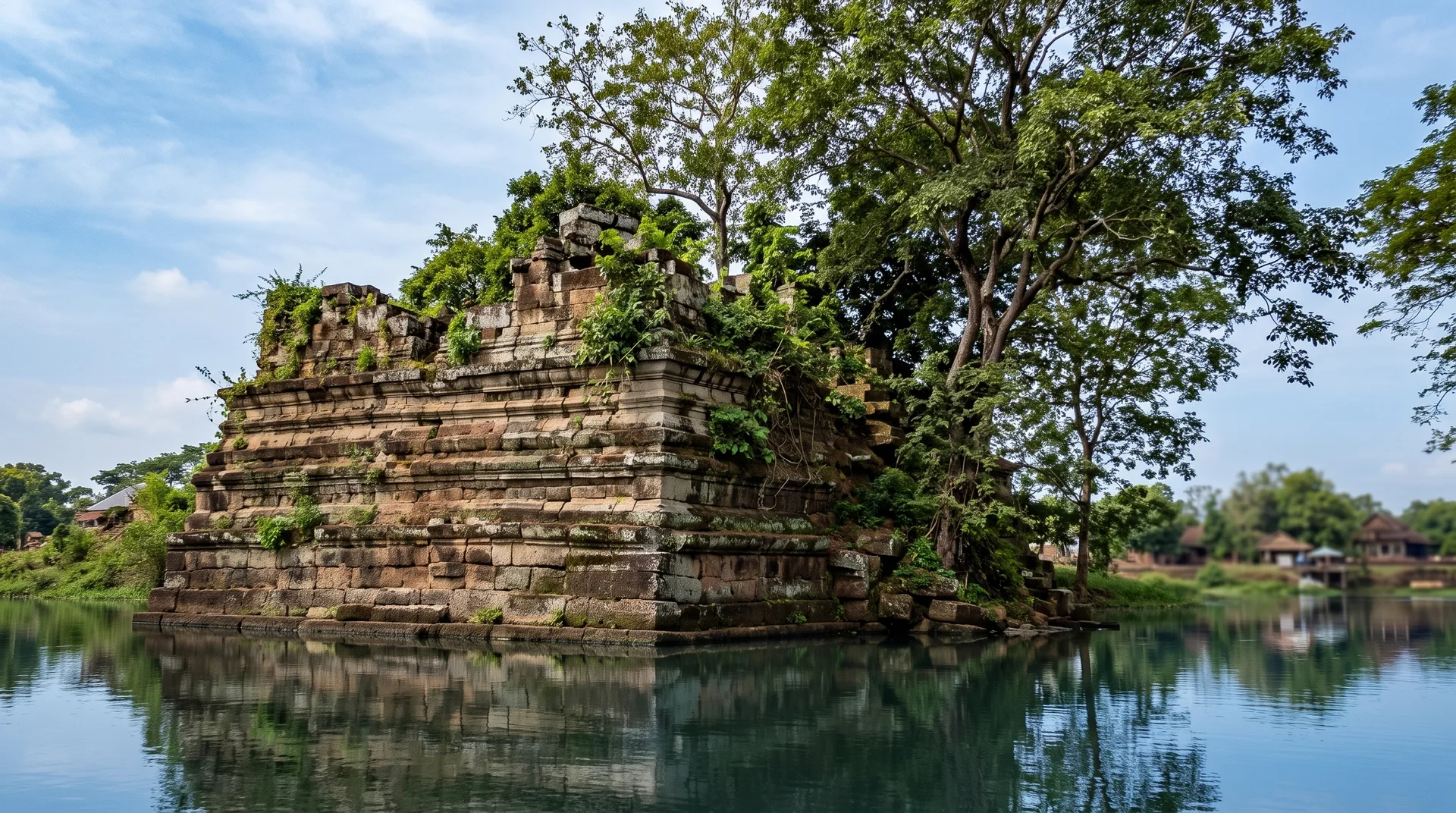
History No clear record survives of its early founding; it is estimated to have been built during the Rattanakosin period. It is the only temple in Thailand with an ordination hall standing in the middle of water, built with an elaborate, exquisite architecture rather than the simple, ordinary style typical of such halls.
Important features within the temple 1. The mid-water ordination hall. 2. A Buddha image in the "subduing Mara" gesture, enshrined in the abbot's quarters, Lanna art, 21st–22nd Buddhist century (16th–17th century CE), bronze, lap width 42 centimeters, total height including base 62 centimeters. 3. A Buddha image in the "subduing Mara" gesture, Lanna art, bronze, lap width 49 centimeters, total height including base 113 centimeters.
Wat Pa Daet, Tambon Tha Pha, Mae Chaem District
History No record survives of when it was built; it is estimated to date to the early Rattanakosin period.
Important features within the temple 1. A vihara in local Lanna style; the temple contains mural paintings within the vihara, the work of Tai Yai (Shan) craftsmen. 2. A Buddha image in the "subduing Mara" gesture, enshrined in the abbot's quarters, Lanna art, 21st–22nd Buddhist century (16th–17th century CE), bronze, lap width 65 centimeters, total height including base 125 centimeters.
Registration as an ancient monument Registered and its boundary announced in the Royal Gazette, Volume 98, Part 177, dated 27 October 2524 (1981).
Wat Phra Phutthabat Si Roi, Tambon Mae Saluang, Mae Rim District
History No clear record survives of its early founding, but documents record that on Sunday, the 3rd waxing day of the 6th month, B.E. 2162 (1619 CE), Phraya Thammalangka traveled to pay homage to the Buddha's footprint there, then built a vihara enclosing the footprint and performed a face-washing water ceremony. Later, an abbot under royal patronage had the vihara restored, and in B.E. 2471 (1928 CE) Khruba Sriwichai removed the old vihara and had it rebuilt anew.
Important features within the temple Include the Phra Phutthabat Si Roi, the "Four-Ring Buddha Footprint."
Registration as an ancient monument Registered in the Royal Gazette, Volume 70, Part 3, dated 5 January 2496 (1953).
Wat Phra Non Khon Muang, Tambon Don Kaeo, San Sai District
History No record survives of the construction of this reclining Buddha image; only legend refers to its restoration in the 25th Buddhist century (20th century CE), which likely altered its important features, though comparison with similar monuments allows its construction to be dated to around the mid-21st Buddhist century (16th century CE).
Important features within the temple Include the reclining Buddha image, built of brick and stucco with gilding.
Registration as an ancient monument Registered in the Royal Gazette, Volume 71, Part 3, dated 5 January 2497 (1954).
Chedi Ban Tha Kan (abandoned), Tambon Ban Klang, San Pa Tong District
History Chedi Ban Tha Kan stands within what was once an ancient city called "Wiang Tha Kan," a name appearing in Lanna records and referred to in legend as the site of this temple since the 21st Buddhist century (16th century CE); however, the archaeological evidence found in this area is somewhat older than the age of Chiang Mai itself, dating to the Haripunchai period, no later than the 16th Buddhist century (11th century CE), though its architectural style would date its construction to around the 21st Buddhist century (16th century CE).
Important features within the temple 1. A round chedi in Lanna style. 2. An octagonal chedi.
Registration as an ancient monument Registered and its boundary announced in the Royal Gazette, Volume 96, Part 160, dated 18 September 2522 (1979).
Wat Tha Kham, Tambon Sop Poeng, Mae Taeng District
History No record survives of when it was built; it is estimated to have been built around the early Rattanakosin period.
Important features within the temple Include a vihara in local Lanna style, containing mural paintings by Tai Yai (Shan) craftsmen depicting the life of the Buddha and local folk jataka tales — the Saeng Mueang Luang Kon Kaeo tale, the tale of the mother mynah bird, and also an episode of the Buddha's life subduing King Mahachomphu, which is depicted in only a few places in Thailand.
Registration as an ancient monument Registered and its boundary announced in the Royal Gazette, Volume 98, Part 177, dated 27 October 2524 (1981).
Wat Sala Kanlayana Mahantaram (Wat Chiang Saen), Tambon Luang Nuea, Doi Saket District
History Wat Sala Kanlayana Mahantaram (Wat Chiang Saen) was originally an abandoned temple; it was later restored, with the religious buildings improved and additional construction carried out in B.E. 2545 (2002 CE), and monks came to reside there again, though today it has once more been left abandoned. A survey of the temple found two stone inscriptions: the first dated to around B.E. 2032–2052 (1489–1509 CE); the second, referring likewise to the founding of the temple, dates to around the same period. This evidence indicates that Wat Sala Kanlayana Mahantaram was built by Muen Dap Ruean sometime between B.E. 2032–2052 (1489–1509 CE), corresponding to the reign of King Tilokarat of Lanna.
There is also a related group of monuments with no surviving founding history, but which on stylistic grounds may be dated to around the 20th Buddhist century (15th century CE) or earlier; each of these sites originally had only a chedi, now collapsed, and they may be classified as follows:
1. Bell-shaped chedi group, including: 1.1 The chedi of Wat Saen Lao — notable for niches cut into its base, suggesting Burmese influence; it has since been restored, and traces of the original base have been covered over. 1.2 The chedi of Wat Pan Sao — a bell-shaped chedi of around the mid-20th Buddhist century (15th century CE), built over an inner octagonal palace-style chedi. 1.3 The chedi of Wat Si Suk, where a stone inscription was discovered dating to around the mid-to-late 21st Buddhist century (16th century CE). 1.4 The chedi of Wat Phon Soi, mentioned in the "Khlong Nirat Haripunchai" poem of around B.E. 2060 (1517 CE), a date consistent with the chedi's stylistic form. 1.5 The chedis of Wat Nong Lom, Wat Chettha, Wat Pa Oi, and Wat Saen Da Hoi — although differing somewhat in architectural detail, all can be classed as monuments of around the 21st Buddhist century (16th century CE). 1.6 The chedi of Wat Muen Kong, a bell-shaped chedi in later Burmese style.
2. Palace-style chedi group, including: 2.1 The chedi of Wat Tum Mo, an important surviving example of Chiang Mai chedi architecture of around the 20th Buddhist century (15th century CE), notable in particular for its surviving stucco reliefs. 2.2 The chedi of Wat Pan Sat, a mondop-style palace chedi built over an inner bell-shaped chedi in local style; besides its distinctive form, its most notable feature is its stucco ornamentation, characteristic of Chiang Mai craftsmanship of that era.
3. There is also the chedi of Wat Ta Du Klang, in the "rice-bundle" (phum khao bin) chedi form distinctive of Sukhothai art, though this example has been substantially altered by local craftsmen; it is estimated to date to around the 21st Buddhist century (16th century CE).
Industrial Sites (Ancient Kilns)
Inthakhin Kiln
Located at Ban San Pa Tong, Tambon Inthakhin, Mae Taeng District. Kiln remains have been found at three locations: house number 48, belonging to Nai Duang Di; the Rong Thong site [translator's note: source text here is severely garbled and could not be reliably transcribed — it references a location near the north side of a Police Border Patrol unit checkpoint (Police Border Patrol Sub-Division 33, K-9 unit) and the bank of Huai Chang Tai, behind the temple, in an area of raised ground within a longan orchard].
The kilns are ceramic-firing kilns of the cross-draft type, built of clay, with a firebox at the front, a firewall, a central chamber or ware-loading room, wider at the front near the firebox and narrower toward the rear, sloping upward toward the chimney at the back; the upper structure is an arched roof coated with clay.
The ceramic ware produced by the Inthakhin kilns is stoneware with pale-green celadon glaze, some pieces glazed brown and pale green together on the same vessel, with a white clay body similar in quality to wares from the San Kamphaeng kiln sites and the Phan kiln sites in Chiang Rai province. The Inthakhin kiln sites are dated to between the reign of King Sam Fang Kaen and the reign of King Tilokarat.
San Kamphaeng Kiln
The San Kamphaeng kiln group is found scattered through valleys along streams that are tributaries of the Mae Taen and On rivers. Excavation and survey have found kiln groups at Huai Pa Rai, Thung Ho, Huai Buak Pin, Doi Thon, Huai Pu Laem, the Mae Taen reservoir, Ton Naen, and Ton Chok, all within the area of Ban On Tai, San Kamphaeng District.
The kilns are of the cross-draft type, generally built in two forms: the first built of brick set in clay, found in the Huai Pa Rai, Huai Buak Pin, Ton Naen, Ton Chok, and Wat Sao Saen kiln groups, built by digging into the earth, then coating the interior with clay mixed with coarse sand, allowed to dry and then fired to fix the structure — a process in which the kiln roof had to be removed each time to extract the fired vessels, since the firebox and flue were quite small. The second form was likewise dug into the earth but with the kiln walls built up of clay mixed with coarse sand, found in the Cham Bon and Kong Bo kiln groups.
Vessel forms found include bowls, plates, cups, trays, bottles and vases both small and large, oil lamps, votive-lamp dishes, animal figurines, and Buddha images, though the most commonly found are bowls, plates, and jars. Surface decoration most often used a green-toned glaze, the most commonly found glaze, mostly in pale green, cream-green, and brownish-green tones; brown glaze is found on jars of various sizes, small pots, and votive-lamp dishes. Some pieces are also decorated with black underglaze painting, and some vessels combine green and brown glaze on the same piece, known by the name "krabueang yai."
Decorative motifs on the vessels include incised and scratched patterns as well as painted designs, including foliage, flowers, fish-scale/chain motifs, floral vines, paired fish, single fish, wave patterns, star/rosette motifs, spiral vine motifs, and animal motifs.
In loading the kiln, ware supports (kiln furniture) were used to stack vessels rim-to-rim and base-to-base in stacked trays, allowing more vessels to be packed into the kiln and ensuring even heat distribution.
The dating of the San Kamphaeng kilns cannot yet be confirmed by scientific dating methods, but associated evidence — a stone inscription at Wat Sala Kanlayana Mahantaram [Muen Dap Ruean], a bronze Buddha image moved from that same temple, and an inscription on a small jar —
Dating places the earlier group in the reign of King Sam Fang Kaen, and a second charcoal sample group dates to B.E. 1950–1998 (1407–1455 CE), possibly extending to B.E. 2000 (1457 CE), spanning the reign of King Sam Fang Kaen to the reign of King Tilokarat.
Archaeological Sites (Prehistoric Era)
Evidence of prehistoric-era archaeological sites found in Chiang Mai province is as follows.
Pha Khan Na Rock Painting Site
Located at Doi Mae Klang, Doi Hua Chang, Chom Thong District. Pha Khan Na is a rock cliff face along the Huai Mae Klang stream, whose headwaters rise at the summit of Doi Inthanon and flow down into the Ping River. The paintings are prehistoric, believed to predate the invention of writing; considering the composition of the imagery, the depicted human figures may represent the community as a whole, including the artist. The elephant appears to be depicted as a fierce, frightening animal, shown lying down, unmoving; the painting technique closely resembles that found in northeastern Thailand, as do the symbolic imagery and technique.
Evidence found includes human figures, animal figures, and symbolic images such as triangles, squares, and circles.
Pha Waen Kaeo
Located at Ban Sop Aep, Tambon Thung Luang [translator's note: tambon name uncertain in source], Chom Thong District — a rock shelter in a limestone mountain range, approximately 16 meters long and 2–3 meters deep, with an overhanging roof projecting out to form a ceiling, about 3 meters above the ground. The rock shelter faces northwest; from this high cliff, the Chom Thong–Mae Chaem road can be seen, while to the east lies a plateau area, the headwaters of the Mae Klang stream. The area where the paintings were found measures approximately 5.5 meters long and 3 meters deep.
Evidence found includes human figures, hand-print images, and dot patterns, made by dabbing pigment onto the tips of the five fingers and pressing them onto the rock face.
Ban Aen Temple Archaeological Site (New)
Tambon Ban Aen, Doi Tao District, located on a flat plain. Judging from the evidence found, this was likely a habitation site, since it yielded stone tools flaked on one and both faces, stone flakes, and hammerstones, all made from river cobbles obtained from ancient stream deposits, which are common throughout the area.
Evidence found includes flaked stone tools worked on one face and on both faces, made from river cobbles, as well as stone flakes — broken tool fragments — and hammerstones made from river cobbles.
Ban Mai Tha Nuea Archaeological Site
Located at Ban Mai, Village 2, Tambon Sop Tha Nuea [translator's note: tambon name likely "Sop Tha Nuea," uncertain in source], Mae Taeng District. The Ban Mai Tha Nuea site was likely a temporary camp of prehistoric people, judging from the small quantity of stone tools found relative to the extensive area, most of which show signs of use. The habitation area was likely on the flat land along the Mae Tha riverbank; the population was probably not dense. The site's stone-tool assemblage belongs to an agricultural society (Neolithic period), dated to approximately 2,500–3,000 years ago.
Evidence found includes horseshoe-shaped flaked stone tools, stone flakes showing polishing marks, unshouldered polished stone axes, and polished stone axes made of basalt.
Ban San Pa Kha Archaeological Site
Located in Tambon San Pa Pao, San Kamphaeng District, a mound measuring 30 by 8 meters, to the northeast of the village. Excavation uncovered three skeletons together with vessels and ritual grave goods, such as earthenware vessels, polished stone axes, stone bracelets, in burial pits, along with animal bones and shell/gold ornaments. The associated burial custom evidence can be dated to the prehistoric period, either the pre-Haripunchai cultural group or a lagging group contemporary with Haripunchai urban society, dating to between the 16th–17th Buddhist century (11th–12th century CE).
Layer 1: A burial site, similar to the Ban Yang Thong Tai archaeological site. Excavation found three skeletons, earthenware vessels such as pottery, polished stone axes, and stone bracelets in sand-filled pits, along with animal bones and shell/gold ornaments. The distinctive character of the pottery found with these burials belongs to the late prehistoric period, associated with a lagging group contemporary with Haripunchai urban society, dated to between the 16th–17th Buddhist century (11th–12th century CE).
Evidence found includes human skeletal remains, pottery of San Kamphaeng type and Wiang Ka Long type, plain red-slip earthenware vessels, polished stone axes, iron spearheads, animal bones, shells, and Wiang Ka Long ceramic sherds.
Layer 2: A layer of habitation and activity from the Lanna period, dated by comparison with the artifacts found, consisting of San Kamphaeng and Wiang Ka Long ceramic sherds, dated to approximately the 20th–21st Buddhist century (15th–16th century CE).
Evidence found includes three skeletons, plain red-slip earthenware vessels, polished stone axes, iron spearheads, animal bones, shells, and Wiang Ka Long ceramic sherds.
Ban Yang Thong Tai Archaeological Site
Located at Village 4, Tambon San Pu Loei, Doi Saket District — a burial site only, with no habitation layer found for this group of people within the excavated area; the burial evidence indicates a single period and culture, that of the late Metal Age. The use of iron tools is consistent with comparison of the pottery styles used in mortuary activity of the Haripunchai cultural group in the Chiang Mai–Lamphun area, showing a continuity of culture leading into the Haripunchai cultural group, since the Ban Yang Thong Tai site's age falls at the late end of the prehistoric period, in the process of developing into the settled cultural groups that followed.
Evidence found consists of earthenware sherds, glass beads, iron nails, human bones, bronze bracelets, iron tools, snail and mollusk shells, and fossilized wood.
Ban Op Luang Archaeological Site
Located in Tambon Hang Dong, Hot District. The site's topography lies on a fairly steep slope descending from the east; surface archaeological evidence consists of stone tools flaked on one and both faces, ground stone tools, and stone flakes scattered fairly densely across the ground surface, though no pottery sherds at all were found — indicating that this area was likely not a permanent habitation site. To the south of the surveyed archaeological site is a low mound, where excavation revealed a dense buildup of archaeological evidence, such as earthenware pottery vessels, flaked stone tools, and fragments of clay bracelets — indicating that this area was likely a permanent habitation site.
Evidence found includes stone cobbles, flaked stone tools worked on both faces and one face, ground stone tools, and stone flakes.
Op Luang Archaeological Site
Located at Op Luang Park, on the border of Hot and Chom Thong districts. Archaeological evidence found from the group of finds in this Op Luang park area broadly confirms it to be a burial group of people from a Bronze Age agricultural society, and likely dates to a period showing advances in technology — pottery-forming showing traces of wheel-turning used in shaping, particularly the upper part of the vessel resembling a bowl form; and the presence of imported shell ornaments clearly confirms contact between communities in the surrounding area.
Evidence found includes flaked stone tools, stone cores, and stone flakes; unshouldered polished stone axes; perforated cowrie shells; red ochre nodules; human skeletons; vessel or ornament fragments confirming shell-ornament trade; silver-decorated ware of Chinese origin; glazed earthenware vessels; plain red-painted "mo si" ware vessels; and patterned "mo si" ware vessels.
Pha Phomai
Located at Ban Mae Long, Tambon Hang Dong, Hot District — a limestone rock shelter within the limestone range of Doi Mu Krathing, part of the Thanon Thongchai mountain range, approximately 9 meters [translator's note: unit/dimension unclear in source] with a width (height) of 6 meters. Above, an overhanging shelf projects out in the manner of a roof or ceiling; in front is a fairly broad open area, with flaking damage visible throughout. Rock paintings appear on the stone wall, measuring 5 by 12 meters, divisible into two groups.
Group 1: a group of large-scale images; the composition begins at the center of the rock face and extends to the far right edge in a large image group, painted in a solid silhouette technique, in red, black, and white.
Group 2: a group of small images, entirely in solid silhouette technique, painted in red.
Evidence found includes human figures, animal figures, symbolic images, images of objects, and [additional unclear imagery, per source].
Pha Chang
Located at Op Luang National Park — a rock shelter with an overhanging upper ledge.
Historic Districts and Traditional Communities
Chiang Mai has a number of important historic districts; several such districts appear throughout the city, each with a long history extending from the Lanna period down to the Rattanakosin period, including communities of Tai Yai (Shan), Chinese, Tai Khoen, and Tai Yuan people, among others.
The Tai Yai (Shan) community is located in Tambon Chang Phueak, Mueang Chiang Mai District, in the area north of Chang Phueak Gate. Its people originally worked in betel-nut cultivation, glazed pottery, and blacksmithing, with Wat Pa Pao as the community center — considered the first Tai Yai temple in Chiang Mai, built in B.E. 2466 (1923 CE).
The Chinese community is concentrated in the Wat Ket area, near the Warorot Market (Kat Luang), Mueang Chiang Mai District.
The Tai Khoen community is located around Wat Chai Lek Luang (Inthraram), Tambon Si Lak [translator's note: tambon name uncertain in source], Mae Rim District, Chiang Mai province. According to legend, since the Mangrai dynasty, the ruler of Chiang Mai ordered soldiers to build the "great iron banner" temple to ward off armies invading from the north; the conflict later ended, said to be through the intervention of a sacred banner-post spirit, and the local people, fearful, kept their distance from opposing forces — the great iron banner post has since been lost, its exact location among the descendants uncertain, somewhere around Ban Muat, San Sai District. The Tai Khoen people living in this area migrated from Chiang Tung around B.E. 2300 (1757 CE). When Chao Inthawichayanon inspected the area and was pleased by its tranquility, he had a new vihara built, since the old vihara on the bank of the Ping River had been eroded by the river, and moved the original Buddha image to the new vihara. Later, in B.E. 2480 (1937 CE), Phra Rajajaya Chao Dara Rasami had it rebuilt again and renamed it Wat Inthraram, after Chao Inthawichayanon's name; Wat Inthraram is a public (non-royal) monastery.
The Tai Yuan community is located in the Ban Tom area, Tambon Chang Khlan, Mueang Chiang Mai District — a Tai Yuan community forcibly resettled from Chiang Saen around B.E. 2347 (1804 CE) during the reign of King Kawila. In the past, the people of Ban Tom possessed a distinctive character in art, architecture, dress, and cuisine.
In addition, during the reign of Phraya Kawila, skilled craftsmen in various fields were also forcibly resettled into Chiang Mai, such as the communities of Ban Wua Lai and Ban Hai Ya, Tambon Hai Ya, Mueang District, Chiang Mai province. Ban Wua Lai is a community resettled from the original Ban Wua Lai, located on the west bank of the Salween River; in the reign of King Kawila, the Ban Wua Lai community became renowned silversmiths, a reputation it retains from the past to the present, with Wat Muen San as the community center — hence the name "Ban Wua Lai–Muen San." Ban Chang Lo (Foundry Village) takes its name from the foundry-casting trade practiced by a community originally from the ruler of Chiang Saen; today most of these craftsmen have relocated to Ban Chang Lo in the Chiang Saen area.
The longest continuously settled community is Ban Chang Khian, Tambon Suthep, Mueang Chiang Mai District. This community was originally called "Thung Chang Khian," a core community whose name appears from the reign of King Tilokarat; during the era when Burma ruled over Chiang Mai, Chao Ong Kham designated land here as an offering to the monkhood; later, in B.E. 2461 (1918 CE), oversight was given to the head of the city, the Chao Ratchawong. The Mae Sa stream flows through Thung Chang Khian; the temple serving as the community center is Wat Chang Khian, used by people carrying supplies up to make offerings at Phra That Doi Suthep.
Markets are another site considered an important historic district. Several market districts appear in Chiang Mai. One especially important trading center and port town in history was Wiang Kum Kam, which had an important market and landing serving as a center of trade exchange; the Chiang Mai chronicles record that "boats trading from various places came to trade at the Kum Kam market in such numbers that boats moored there every single day." A nearby market in old Chiang Mai stood in front of what is today Wat Sing (Wat Phra Singh), continuing on to the area of the Bodhi tree in the middle of the walled city, Tambon Phra Singh, Mueang District.
Among the markets that became well known and continued trading in Chiang Mai in later periods is Warorot Market (Kat Luang), established around B.E. 2453 (1910 CE), after Phra Rajajaya Chao Dara Rasami relocated the old royal cremation ground/cemetery of the northern nobility to Wat Suan Dok in B.E. 2452 (1909 CE); it was treated as the royal fresh market, with the ruling family renting out market space to the public for trade, and it has continued trading without interruption to the present day.
Noble Residences and Modern-Era Architecture
There were also a number of residences (khum) belonging to the northern nobility, such as Khum Choeng Doi Suthep (today the site of Choeng Doi School and the Faculty Council of Chiang Mai University), the Ban Buak Khrok residence on San Kamphaeng Road, Khum Kaeo on Chang Kaeo Road (also called Khum Tang Kaeo, or "Chedi Ngam"), today the American Consulate; and Khum Luang, today a commercial building in the Warorot market area. These residences are said to have been built during the era of Field Marshal Chao Kaeo Nawarat; the same period also saw the construction of the road up Doi Suthep, begun on 9 November 2477 (1934) and opened for use on 30 April 2478 (1935).
Another site of importance in Chiang Mai is the First Church of Chiang Mai, in Tambon Wat Ket, Mueang Chiang Mai District — the first Christian church in Lanna.
Notable Architecture
Chiang Mai possesses a number of architectural works of distinctive character and value in various respects, including the following.
Phra That Doi Suthep is located on Doi Suthep, at an elevation of 1,664 meters above sea level, a sacred site held in deep reverence by the people of Chiang Mai. It was first built when the elder monk Sumana enshrined a Buddha relic there in the reign of King Kue Na, in B.E. 1929 (1386 CE). The present chedi form is a bell shape on a single twelve-sided base, entirely clad in gilded copper plate, surrounded by a boundary wall (kamphaeng kaeo), royal umbrellas, a covered cloister gallery, and viharas arranged around it.
Vihara Lai Kham, Wat Phra Singh Woramahaviharn is a single-story, gable-roofed building; behind it a reliquary chamber replaces a mondop, built flush against it. Its base is set back in tiers, raised on a brick-and-stucco platform facing southeast, its column structure comprising a central pair of columns supporting the gable roof and outer columns supporting the two wings; the walls are of brick-and-stucco construction with windows set at the mid-point of the side and rear walls; the roof is of timber construction covered in terracotta tile. The ceiling is decorated with gilded star motifs on a red-lacquer ground, matching the columns; the pedestal platform bears colored glazed stucco relief on a red-lacquer ground with gilt decoration, and the lower interior walls bear mural paintings depicting the Suwannahong and Sang Thong tales; the exterior is decorated with gilt ornament on a red-lacquer ground across its various elements — the finial, the roof ridge trim, the gable, the eave brackets, the "second collar" beam, the curved bargeboard, the "elephant-ear" brackets, and so forth. It stands as an example of local Lanna vihara architecture, one of the most beautiful and valuable in Chiang Mai province.
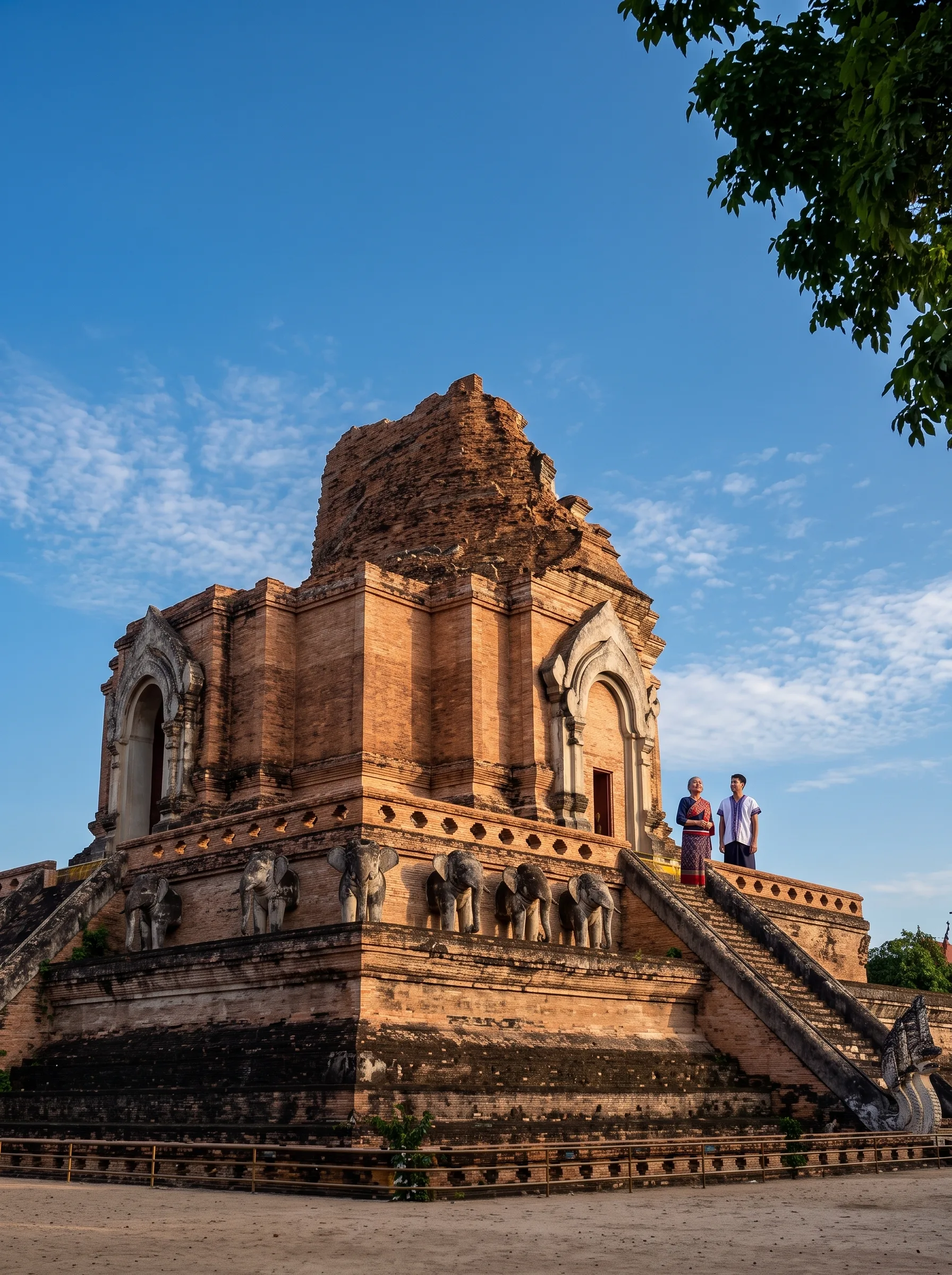
Wat Chet Yot, built in the reign of King Tilokarat in B.E. 1998 (1455 CE), served as the site of the Eighth World Buddhist Council in B.E. 2020 (1477 CE). Later, Phra Mueang Kaeo had further viharas and chedis added. The important monuments within the temple include a group of five chedis in the style of Bodh Gaya, India, the largest central one serving as the principal monument, with two bell-shaped chedis in front adorned with celestial figures; also present are the site associated with King Tilokarat's meditation, the Animit Chedi, the reliquary (ku) of King Tilokarat, the ordination hall, the mondop, the Mucalinda pond, the Rattana Chongkrom Chedi, subsidiary chedis, and the entrance gateway.
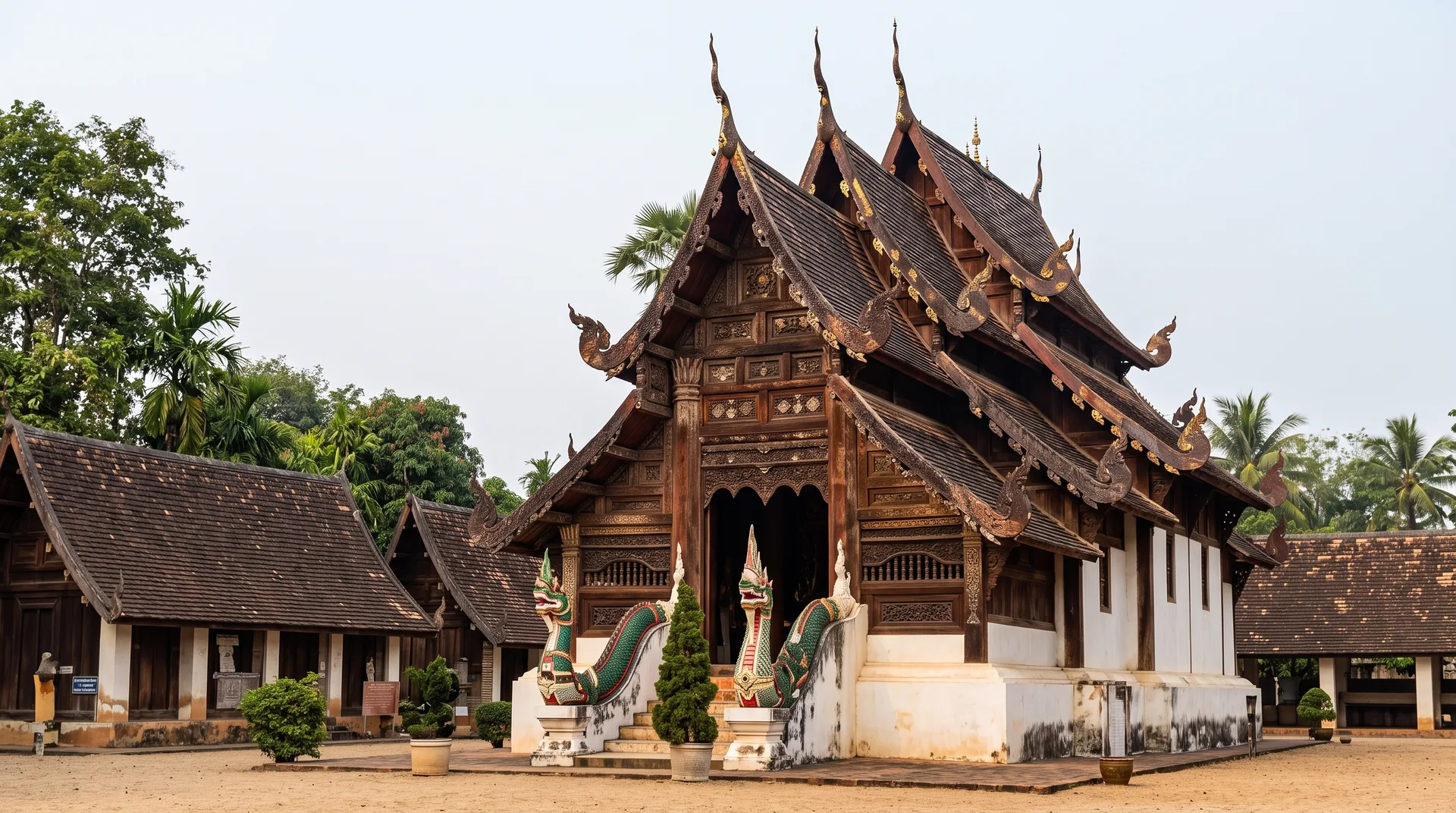
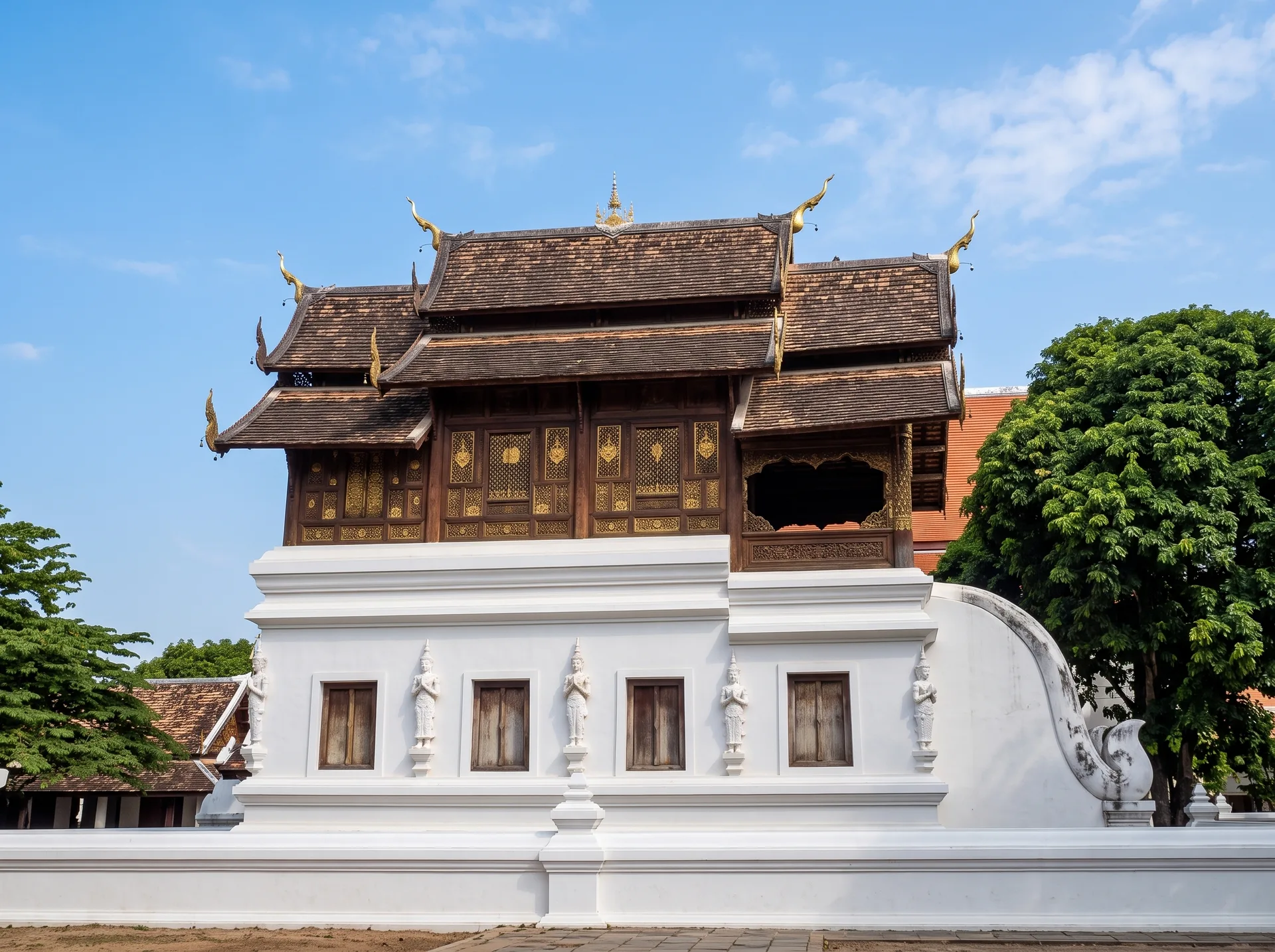
Wat Ton Kwaen received the National Award for Outstanding Architectural Conservation. It comprises a vihara in Lanna style and a corner-porch mondop in Lanna style; the buildings are of wood construction, the roof structure unadorned with stucco, roofed with its original timber roofing materials.
Wat Saen Fang, located on Tha Phae Road, Tambon Chang Khlan, Mueang Chiang Mai District. Within the temple stands a principal chedi in Burmese architectural style, set on a square circumambulatory base with four small subsidiary chedis at its corners. To the east, slightly offset, stands a wooden vihara in a mixed Burmese-Lanna style, decorated with carved floral motifs. This vihara was built around the early Rattanakosin period; later, in B.E. 2430 (1887 CE), the audience hall of King Kawilorot Suriyawong was dismantled and used to build the vihara.
Wat Suan Dok (Wat Buppharam), located on Suthep Road, comprises subsidiary chedis surrounding the principal chedi, an open-sided vihara in front of the chedi, chedis containing the remains of the ruling princely lineage of Chiang Mai, and the former cremation ground of the northern nobility.
Important Monuments and Statues (continued)
The Three Kings Monument, located on Ratchadamnoen Road, Tambon Si Phum, Mueang Chiang Mai District, is a bronze statue group depicting King Mangrai, King Ngam Mueang, and King Ram Khamhaeng standing together in consultation over the founding of Chiang Mai. It was designed and cast by Khai Muk Chuto, an artist under the patronage of Her Majesty the Queen Mother, on the occasion of Chiang Mai's 700th anniversary in B.E. 2539 (1996), with the formal enshrinement ceremony completed at that time. It reflects the good relations among the three kingdoms that jointly established the city, and its figures — installed on the outer wall of the Maha Photharam vihara — were rendered with proportions and musculature based on anatomical study.
The King Kawila Monument is a bronze statue, roughly one-and-a-half times life size (2.50 meters), depicting the king standing, holding his sword in a slightly drawn stance, dressed in royal attire and wearing a wide-brimmed hat, facing east toward the Kawila military encampment. It was designed by Nai Chin Preechayan, a skilled artist, with Nuchanoi Boon [translator's note: name uncertain in source] as senior artisan of the Fine Arts Department's Handicrafts Division (as it then was); the monument was completed and formally unveiled on 5 February 2515 (1972).
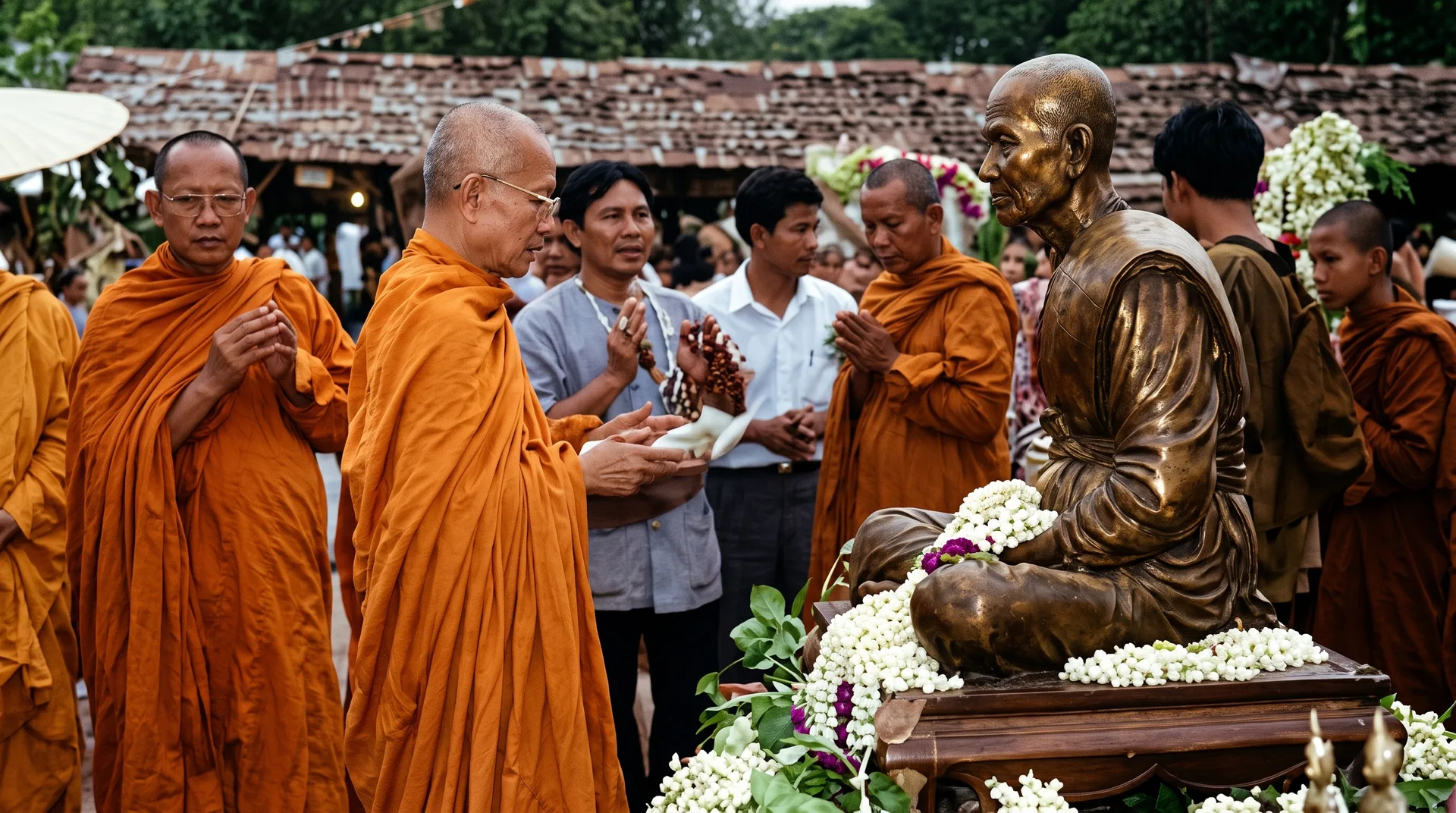
The Khruba Sriwichai Monument — another figure held in great reverence by the people of Chiang Mai, a great elder monk devoted to insight meditation practice, given the epithet "Ton Bun Haeng Lanna" (the meritorious founder of Lanna), meaning one of great accumulated merit for the land of Lanna. The Khruba Sriwichai Monument stands at the foot of Doi Suthep, Mueang Chiang Mai District — a cast metal statue depicting Khruba Sriwichai seated with his monastic requisites, standing with staff in hand, at roughly one-and-a-half times life size, designed, sculpted, and cast by the Fine Arts Department in B.E. 2506 (1963), as a memorial to this great meditation-master elder, toward whom the people of Lanna hold deep and fervent devotion.
Another figure held in high esteem and reverence by the people of Chiang Mai is Phra Rajajaya Chao Dara Rasami. The monument to Phra Rajajaya Chao Dara Rasami was first created around B.E. 2525 (1982), the year marking the 100th anniversary of her royal marriage to King Chulalongkorn (Rama V). The first version was a marble half-figure monument of this royal consort of the Fifth Reign; subsequently, funding was raised for a new version — a plaster half-figure statue, which was then taken to the Fine Arts Department, where Nai Sak Sanaerongrong, Deputy Director-General of the Fine Arts Department, oversaw the sculpting; in her capacity as a royal descendant, Than Ying Chatsuda Wongthongsri was invited to take part, and Nai Aram Sawatdi was appointed to coordinate with the bronze-casting artisans.
Sacred Symbols of the City
Certain sites are held to be sacred symbols of Chiang Mai, so important that it is said a visitor to Chiang Mai who has not paid homage at these places has not truly visited Chiang Mai at all. They are:
Wat Phra That Doi Suthep — documentary evidence records that the Doi Suthep relic came from the city of Pang Cha (between Sukhothai and Si Satchanalai), brought as an offering to King Kue Na (r. B.E. 1898–1928 / 1355–1385 CE). It had originally been a single relic that broke into two pieces; one piece was enshrined in the principal chedi of Wat Suan Dok (Pupparam), and the other was placed on the back of an elephant, which was released to wander until it climbed up to the site of present-day Doi Suthep. The elephant walked up and stopped at that spot, whereupon a chedi was built there to enshrine the relic, forming the Phra That Doi Suthep seen today. This is said to have served, at that time, to bring the peoples living on Doi Suthep (the Lawa) to accept Buddhism just as the lowland people (of Chiang Mai) had, alongside the veneration of relic chedis already practiced by the people of the plains.
Phra Buddha Sihing — a Buddha image held as a sacred symbol of Chiang Mai, enshrined in the Lai Kham vihara of Wat Phra Singh Woramahaviharn. According to legend, the Phra Buddha Sihing originated in Sri Lanka and was subsequently moved to Nakhon Si Thammarat, Chainat, Ayodhya (Ayutthaya), Chiang Mai, and Chiang Rai. Today three images bear the name Phra Buddha Sihing — in Bangkok, Nakhon Si Thammarat, and Chiang Mai — the Chiang Mai image, enshrined as the principal image of the Lai Kham vihara, being classed among the "Sinhalese-style" (Sing Nueng) group of Buddha images: a somewhat stout figure, a rather round face, large curled hair-knots, in a meditative expression, robed with the right shoulder bared, the short sanghati robe-end resting above the chest — resembling in these respects the Pala-Sena school Buddha images of India (c. 14th Buddhist century / 9th century CE) [translator's note: source text repeats this comparison with two different century figures, 19th and 14th Buddhist century, likely a transcription inconsistency; the Pala-Sena reference is retained as given].
The Inthakhin Pillar, within the grounds of Wat Chedi Luang Woraviharn. Ancient Chiang Mai legend links the origin of the custom of venerating the Inthakhin pillar to both the Lawa and Thai peoples. According to the account, Phraya In (Indra), moved by devotion to the god Indra, granted a stone pillar for the Lawa and Thai communities to jointly observe from that time on, in truthfulness and the keeping of the five and eight precepts — accounts vary somewhat on this point. Regarding the history of its installation, the legend speaks of "Sao Sin," a pillar belonging to Indra in the Tavatimsa heaven, which three Kumphan giants were tasked with carrying down and installing beneath a great yang tree within the grounds of what is now Wat Chedi Luang, with Indra charging the Kumphan to guard it thereafter; the legend also tells of Indra's creation of the Tavatimsa heaven, from which the name "Inthakhin" — meaning "Indra's pillar" — derives. Tradition holds it to be the pillar Indra granted to the Lawa people, carried down from the heavens by two Kumphan giants, who then remained to guard the Inthakhin pillar, believed to be buried beneath the ground. The people of Chiang Mai hold the Inthakhin to be a sacred pillar and guardian symbol of the city, serving as the city's guardian spirit (suea mueang), with the power to protect the city from danger and to bring prosperity; accordingly, a ceremony of veneration called "Khao Inthakhin" is held every year in the eighth month of the northern Thai calendar.
Considering the content of this legend, the Inthakhin pillar is a stone pillar whose founding narrative draws on Buddhist doctrine, embracing both the Thai and Lawa peoples, invoking both the hermit-sage figure and the god Indra (a deity within the Buddhist cosmology) to lend it sanctity — a characteristic pattern in the composition of Lanna Buddhist legend, or, put another way, a fusion of belief in guardian spirits of house and city with the Thai peoples who came to settle here.
Terra Lanna Travel was founded out of a love for Lanna history and culture. We believe the stories of the northern land — its legends, traditions, temples, and the way of life of those who came before us — are a precious heritage worth recording, preserving, and passing on to future generations. That is why the core content of this website is centered on travel, history, and culture articles about Lanna.
Hotels & Tours: A Supporting Role
The hotel accommodations and tour programs featured on this site are a supplementary source of income, used to develop and maintain the website so it can continue in the long run — they are not our primary purpose.
Our Role
Our main role is to tell stories and share knowledge about Lanna history, so this cultural heritage can be preserved, protected, and passed on to future generations. We also translate our content into multiple languages so that international readers with an interest in Lanna culture can access and learn these stories too.
About Our Images
The images on this website include both genuine photographs and images restored using AI technology from old black-and-white photographs, so readers can see the atmosphere of those eras more clearly and vividly.
Privacy Policy / นโยบายความเป็นส่วนตัว
Last updated: 26 April 2026 | อัปเดตล่าสุด: 26 เมษายน 2569
This site contains affiliate links to Agoda, Viator, and Trip.com. When you click these links and make a booking, we may earn a commission at no extra cost to you. Hotel prices (Agoda) and tour prices (Viator) shown on this site are live prices pulled directly from our partners; Trip.com prices require clicking through to the partner's own site. Affiliate cookies are only set when you click these links directly.
คุกกี้สถิติและการวิเคราะห์ (Analytics Cookies): วิเคราะห์แนวโน้มการเข้าชมหน้าเว็บเพื่อปรับปรุงคุณภาพเนื้อหา ผ่าน Google Analytics (G-CSV1H77PY8)
We use cookies and similar technologies to enhance your browsing experience:
Preference Cookies: Remember your selected language and cookie banner consent status.
Analytics Cookies: Help us understand audience engagement and improve article quality via Google Analytics.
5. นโยบายโฆษณา Google AdSense / Google AdSense Advertising Disclosures
เว็บไซต์นี้ใช้บริการโฆษณาจาก Google AdSense เพื่อสนับสนุนการดำเนินงานและการผลิตเนื้อหาคุณภาพ เพื่อให้เป็นไปตามข้อกำหนดและนโยบายความเป็นส่วนตัวของ Google เราขอแจ้งให้ผู้ใช้ทราบดังนี้:
ผู้ให้บริการภายนอก ซึ่งรวมถึง Google ใช้คุกกี้ (รวมถึง DoubleClick cookie) เพื่อแสดงโฆษณาตามประวัติการเข้าชมเว็บไซต์นี้หรือเว็บไซต์อื่นๆ ในอินเทอร์เน็ตของผู้ใช้ในอดีต
การใช้คุกกี้เพื่อการโฆษณาช่วยให้ Google และพาร์ทเนอร์สามารถแสดงโฆษณาที่เกี่ยวข้องและตรงกับความสนใจของผู้ใช้ อิงตามประวัติการเข้าชมเว็บไซต์ของเราและ/หรือเว็บไซต์อื่นๆ ในเครือข่ายอินเทอร์เน็ต
ผู้ใช้มีสิทธิ์เลือกปิดการใช้งาน (Opt-out) โฆษณาที่ปรับแต่งตามโปรไฟล์ความสนใจส่วนบุคคลได้ทุกเวลา โดยเข้าไปที่ Google Ads Settings หรือเข้าไปที่เว็บไซต์ www.aboutads.info เพื่อปิดการใช้คุกกี้ของผู้ให้บริการภายนอกสำหรับการโฆษณาตามความสนใจ
This website partners with Google AdSense to display advertisements. In strict accordance with Google AdSense Publisher Policies, please be advised:
Third-party vendors, including Google, use cookies (including the DoubleClick cookie) to serve ads based on a user's prior visits to this website or other websites across the Internet.
Google's use of advertising cookies enables it and its partners to serve personalized ads to users based on their visits to our site and/or other sites on the Internet.
Users may opt out of personalized advertising at any time by visiting Google Ads Settings. Alternatively, users can opt out of a third-party vendor's use of cookies for personalized advertising by visiting www.aboutads.info.
Terra Lanna Travel Chiang Mai — เชียงใหม่, ประเทศไทย
Terms of Service / ข้อกำหนดการใช้งาน
Last updated: 25 September 2026 | อัปเดตล่าสุด: 25 กันยายน 2569
1. เกี่ยวกับบริการของเรา / About Our Service
Terra Lanna Travel Chiang Mai ("เรา", "Terra Lanna") ให้บริการเว็บไซต์ที่รวมหลายส่วนเข้าด้วยกัน ได้แก่ ที่พัก Nampiangdin Boutique Hotel ทัวร์ฟาร์มออร์แกนิกที่ลำพูน โปรแกรมทัวร์คัดสรร ไดเรกทอรีโรงแรมพร้อมราคาสดจากพาร์ทเนอร์ บล็อกเรื่องราวเชิงวัฒนธรรมล้านนา และ "ห้องสมุดล้านนา" ซึ่งเป็นคลังหนังสือประวัติศาสตร์/วัฒนธรรมล้านนาที่แปลและเรียบเรียงขึ้นใหม่ การใช้งานเว็บไซต์นี้ถือว่าคุณยอมรับข้อกำหนดฉบับนี้
Terra Lanna Travel Chiang Mai ("we", "Terra Lanna") operates a website combining several parts: Nampiangdin Boutique Hotel accommodation, organic farm tours in Lamphun, curated tour programs, a hotel directory with live partner pricing, a Lanna culture blog, and the "Lanna Library" (ห้องสมุดล้านนา) — a collection of translated and re-edited Lanna history and culture books. By using this website, you agree to these Terms.
2. เนื้อหาบล็อกและห้องสมุดล้านนา / Blog & Lanna Library Content
บทความบล็อกและหนังสือใน "ห้องสมุดล้านนา" เป็นผลงานที่เรียบเรียง แปล และดัดแปลงขึ้นโดย Terra Lanna จากแหล่งข้อมูลประวัติศาสตร์/วรรณกรรมล้านนาสาธารณะ โดยมีเจตนาเพื่อการสานต่อและอนุรักษ์วัฒนธรรมล้านนาให้เข้าถึงได้ในหลายภาษา เนื้อหาที่แปล/เรียบเรียงใหม่นี้เป็นลิขสิทธิ์ของ Terra Lanna ส่วนผลงานต้นฉบับยังคงเป็นของผู้ประพันธ์/สำนักพิมพ์เดิมตามที่ระบุไว้ในแต่ละเล่ม รูปภาพประกอบบางส่วนเป็นภาพถ่ายจริง และบางส่วนสร้าง/บูรณะขึ้นด้วยเทคโนโลยี AI จากภาพถ่ายเก่าขาวดำ (ดูรายละเอียดที่หน้า About Us) เนื้อหาทั้งหมดจัดทำขึ้นเพื่อวัตถุประสงค์ด้านการศึกษาและวัฒนธรรม ห้ามคัดลอกหรือนำไปเผยแพร่ซ้ำเพื่อการค้าโดยไม่ได้รับอนุญาตเป็นลายลักษณ์อักษร
Blog articles and books in the "Lanna Library" are compiled, translated, and adapted by Terra Lanna from public Lanna historical/literary sources, with the intent of continuing and preserving Lanna culture in multiple languages. This translated/re-edited content is copyrighted by Terra Lanna; original source works remain the property of their original authors/publishers as credited within each volume. Some accompanying images are genuine photographs, while others are AI-restored or AI-generated from old black-and-white photographs (see the About Us page for details). All content is produced for educational and cultural purposes. Copying or commercial redistribution without written permission is prohibited.
3. การจองผ่านลิงก์พาร์ทเนอร์ / Bookings via Partner Links
Hotel (Agoda) and tour (Viator) prices shown on this site are pulled live from our partners, but the actual booking is completed on the partner's own website and is governed by that partner's own terms and cancellation/refund policy — not Terra Lanna's. We act only as an affiliate referrer and are not a party to that booking contract, and are not responsible for service issues, cancellations, or disputes arising from the partner. (See Privacy Policy for affiliate commission details.)
You may not use this website to: violate Thai or applicable law, scrape or bulk-extract content without permission, or attempt unauthorized system access.
We provide information on this website "as is" and make reasonable efforts to keep it accurate and current, but do not guarantee that content, prices, or availability are correct, complete, or error-free at all times. To the maximum extent permitted by law, Terra Lanna is not liable for indirect, incidental damages, or loss of profit arising from use of this website or our partners' services.























 ภูมิปัญญาดินอินทรีย์ · 4 นาที