★ 9.4/10 EXCEPTIONAL ON AGODA & BOOKING.COM • ROYAL FLORA RATCHAPHRUEK CERTIFIED
Overnight Nature Farmstay • KAS Farmstay
KAS Farmstay (Private Farmstay Tent & Campfire)
Experience a peaceful private farmstay amidst our organic orchards in Lamphun. Cozy tent glamping, evening campfires under starry skies, and organic garden-fresh mookata BBQ. Official online booking is now live.
A collection of translated rare books on Lanna history and culture
Terra Lanna is gathering and translating rare books on Lanna history, beliefs, and way of life — preserving these stories and sharing them with readers everywhere.
Sort by:
Listen to Lanna Stories
Translating and gathering books — coming soon
Contact Us
Talk to us, or share your feedback to help us improve and grow.
Our Hotel
NampiangdinBoutique Hotel
4-Star Lanna Boutique Hotel in the Heart of Chiang Mai
★★★★ 4-Star Boutique46 Rooms15 Min from AirportFree Airport Transfer
Nampiangdin Boutique Hotel is a 4-star boutique property blending ancient Lanna architecture with modern comfort. Located in central Chiang Mai, 15 minutes from the airport, with a warm atmosphere, heartfelt service, a lush garden, outdoor pool, and a restaurant featuring local ingredients.
Rooms
Choose the ExperienceThat's Right for You
All rooms feature a private balcony, pool view, AC, free WiFi, minibar, and breakfast included
Sorted by guest review score — prices updated daily
Active & Available in Chiang Mai
Your Eyes, Ears & Boots on the Ground in Chiang Mai
Moving, investing, or sourcing in Northern Thailand? We provide what no remote tool or overseas agency can ever match: genuine local presence, native northern dialect negotiation, and zero-bias on-site execution.
Why Technology Cannot Replace Local Boots on the Ground
Overseas expats, digital nomads, and remote investors face significant friction when managing property or sourcing in Northern Thailand. Having trusted on-the-ground representation eliminates risks, protects your budget, and gives you total peace of mind.
Common Pitfalls of Managing Remotely
Misleading Listings: Online photos are frequently edited or years out of date. In reality, properties may have hidden mold, weak water pressure, noisy air-conditioning, or loud construction right outside your window.
Unwarranted Price Markups: Without local Thai and Northern dialect negotiation skills, foreigners often face inflated quotes—paying 20%–40% above true local market rates for rent, contractor labor, and artisan craft manufacturing.
Unreliable Wi-Fi Claims: Landlords routinely advertise 'high-speed internet' that turns out to be congested shared building Wi-Fi with high latency, dropping client Zoom calls and disrupting remote work.
Zero On-Site Emergency Recourse: When an air conditioner leaks, plumbing bursts, or a guest locks themselves out late at night, remote coordination across time zones is stressful and ineffective.
The Terra Lanna Advantage
Objective High-Definition Video Inspections: We physically inspect every corner of the property, testing plumbing pressure, air-con odor, noise decibels, and surrounding neighborhood conditions without bias.
Direct Native & Northern Dialect Negotiation: We speak fluent Thai and Kam Mueang directly with landlords, technicians, and workshop owners—securing authentic, fair local terms and lease conditions.
Certified On-Site Speedtests: We plug in directly to run certified Ookla Speedtests (measuring ping latency, jitter, download, and upload speeds) before you commit to any rental deposit.
Trusted Keyholding & Urgent Dispatch: Permanently stationed in Chiang Mai, ready to handle emergency lockout rescues, supervise contractors, and deliver structured photo/video reports directly to you.
Our 4 Core Capabilities
What Overseas Clients Hire Us to Do
Four specialized on-the-ground services tailored for expats, remote entrepreneurs, Airbnb owners, and international media agencies.
For Nomads & Expats
Local Fixer & Personal Assistant
Your personal problem solver in Chiang Mai. Whether you are landing soon or already living here, we eliminate bureaucratic stress, rental headaches, and language barriers.
Core Focus
Condo pre-lease walk-throughs, Wi-Fi stability tests, lease negotiation to kill farang markups, parcel reception, and initial government/immigration logistics guidance.
Key Deliverables
Detailed video walkthrough & timestamped photo inspection
Live Ookla Wi-Fi speedtest (latency, download/upload speeds)
Lease contract review & direct Thai landlord negotiation
Urgent parcel pickup, mail forwarding & local errands
Overseas retailers and interior designers import handcrafted furniture, teakwood, ceramics, and textiles from Chiang Mai artisan hubs. We are your dedicated QC eyes on the workshop floor.
Geographical Advantage
We know the back alleys of Baan Tawai, San Kamphaeng, Bo Sang, Hang Dong, and Mae Rim. We talk directly to carvers and weavers in local dialect, preventing communication errors.
Key Deliverables
In-person workshop & factory visits across Chiang Mai & Lamphun
Foreign investors who own condos or pool villas in Chiang Mai for Airbnb need trustworthy local oversight. We inspect rooms after cleaning, hold emergency keys, and dispatch trusted tradesmen.
Timezone Synergy
We chat and report to you during your evening hours overseas, then execute daytime on-site checkups and maintenance across Chiang Mai during local business hours.
Commercial film crews, YouTube creators, and high-end travelers demand secret, authentic locations away from mass tourist traps. We scout hidden temple grounds, mountain overlooks, and private chef tables.
Exclusive Synergy
Seamlessly paired with Terra Lanna's private farmstead: organic orchard walks, botanical craft liquor workshops, and private campfire dinners in Lamphun.
Key Deliverables
On-site location scouting with lighting notes, acoustics & GPS coords
From initial inquiry to completed mission in 4 simple steps.
01
1. Send Your Brief
Share your requirements, links, or address via email or the booking form below.
02
2. Action Plan in 2 Hours
We confirm feasibility, provide an exact upfront quote, and schedule the on-site mission.
03
3. On-The-Ground Execution
We drive directly to the property, factory, or location with our equipment and live status updates.
04
4. Comprehensive Report
You receive comprehensive video walkthroughs, speedtest stats, defect photos, and our honest local recommendations.
Request a Fixer or Property Inspection
Tell us what you need done on the ground in Chiang Mai. We reply within 2 hours during active daytime hours.
Frequently Asked Questions
Everything You Need to Know
Online listings in Thailand frequently feature stale photos, hidden structural/mold defects, or inflated 'Farang' prices (20%–40% above local rates). Without speaking northern Thai or being physically present to smell the room, test the water pressure, and check for noisy construction, you risk getting trapped in an inflexible 12-month lease. We serve as your unbiased on-site representative.
We cover all major expat and residential districts: Old City (Sri Phum, Phra Sing), Nimmanhaemin, Santitham, Jed Yod, Chang Phueak, Chang Khlan / Night Bazaar, Wat Gate / Riverside, Mae Hia, Hang Dong, San Kamphaeng, Doi Saket, and Mae Rim. We also travel to Lamphun artisan workshops upon request.
Standard requests are completed within 24–48 hours. Urgent same-day emergency callouts can often be accommodated depending on current schedule. Contact us via email (terralanna67@gmail.com) for rapid dispatch.
We bring a laptop and mobile testing kit directly to the unit. We connect to the actual in-room router and run certified Ookla Speedtests measuring ping latency, jitter, download Mbps, and upload Mbps. We also check 4G/5G mobile signal backup coverage inside the room.
Never. Terra Lanna maintains a zero-kickback, zero-commission policy. When negotiating rent or product costs, 100% of the discount goes directly to you. You pay us solely for our time, expertise, and transparent on-the-ground service.
We accept Wise (formerly TransferWise), standard international bank wire transfer, Thai PromptPay / QR bank transfer, and major credit cards via Stripe.
Ministry of Education and Ministry of Interior, via the Fine Arts Department, with Chiang Mai Province · 1999 CE (B.E. 2542) · Chiang Mai
Lanna sculpture and mural painting, plus sacred architecture — viharas, ordination halls, chedi, and scripture halls.
Local Arts, Crafts, and Craftsmanship
The arts, crafts, and craftsmanship of Chiang Mai have a continuous history and development from the past to the present, possessing a distinctiveness that expresses well the wisdom, beliefs, and way of life of the people of Chiang Mai, as set out below.
2.2.1 Sculpture. The art of Chiang Mai, from its earliest period, including the art of sculpture, is known collectively as Lanna art and may be divided into three periods, as follows:
The Great Lanna Kingdom period (the period of the Mangrai dynasty) began in the reign of King Mangrai, who received influences from Hariphunchai art (Dvaravati art of the North blended with Mon elements), from Burmese art of the royal and late Pagan styles, from Sukhothai art, and from Gampola-period [Sri Lankan] art. All of these fused with the local taste of the Lanna people to give rise to a distinctly Lanna Theravada Buddhist art, into which Brahmanical concepts were also woven as a subsidiary element.
The reign of King Ku Na received the influence of Sukhothai art, through the missionary monk Phra Mahasumana Thera, who brought the Lankavamsa (Sinhalese) sect of the Rammanya (Mon) branch and established a monastic seat at Wat Suan Dok.
From the reign of King Tilokarat to the reign of Phra Mueang Kaeo, the art of this era received the influence of Buddhist art of the Lankavamsa sect from the Pa Daeng monastic fraternity, combined with Sukhothai, Ayutthaya, Burmese, and Yunnanese-Chinese art [associated with the mining settlements of the period — passage unclear in source], as well as Pala-style Indian art, all blended together into what became the golden age of Lanna art.
The period of Lanna's collapse began when Phra Nang Chiraprapha Thewi, the last monarch of the Mangrai dynasty, passed away, and the Lanna kingdom became entirely a vassal state of Burma. All forms of art declined, existing as little more than folk art, for a period of more than 200 years.
The period of Lanna as a vassal state [of Siam] began when King Kawila allied himself with Rattanakosin and waged a war of liberation that succeeded in freeing Lanna from Burma; he then restored Chiang Mai as the centre of power of the Lanna kingdom once again, holding the status of a vassal state of Rattanakosin for a further nine reigns [of Chiang Mai's ruling lords] under the rule of the Chiang Mai princes. The art of this period was founded chiefly on Tai Yai (Shan)–Chiang Tung art, brought in through the resettlement of captured populations by King Kawila; it was also influenced by Burmese art of the Ava and Mandalay styles, introduced by traders, since the new rulers held considerable sway, and by Western art in the British Victorian and Baroque-Rococo styles, transmitted at one remove. The final component was Chinese art of the Qing dynasty period, brought by Chinese merchants who settled in Lanna territory in the late vassal-state period. All of these fused together to form the characteristic style of Lanna art of this era.
The sculpture of Chiang Mai, a branch of Lanna art, has passed through many vicissitudes of history from ancient times to the present, and may be classified into four categories:
Buddha images. Commonly made seated in meditation, in the gesture of subduing Mara (Bhumisparsha); a smaller number are seated in royal attire as a Universal Monarch (Chakravartin). Standing images are made in the gestures of "Opening the World" (Lokanat), walking (Lila), carrying the alms bowl, forbidding relatives, and forbidding sickness. The reclining posture (the Sleeping Buddha) is commonly made differently from the central-region style: the image lies on its right side with the head resting on a pillow and the tips of the feet spread apart, for auspiciousness. [The passage continues with a reference, unclear in the source, to a set of "Nine Planetary Buddhas" — seven images for the days of the week together with images for day and night, all seated in the Maravijaya gesture, making nine images in total.]
Arahant disciples. The image most commonly made is that of Phra Maha Kaccayana, seated in meditation with a pot-belly, usually modelled in stucco, life-size or larger, and enshrined in a separate small vihara of its own; it is believed that [devotion to] this image brings men well-being and a happy life. Images of the two chief disciples, Moggallana and Sariputta, are also commonly made, placed on either side of the principal Buddha image, standing with palms joined, holding fan-shaped bases.
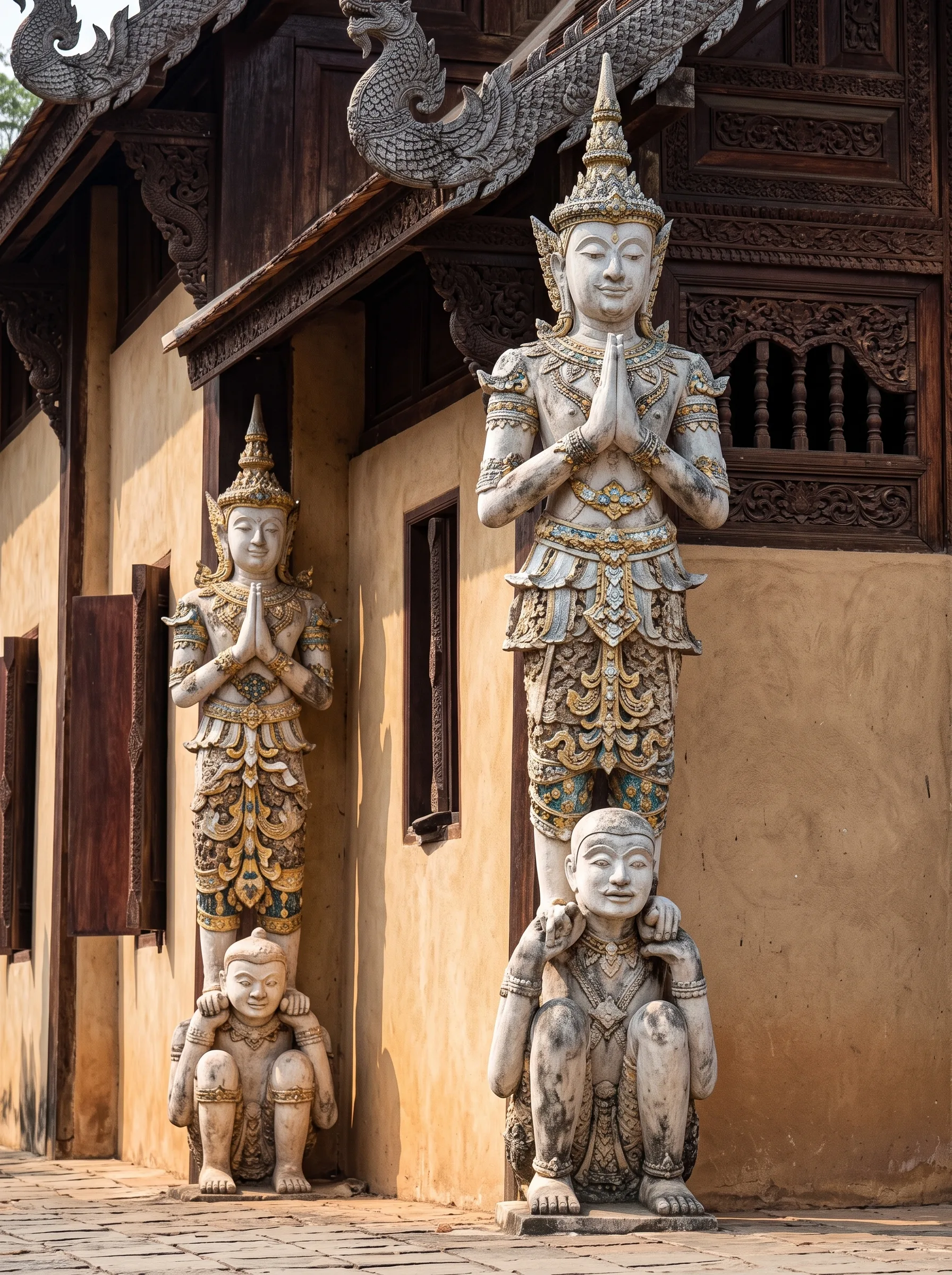
Guardian spirits (Arak). Commonly made to guard the temple, placed on the terrace of the vihara or at the corners of the chedi; mostly stucco figures dressed in tight garments, set against walls or the corners of buildings.
Himmaphan (mythical) animals distinctive of Lanna-style temples are the lion (singha) and the naga. Lions are typically made in pairs, seated on high pedestals beside the vihara doorway or at the corners of a chedi, and may be built at the scale of the whole vihara or chedi. The naga may be rendered coiling in relief, its body winding from mouth to chest, sometimes with five heads, resembling a dragon-naga.
Elephant figures are commonly used to decorate the bases of important chedi, modelled so that only the front half of the elephant projects from the base; a chedi of this type is called a "chang khamma" (elephant-supported) chedi — what in Sukhothai is called an "elephant-encircled base" or "elephant-surrounded" style. The form originated in India, was transmitted to Sri Lanka, and thence came to Thailand through the Lankavamsa missionary monks.
Hongsa (sacred goose/swan). Originating from the hongsa, a species said to dwell at the foot of the Himalayas, this figure is commonly used to decorate the "ngao" — the bargeboard finials of the vihara roof — on both sides of the arched gable-end shrine (sum khong), above the frame of the main vihara doorway, and on other parts of the roof structure; along the ridge of the vihara roof, glazed hongsa finials are used in place of the usual roof-ridge ornaments.
In addition there are other Himmaphan creatures — kinnari, the hatsadiling (elephant-bird), the makara or "Lord of the Naga," Hanuman, mermaids, garuda, peacocks, the mom (Chinese lion), and the kilen (Chinese dragon-horse) — commonly rendered in stucco in the Lanna technique known as "sadai chin" (Chinese stucco inlay), worked in low or high relief and used to decorate the arched gable shrines of mandapas, the bases of principal Buddha images, chedi bases, and building plinths, together with scrolling foliage motifs and low-relief wood carving in the double-sided form known as "nak than."
Patterns of the twelve zodiac animals (the animals of the year of birth), called in Lanna "tua peng" (read: tua-peung, meaning the animal that "supports" or carries a person's spirit into birth and continues to watch over that person's fate), are commonly modelled or carved to decorate architectural elements such as gables, brackets (khan thuai), and the arches above doors and windows; however, they are found to have become widespread only from the Lanna vassal-state period onward.
2. Metal (bronze) sculpture may be divided into two categories:
Buddha images: the important ones include the standing Buddha of Wat Phra Chao Meng Rai, in the walking (Lila) posture, 4.50 metres tall — considered the largest and oldest standing walking-posture Buddha image in Chiang Mai, and the very first Buddha image of Lanna art. The standing Buddha of Wat Chedi Luang Worawihan, commonly called Phra Attharot, is 18 sok (cubits) tall, in the gesture of forbidding relatives, the right hand raised level with the chest in a forbidding gesture and the left arm hanging at the side of the body; the images of the chief disciples Moggallana and Sariputta stand to its left and right, the one on the left slightly lower than Sariputta on the right. The standing alms-bowl-carrying Buddha of Wat Chiang Man, of similar size to the Sariputta image at Wat Chedi Luang, is enshrined in the main vihara of the temple, notable for its finely modelled, resolute face. The standing image commemorating the height of Khruba Chao Sri Wichai at Wat Suan Dok comprises two images of similar size, enshrined flanking [the principal image]; there is also an image called "Phra Chao Kha Khing Phya Ku Na Thammikarat" (commemorating the height of King Ku Na), a bronze seated meditation image, the central one 2.21 metres [in height, and a smaller one] 1.18 metres [figures as given in the source, partly unclear].
Cast-metal Buddha images in the "Thap" tradition are commonly made in the Maravijaya gesture, seated in the "diamond" cross-legged posture (khat samathi phet), the robe rendered finely, gilded, and lacquered; notable examples include the Phra Sihing at Wat Phra Sing Woramahawihan, the Phra Sihing of Wat Pa Beng, the Phra Chao Dap Phai of Wat Dap Phai, and the Chao Un Mueang of Wat Phra That Doi Suthep Ratchaworawihan, among others. Images in the "Sing Sam" (Third Chiang Saen) style are found chiefly in Chiang Mai — for example, at [a temple whose name is unclear in the source] — combining features of both the "Sing Nueng" (First Chiang Saen) and "Sing Sam" styles: seated in the Maravijaya gesture, lacquered and gilded, with a lap width of about 2 metres; the facial features follow the Sing Nueng style — a rather round face, hair in the shape of a closed lotus bud, the sanghati robe draped over the shoulder down to the navel, and the ushnisha (finial) in the closed-lotus-bud form — an especially large and beautifully composed image blending the two styles of Buddhist art. Images in the true "Sing Sam" style have as their chief characteristics: seated cross-legged flat on the base, the body less full than the Sing Nueng style, the sanghati robe draped from the shoulder down past the navel, and an ushnisha in the flame form rather than the lotus-bud form. Notable Sing Sam images include Phra Chao Lan Kham at [a stupa whose name is unclear], Phra Chao Fon Saen Ha of Wat Chang Taem, Phra Chao Saen Kham of Wat Si Koet, Phra Chao Ram Poeng of Wat Thok Kham (Wat Ram Poeng), Phra Chao Saen Mueang Ma of Wat Chuang, Phra Chao Sri Suphan, the pair of Sing Sam principal Buddha images of Wat Suan Dok, Phra Chao Tue of Wat Suan Dok, the "Kha Khing" image of King Ku Na at Wat Suan Dok, and the royally adorned Sing Sam image of Wat Dok Ueang, among others.
Disciple images: important ones exist in two places — the Moggallana and Sariputta images of Wat Chedi Luang Ratcha Woravihan, the largest and oldest such bronze pair standing together in Chiang Mai, standing on either side of the Phra Attharot principal image in the vihara. Phra Upakhut of Wat Upakhut is a large bronze disciple image nearly life-sized, seated cross-legged, raised above the ground, with both hands joined at the chest and turned outward behind, the four fingers of each hand held even, the head shaven — regarded as an important, large, beautiful, and ancient image of an arahant disciple, the work of early Lanna royal craftsmen.
3. Wooden Buddha images. Wooden Buddha images were made widely throughout Lanna, though those surviving from the early Rattanakosin period onward are more numerous, generally of middling workmanship, carved and lacquer-gilded on bases of teak or sandalwood. Important wooden Buddha images in Chiang Mai include that of Wat Buppharam, carved from a single length of golden teak. The pair of standing Buddha images flanking the [central] stone Buddha at Wat Chao Mueang Ma comprises two images carved from teak, commemorating the height of King Mangrai, dating to the early Rattanakosin period, enshrined in the vihara. The standing image in the "Tero Hana" gesture for Chiang Mai University, life-sized and carved from a single length of teak, is now housed in the Chiang Mai National Museum.
4. White-plaster (stucco) Buddha images. Notable examples include the pair of Buddha images carved and mounted on the two tusks [of an elephant tusk pair], produced by Lanna court craftsmen in the reign of Chao Kawilorot Suriyawong, the sixth Lord of Chiang Mai, commissioned in B.E. 2401 (1858 C.E.); one tusk is 110 centimetres and the other 91.6 centimetres [figures as given in the source], measured along the curve at 155 centimetres, together with a Sing Sam image seated in the Maravijaya gesture within a Lanna-style late-period foliate arch, 36 images per tusk, 72 in total; these are now enshrined before the standing Phra Attharot image in the vihara of Wat Chedi Luang Worawihan. 5. Stone Buddha images. Notable examples include the black stone Buddha in the gesture of subduing the elephant Nalagiri at Wat Chiang Man, a high-relief image carved from black granite, about 11 inches tall, of Indian workmanship in the Pala style, brought by the ruler of Lampang to present to King Tilokarat, and enshrined together with the Phra Sae Tang Khamani at Wat Chiang Man.
The Sing Sam meditation image carved from green jade from Vancouver, Canada, was created to celebrate the 700th anniversary of the founding of Chiang Mai and the occasion of His Majesty the King's Golden Jubilee (fifty years on the throne), completed in B.E. 2538 (1995 C.E.). His Majesty the King graciously bestowed upon it the name Phra Phuttha Chaloem Siriraj; it is enshrined on a pedestal in the eastern-facing arched shrine of Chedi Luang, which had once housed the Emerald Buddha — regarded as the largest and most beautiful jade Buddha image of the present era.
2.2.2 Painting. The paintings of Chiang Mai visible today were, for the most part, created within only the last 150 years; works older than this are very rare. The causes of this loss lie partly in the natural deterioration of age, and partly in the impermanent materials of the paintings themselves, which could not withstand a climate of heavy rain and high humidity. In addition, restoration was traditionally carried out by erasing the old work and repainting it afresh, rather than by conserving or preserving the original — a practice rooted in the Buddhist acceptance of the impermanence of all things, and in the belief that creating a new religious work brings greater merit than preserving an old one.
The purposes of painting. Traditional Chiang Mai painting shares basic characteristics with painting in other regions of Thailand, being created chiefly in connection with Buddhism, for purposes that may be classified as follows: To be offered in veneration of the Buddha, in accordance with religious faith — this is the most fundamental purpose, being a response to the general Buddhist way of life and culture, which seeks to accumulate merit according to religious belief; the meritorious act believed to yield the highest reward is the creation of religious objects or structures within Buddhism — the making of Buddha images, chedi, ordination halls and viharas, monks' quarters, scriptures, and the restoration of various things within the temple — the creation of paintings being counted as one such activity, whether commissioned and funded by a devout patron who hires a painter, or offered freely by the painter without payment.
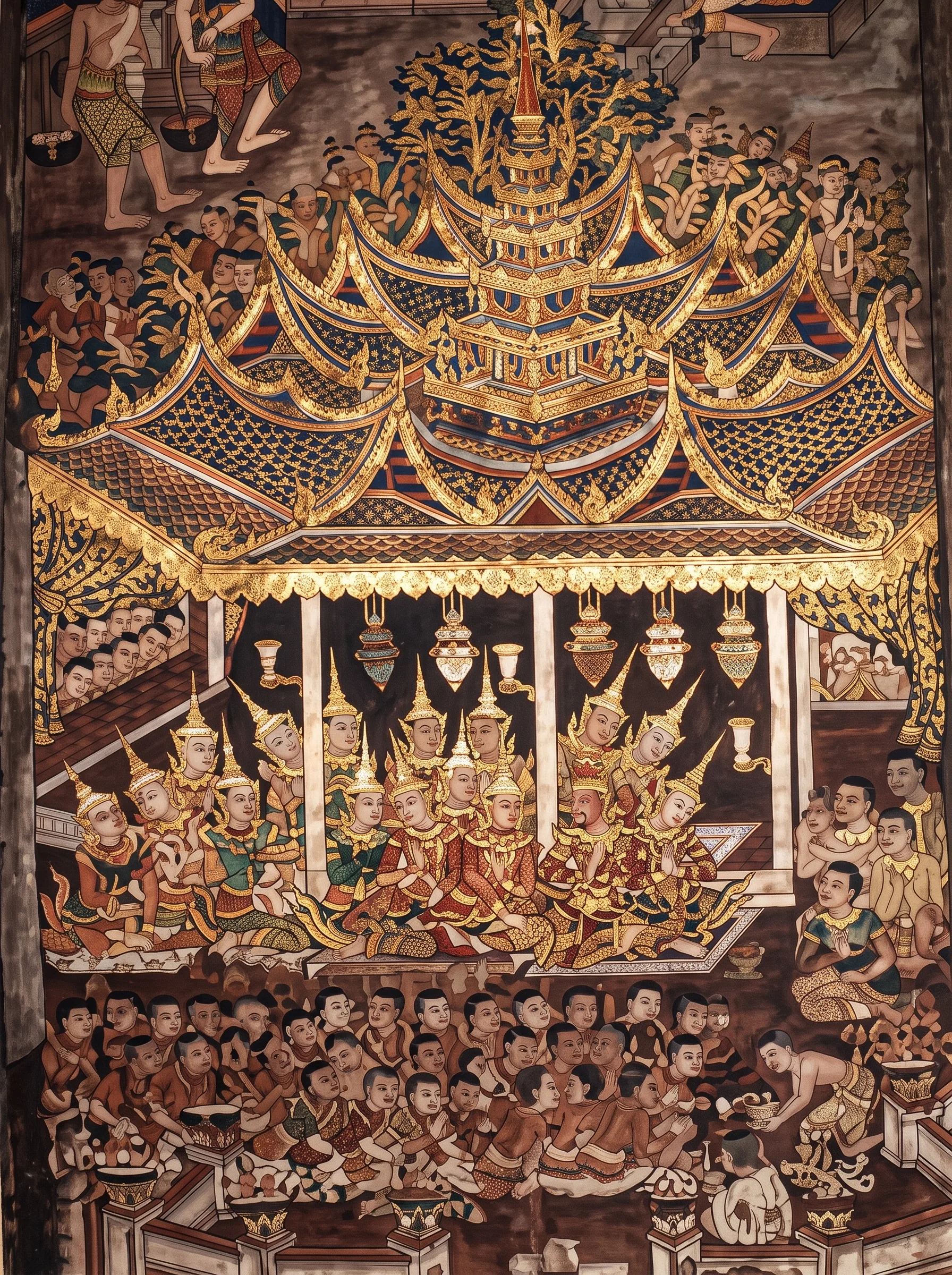
To teach and propagate the Dharma through the stories depicted in the paintings — this purpose follows from the images and stories themselves as the central concern, in that the subjects most commonly painted are drawn from Buddhist literature composed to inspire faith and instruct the faithful, embedding religious principles within the form of various tales — such as belief in the workings of karma or the various perfections (paramita) — and transmission through pictures could convey both the narrative and enjoyment at the same time; moreover, since literacy in ancient society was confined largely to the upper classes and the monkhood, temple paintings served in part as a means of teaching the Dharma to the general public. There are exceptions, however, where some paintings depict subjects not directly related to religion — such as the stories of Sang Thong and Suwannahong in the Wihan Lai Kham — which appear to have been painted purely for enjoyment.
To decorate the interior of the building beautifully and to create an atmosphere conducive to religious feeling. The presence of paintings adorning an ordination hall or vihara not only enhances its beauty but also helps to create an atmosphere of sanctity within the building. The colours and overall forms of the paintings reduce the bareness of the walls and the amount of light entering, making the interior atmosphere somewhat dim, which in turn helps set off the principal Buddha image, making it appear more prominent and radiant — producing a strong sense of reverence and devotion in those who enter the building.
To lend completeness of meaning to the building itself. Painting is an important element in establishing the doctrinal meaning of a building; that is, painting functions as a symbol that completes the religious significance of a Buddhist structure — where "the doctrinal meaning of a Buddhist structure" here refers to a symbolic realm of purity, or Buddha-field (Buddhabhūmi). In representing this meaning through painting, craftsmen employed many kinds of symbols at varying levels of complexity, depending chiefly on the evolution of the art and the intellectual sophistication of the craftsman concerned.
General characteristics of Chiang Mai painting. Painting may be divided on various bases: by form and use — for example, mural painting, phra bot (painted cloth banners for veneration), and illustrated manuscripts; and by technique of creation. [The following sentence repeats the definition of "doctrinal meaning of a Buddhist structure" given above, apparently a duplication in the source.]
As far as the surviving evidence shows, Chiang Mai painting is chiefly confined to mural painting, most of it executed in tempera (powdered pigment) technique; some [gilt] work appears on the upper sections of walls. Painting can also be classified by the social and cultural level of its patrons, reflecting whether a work was produced to a royal-workshop standard or a folk-craftsman standard.
As for Chiang Mai mural painting, it is found to have been commonly executed inside the vihara (whereas in the central region it was commonly painted inside the ordination hall, or ubosot) — presumably because the Lanna vihara was the principal building of the temple, housing the main Buddha image, where villagers would come to make merit, listen to sermons and teachings, and carry out other secular activities as well; the vihara thus served as a multi-purpose hall or community pavilion in its own right. Painting within the vihara was therefore most fitting for the purposes of people in ancient times, who commonly used pictures both to instruct and to delight at the same time.
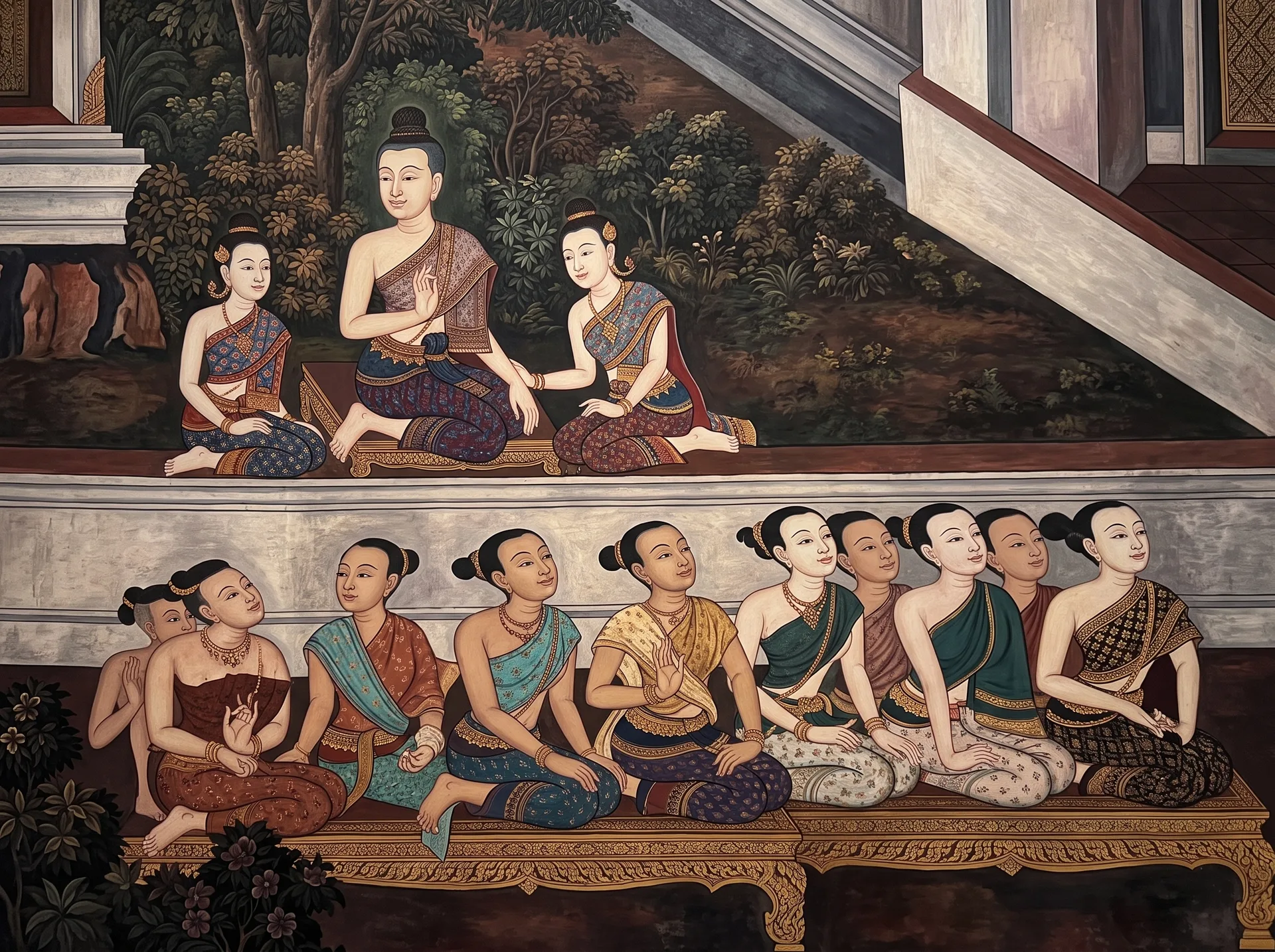
Forms and subjects in painting. In terms of expressive form, Chiang Mai painting is found to include both narrative pictures and non-narrative pictures (symbolic and decorative patterns). Narrative pictures commonly depict the life of the Buddha, the Ten Great Birth Tales (Dasajati/Thotsachat), and the Pannasa Jataka (Fifty Jatakas), a body of local Dharma tales; in addition, the stories of Sang Thong and Suwannahong were also rendered as paintings. Such stories were painted as a sequence of important scenes arranged one after another across the successive registers of the wall; interwoven with the narrative are depictions of everyday surroundings — buildings and houses, social conditions, and the environment of the period — allowing us today to see clearly the life, culture, living conditions, and traditional games and pastimes of the time.
Symbolic and decorative pictures are attested from as early as the 20th to the 25th Buddhist century [approx. 15th–20th centuries C.E.], commonly taking the form of repeated rows of Buddha images seated beneath the Bodhi tree. There are also floral images, and depictions of the Buddha descending from the Tavatimsa heaven after preaching the Dharma to his mother; decorative-pattern work, meanwhile, takes the form of ornamental art, comprising both pictorial and painted linear-pattern types.
The pictorial elements found in painting consist of various sub-elements — figures, architecture, and natural scenery. Figures are commonly distinguished by identifying features and attributes that clearly indicate social status, discernible from dress and the position of the figure within the composition, comprising kings, nobles, soldiers, palace attendants, villagers, and foreigners. Palace figures can in turn be divided into different ethnic groups — Tai Yuan, Tai Yai (Shan), Burmese, and Chinese — reflecting the way of life of these various peoples.
Architectural imagery in painting blends invention with the imitation of real buildings, including palaces, wings, gateways, and city walls; images of ordinary houses, by contrast, are painted in a manner consistent with reality — for example field huts, rice-field watch-huts, pavilions, wells, and everyday household items such as betel trays, cups and bowls, water jars and wells, and so forth.
As for the natural scenery depicted, this ranges from beautifully rendered landscape views to sketchy renderings of thickets, rock outcrops, and low ridges of ground, generally used to separate or divide groups of figures, as well as to set off and emphasise the depiction of palaces.
The artistic styles of Chiang Mai painting, viewed in terms of artistic development, do not show a great deal of continuity, since the surviving evidence spans gaps of as much as three hundred years between groups. The first group comprises older paintings dating to the 20th–21st Buddhist century [roughly 14th–16th centuries C.E.]; the other group comprises later paintings of the 25th Buddhist century [roughly 19th–20th centuries C.E.]. The older paintings, although very few survive, are of great importance as examples of Lanna painting from its period of flourishing. However, we cannot define the specific characteristics of this older painting with certainty, because the surviving evidence is in damaged condition and too limited in quantity — consisting of only two sets of mural paintings and two or three phra bot cloths.
The oldest painting known in Chiang Mai at present is the mural inside the relic chamber of the principal chedi of Wat Umong, at the foot of Doi Suthep, depicting the twenty-eight past Buddhas, executed in outlined brushwork against a gilded ground; in terms of artistic style it shows a mixture of influences, chiefly Sukhothai and Ayutthaya. This painting is today entirely faded. Another example, within the same temple, is the painting decorating the walls and ceiling of the vaulted tunnel-vihara [Wihan Lai Kham (?) — reference unclear], with its many interconnecting arched sections; what survives is only faint traces of floral patterns worked into the wood, and images of birds on the western [gable?], forming a decorative painted pattern extending throughout the layout, with the pattern differing in each vaulted section. In general no date is fixed for this work, but scholars surmise that the mural painting within the relic chamber of this temple's chedi dates to around the 20th Buddhist century [c. 14th–15th century C.E.], around the time of King Ku Na, while the decorative painting in the tunnel-vihara dates to around the early 21st Buddhist century [c. early 15th century C.E.].
In addition to mural paintings, evidence of phra bot (painted cloth banners) has also been found — paintings on long rectangular cloth panels hung vertically, possessing a distinctive form specific to this type. One example, used in place of a phra bot within the relic chamber of the chedi of Wat Dok Ngoen, Amphoe Saraphi, Chiang Mai Province, measures 1.80 × 3.50 metres and is now displayed at the National Gallery, Chao Fa Road, Phra Nakhon District, Bangkok. This phra bot depicts the Buddha descending from the Tavatimsa heaven, stepping down a stairway, surrounded by images of Indra, Brahma, and the host of deities who came to see him off from Tavatimsa — a special composition distinct from those generally found; the detail of the floral garlands of the celestial procession is regarded as characteristic specifically of Chiang Mai art. In addition, this phra bot has a rich colour scheme comprising numerous colours, among them green, blue, yellow, and red, together with gilding applied to the image of the Buddha.
At the Chiang Mai National Museum, another old phra bot is on display, of the standard old type — that is, with the composition arranged symmetrically, showing the Buddha standing in the centre, larger in scale than the attendant disciples paying homage on either side; above are a tiered umbrella (chatra), the sun, and the moon, while the background is decorated with finely and beautifully painted falling-flower motifs. There is also another phra bot at the Suan Pakkad Palace National Museum in Bangkok, clearly in the Lanna style, with the distinctive feature that the image of the Buddha is depicted in royal attire, adorned with beautifully coloured ornaments, and in a very well-preserved condition.
Painting of the 25th Buddhist century [19th–20th century C.E.] shows a marked diversity of artistic style, including styles influenced by Burma and by Rattanakosin (Bangkok); another notable group includes the Tai Yai (Shan) style, the Bangkok style, and the folk style — all distinctive characteristics of this later phase of Chiang Mai painting.
Important paintings in Chiang Mai, classified by material, form, and period, are as follows:
The murals of Wihan Lai Kham, Wat Phra Sing Woramahawihan. Within Wihan Lai Kham are beautiful murals adorning the entire building, divided into two parts: Gilt lacquer-work on a red-lacquer ground (lai thong long chat), a technique of applying gold leaf to the pillars and to the wall behind the principal Buddha image, consisting almost entirely of decorative pattern-work. The gold patterning on the wall behind the principal image is especially striking for its exceptionally lavish use of gold, which sets off the Buddha image within its artistic frame, and shows a blending of Chinese art — images of hongsa (sacred geese) — with central-Thai art, in the form of palace images and the surrounding decorative patterns.
The painted (colour) mural, a narrative work, covers the side walls throughout: the north wall depicts the story of Sang Thong, classed as a work of the Chiang Mai school of painters; the south wall depicts the story of Suwannahong, the work of a local craftsman painting in the Bangkok style.
The Sang Thong narrative mural is an outstanding and famous painting, characterised overall by great refinement and care, both in design and in craftsmanship — for example, the composition of each scene is arranged in harmony with the ground of the adjoining scene, achieved with continuity and a rhythm that blends into a unified whole across the entire wall. In the first wall, for instance, beginning with the image of the king [of the story] near the bottom and moving upward, is the scene of Prince Sang fleeing from the pavilion and slipping away in disguise, moving from one episode to the next as a unified whole across the wall — as in the second register, which shows the image of the ogress [step-mother] Chanthewi, and the image of the young prince, painted with great refinement and life, set within a newly designed palace adapted from Burmese architectural forms, its colours and gilding used to beautiful effect, making it the visual focal point of the whole composition. Also outstanding is the way the painting reflects the life of villagers and townspeople — dress, customs of eating and living, games, courtship — together with beautifully rendered nature and landscape scenes.
The Suwannahong mural is generally much faded and flaking. Its basic character resembles that of the Sang Thong mural — a continuous narrative occupying an equal area of wall, running in the same direction on both sides of the building, and with a similarly dominant colour scheme of red, green, and brown covering most of the picture surface. The points of difference between the two walls lie in the details that give each its distinctive character — artistic style, standard of craftsmanship, and particular technique. It is also found that the Suwannahong mural, unlike the Sang Thong wall, does not commonly depict scenes of everyday life; its overall character is comparatively simple and unelaborate.
The murals of Wat Sao Hin, Mueang District, Chiang Mai, are painting in the central-Thai style of the reigns of Rama IV–V [King Mongkut–King Chulalongkorn], depicting the Vessantara Jataka together with the [royal] capital and foreign craftsmen — in the scene where Prince Vessantara returns to the capital, a procession of Western cavalry rides out to receive him, and, on re-entering the city, images of Western-style mounted processions of striking and unusual beauty are shown — providing valuable evidence reflecting the presence of Westerners in Chiang Mai at that time.
The murals of the Ho Trai (scripture library) of Wat Chang Mon, Mueang District, Chiang Mai, a small two-storey building with stucco and gilt decoration blending several artistic styles: the wall painting is executed on the exterior, on the walls of the upper-storey gallery — which, besides being unusual and striking, helps us understand that the Ho Trai was designed to be appreciated only from the outside.
Narrative mural painting under central-Thai influence, in a folk idiom in both execution and expression, depicts a tale popular locally in the North — the story of Phromma Chak, whose plot resembles the Ramakien — representing the last examples of traditional folk-craftsman painting found within the city of Chiang Mai, likely painted in the years B.E. 2470–2475 (1927–1932 C.E.) or later, since after this period local Chiang Mai craftsmen turned instead to painting in the central-Thai style influenced by Rattanakosin.
Murals in the Tai Yai (Shan) craftsman style. A distinctive feature of Tai Yai painting is the borrowing of elements of high Burmese court culture; accordingly, one finds images of Burmese-style palaces, with figures dressed in the costume of Burmese royalty, and, where Buddha images are depicted, chiefly in the Mandalay style; secondary figures and villagers, by contrast, follow either the Tai Yai style itself or the general Lanna style.
Architecture
Architecture is regarded as a branch of the sciences under the patronage of [the god] Ganesha. Broadly speaking, architecture is understood to mean buildings created by architects of skill, possessing a fundamental academic knowledge of construction, worldly experience, and understanding of nature, whose finished buildings must possess beauty as well as being able to fully serve their intended function. If the building in question is a religious structure, its creator in the past also had to possess sufficient religious knowledge and to have previously entered the monkhood; it is thus unsurprising that the craftsmen or architects — whom the Lanna people term specifically "sala" — were, in the past, for the most part Buddhist monks.
In the past, Chiang Mai was the political, administrative, and religious centre of the land of Lanna. Counting from the founding of the city in the reign of King Mangrai, from B.E. 1839 (1296 C.E.), a period of more than 700 years has passed; it is thus unsurprising that a great variety of architectural forms can be found within the city of Chiang Mai. The discussion here is confined specifically to traditional architecture, excluding the city walls, palaces, modern architecture, government buildings, and special-purpose structures such as ceremonial pavilions (pham) and cremation towers (meru), among others.
For a clearer understanding, the architecture of Chiang Mai city may be divided into two categories:
Architecture connected with daily life — buildings created to serve the daily life of the people, comprising dwelling houses and houses built for both residence and trade — that is, shophouses — which may be further divided as follows:
Houses
Considered a form of vernacular architecture built for dwelling, this refers to the styles of buildings that villagers constructed locally, divided into three types:
Kheuang phuk (bound-construction) houses, or "mai bua" houses, are simply-built dwellings, constructed mostly of bamboo and thatching grass to cover the various parts of the house. This type includes the "thum tid din" — a small house built of bamboo, not raised off the ground, using woven panel walls set directly on the earth — and the "dup yang" — a small house built of timber raised only about one metre off the ground.
Mixed bound-construction and hardwood houses are houses built of hardwood ("real wood") for the posts and main frame, while other materials may be a mixture of real wood and other materials, such as woven bamboo wall panels; the roof is thatched, and this type is typically occupied by people of middling means.
Real-wood houses are houses built entirely of timber, from the posts to the walls (commonly called "fa pen," plank walls) and flooring, with roofs of wood shingles or fired tiles. This type is commonly built as at least two connected sections, or two gable roofs, joined together; those who lived in houses of this kind were generally people of good means. This type may be further divided as follows:
Kalae houses are built of hardwood, raised high off the ground, with a tall gable roof; the body of the house is broad, squat, and low, with the walls flaring outward toward the top; the house has verandas of varying sizes and is generally five rooms in length. A distinctive feature of this type is the crossed finials at the tips of the gable bargeboards, often carved with beautiful decorative patterns; this element is called by the Lanna people "kalae" — for example, the houses known as Ruen Phraya Wong and Ruen Cho Hong, among others.
Middle-period houses are real-wood houses representing a later stage of development from the kalae house, a later type arising from the blending of outside cultural influences that the people of Chiang Mai received — that is, the piercing of window and door openings, and roofs raised in more complex, overlapping planes; some houses are decorated with fretwork wood carving on the gables and eaves ("phaen nam yoi"), a style following the fashion of the reigns of Rama V–VI [King Chulalongkorn–King Vajiravudh]. The Lanna people call this type of house "ruen song sala nai" [term as given in the source].
Shophouses, or "ruen phae" (read: "pae") represent another form of house developed from the middle-period house, particularly houses influenced from outside, adapted through additional functions primarily for trade; these are found in abundance along Tha Phae Road, Charoen Rat Road, and generally along the main streets.
Rice barns ("yung khao" or "long khao") are generally built alongside the dwelling houses of the people of Chiang Mai. The rice barn is a large building, broad, resembling a house with inward-sloping walls, raised on a high floor, used to store agricultural equipment, with verandas on all four sides to accommodate the roof's downward-sloping eaves; the ladder for climbing up to the barn is kept separately. Rice barns are generally built in front of the house, facing the direction in which the household sleeps, as a mark of respect to the rice goddess Mae Phosop, and to display the status of the household — a matter also connected with the choice of a marriage partner for the household's daughters. The size of the barn, likewise, depends on the wealth of the household.
Religious architecture. The flourishing of Buddhism in Chiang Mai can be observed from the great number of temples that exist, both those still in active use and traces of Buddhist architecture belonging to the past. Cosmological doctrine relates to the layout planning of temples and the elements of Buddhist ground plans: according to this cosmology, called the Mangala Cakkavala (auspicious universe), Mount Sumeru forms the central axis of the universe; beyond it lie seven rings of mountains encircling Mount Sumeru, called the Satta Boriphan, surrounding it on all sides. In the four directions around Mount Sumeru and the Satta Boriphan mountains lie four continents — such as Uttarakuru, Purvavideha, and the continent inhabited by humankind, Jambudvipa — all encircled by the Sithandon Sea. At the very outer boundary of the universe lies a surrounding city wall, marking its absolute limit; and, in Buddhist belief, there exist countless such universes without number, forming an "infinite universe" (anantacakkavala).
This concept was skilfully adapted as the basis for planning the layout of temples and religious architecture in Chiang Mai and Lanna generally. The architectural elements of a temple include the arched gateway (sum pratu khong), the vihara, the ordination hall (bot), the scripture repository, and the chedi, detailed as follows:
The arched gateway (sum pratu khong) takes the form of a gate whose arches meet at a curved apex, decorated with stucco patterns using a special technique called "sadai chin" — stucco decorated with inlaid fragments of broken porcelain or animal-hide glue [as an adhesive], among other things. The arched gateway is a distinctive work of Lanna art, appearing at temple entrances (especially of important temples, or "royal temples," wat luang). The building of arched gateways was popular from the Lanna period onward; the oldest surviving example is the arched gateway of Wat Photharam (Wat Chet Yot), built in the reign of King Tilokarat in B.E. 2020 (1477 C.E.). Others are found at Wat Kamphaeng Ngam (Sri Mangkhalachan) and Wat Chomphu in Chiang Mai; in the period following King Sattha Thammathiwongsa, a later king of Chiang Mai (reigned B.E. 2085–2089 [1542–1546 C.E.]), many more arched gateways were built in imitation of the older ones, such as at Wat Fa Ham, Amphoe Om Long [Omkoi?], Amphoe San Sai, and Wat Suan Dok in Mueang District. In addition, arched gateways were also built in the Burmese artistic style, such as the arched gateway of Wat Chiang Yuen, Mueang District.
The vihara is seen as the principal architectural structure of temples in Chiang Mai, generally built oriented on an east–west axis, facing east. In ancient times it was built of timber, using a post-and-beam system with a "fa tang mai" (interlocking wall) structural technique. The typical vihara plan is a large, elongated rectangular building, with projecting bays of two sections (chud) at the front and one section at the rear; the roof is layered in several tiers, stepping down in sequence from small to large in accordance with the rhythm of the building's projecting bays. The base is raised high, sometimes built atop a naga-serpent structure, with an open porch commonly formed at the very front section. The rearmost section of the vihara houses the principal Buddha image, and this is the section where the walls are commonly built solid and enclosed, typically with light apertures (chong boeng chon, or banchon) — window-like light openings resembling a cross shape. The interior walls are commonly decorated with mural paintings or gilt lacquer patterns; the interior columns are commonly round, decorated with gilt lacquer motifs. A special feature is that some viharas are built with a floor raised especially high, requiring a full staircase to enter, such as at Wihan Phra Sing Woramahawihan, decorated with patterns in oil-based stucco or carved woodwork at the gable pediment (na naep) and the "kong khio" (an ornamental board beneath the gable pediment and the wing gable), together with the "phaeng lae" — a small ornamental board with enamel decoration set between the roof and the cross-beam supporting the wing gable — while the "nak than" (elephant ears) are commonly decorated with carved woodwork in naga or foliate-animal patterns. Chiang Mai viharas may be divided as follows:
Open-pavilion viharas (wihan thong) are viharas that do not commonly have enclosing walls; they may have a wall lowered only halfway from the top, called "fa yoi." Found in the vihara of Wat Suan Dok, Mueang District.
Enclosed viharas, or the Chiang Mai vernacular type, have walls built of wood or masonry, generally with the frontmost section kept as an open porch; the roof may be stepped in three sections at the front and two at the rear, and is sometimes built to cover a naga staircase — as at the viharas of Wat Thung Yu, Wat Buppharam, and Wat Muen Ngen Kong [Wat Muen Ram?], Mueang District, among others.
Viharas with an attached mandapa, a Chiang Mai vernacular-type vihara with a small chedi attached at the rear — found at Wihan Lai Kham of Wat Phra Sing Woramahawihan, the vihara of Wat Prasat, and the vihara of Wat Pa Daeng, Mueang District.
Four-porched (chaturamukh) viharas have projecting porches on all four sides, with a mandapa enshrined within — a special type of vihara, found at the vihara of the Chom Thong relic chedi, Chom Thong District.
Viharas built of laterite are a special type peculiar to Chiang Mai, such as the vihara of Wat Chet Yot (Wat Maha Photharam), rectangular in plan, surmounted by seven chedi, or "seven spires."
Hall-type viharas (wihan song rong) do not have a stepped, tiered plan, but instead a simple rectangular ground plan; this is a later type of vihara, found at the Wihan Luang of Wat Phra Sing Woramahawihan and the vihara of Wat Chiang Man, Mueang District, among others.
The ordination hall (ubosot). A building used for the performance of monastic acts (sangha-kamma), the recitation of the Patimokkha, and the ordination of novices or monks. The ubosot of Chiang Mai resembles the vihara in architectural form and elements, but commonly has solid, unopened walls — what is known as the "hall-type" building. The distinction between ubosot and vihara can be observed from the boundary stones (bai sema) set around the ubosot, marking the boundary of the consecrated monastic ground as prescribed by monastic regulation, together with the construction of an outer boundary wall (kamphaeng kaeo) enclosing the ubosot — marking it as a special zone from which women are forbidden entry, unlike the interior of the vihara.
The building of an ubosot was generally undertaken only at temples of importance; furthermore, monks of the seven [associated] temples would generally gather to perform sangha-kamma together in the ubosot of a central temple — known as the "ubosot group of Wat Chiang Man." In the city of Chiang Mai there were eleven temples required to gather for the performance of sangha-kamma together, called a "hua rat" — such as Wat Hua Chuang, Wat Montian, Wat Lam Chang, and Wat Ho San Kao, among others. It is thus unsurprising that an ubosot is not found in every temple, unlike the vihara in the central region; the people of Chiang Mai furthermore hold the belief that the ubosot is a sacred place that should not be casually entered — unlike in the central region. In addition, some temples make use of a "Buddha-sima" chamber instead, as at Wat Phutthoen, Amphoe Mae Chaem.
The chedi. A structure built for veneration by Buddhists. The chedi generally seen is of the type known as a "Buddha chedi," built to enshrine the Buddha's relics; an "uddesika chedi," by contrast, is a chedi built as a dedication to the Buddha [without enshrined relics]; in addition, there are "phra that chedi," which enshrine the remains of chief disciples or of kings. Following the spread of Buddhism from India to various countries from the reign of the Emperor Ashoka (B.E. 279–311 [c. 268–232 B.C.E.]) onward, chedi were built in great numbers throughout the Buddhist countries, and the form continued to evolve throughout. The chedi built in Chiang Mai may be divided into five types:
1. Bell-shaped chedi. The overall form comprises a tiered, stepped base supporting a bell-shaped or hemispherical dome, a "throne" collar, a spire shaft with tiered rings (pli chai), and a finial. This form, in Chiang Mai, received influences from several artistic sources combined, and developed its own particular character; it can be classified into three groups:
Chedi that received the influence of Burmese-style chedi and developed into a vernacular type.
Chedi that received Sukhothai influence blended with the vernacular type — for example, the chedi of Wat Pa Daeng.
Chedi that imitate late-21st-Buddhist-century [c. 16th-century C.E.] Burmese art.
2. "Prasat"-form (tiered-tower) chedi. These are chedi whose relic chamber (reun that) is a solid, massed structure, tiered in many stages, such as:
Prasat-form chedi with a [bell-shaped] chedi spire — with the special feature that, above the relic chamber, the finial takes the form of a bell-shaped chedi. Found, for example, at the chedi of Wat Umong (now abandoned), the chedi of Wat Lok Moli, and Chedi Luang, Mueang District, among others.
Octagonal prasat-form chedi, whose ground plan and relic chamber are commonly built [octagonally] — found, for example, at the chedi of Wat Sadue Mueang and the Animit Chedi of Wat Chet Yot.
"Chedi plong," the name given by the people of Chiang Mai to chedi built with niches (khuha) around the body of the chedi to enshrine Buddha images. In Chiang Mai only three such chedi are found.
3. Square bell-shaped chedi. Only a single example is found: the chedi of Ku Kham, Wat Chedi Liam.
4. "Phum khao bin" (rice-mound) chedi, or "closed-lotus-bud" chedi, chedi that received Sukhothai influence, found for example at the chedi of Wat That Klang [and], according to an old photograph, at the chedi of Wat Suan Dok.
5. Indented-corner chedi (chedi yo mum), a chedi with a square ground plan whose corners are indented into multiple smaller re-entrant angles, which likely received the influence of Ayutthaya art; found, for example, at the chedi of Wat Si Sophon, among others.
The scripture repository (ho phra trai pidok). A building for storing the Tripitaka and other important scriptures; ancient documents mention the construction of a scripture repository, also known as a "ho tham," in the reign of King Tilokarat in B.E. 2020 (1477 C.E.), to house the Tripitaka that had been recompiled through a council held at Wat Maha Photharam. The ho tham of Chiang Mai, as they survive today, are commonly built as small two-storey buildings, the lower storey generally of brick and masonry, the upper storey generally built of wood, decorated with roof finials (cho fa, or "elephant ears"), and often decorated with gilt lacquer work (lai rot nam) or ornamental stucco carving. A special characteristic of the ho tham is that a permanent staircase was not commonly built — a consequence of the desire to protect the security of the Tripitaka, regarded as equivalent to the very word of the Buddha, together with the other scriptures preserved within the ho tham; each ho tham houses various scriptures. Another notable point about the ho tham of Chiang Mai is that they were commonly built only at temples of importance — for the same reason, perhaps, as the building of an ubosot — whereas monks' sleeping quarters can be found in nearly every temple in Chiang Mai. The ho tham of Chiang Mai can be divided into several types:
Two-storey ho tham with a porch on one side only, the type most commonly found in Chiang Mai, resembling a small hall-type vihara; the lower storey is of brick and masonry, the upper of timber, with an entrance door at the front; windows were not commonly built, and a surrounding gallery for walking around the building is often found. This form of ho tham is found at the ho tham of Wat Phra Sing Woramahawihan and the ho tham of Wat Chiang Man.
Ho tham with a four-porched (chaturamukh) upper storey, similar in form to the first type but with porches projecting on all four sides of the building; the roof is built either in a plain form or in a stepped, "dipping" form. Found at the ho tham of Wat Phraya Rakham [name as given], Mueang District.
Two-storey brick-and-masonry ho tham in the Chinese style, rectangular in plan, decorated with painted images and ornamental stucco work; its point of difference from the vernacular type lies in the entrance, which is on the side of the building — a feature specific to itself. Found in only one location: the ho tham of Wat Chang Mon, Mueang District.
Single-storey, square-plan ho tham with a mandapa-form roof, decorated at the windows with Chinese-style stucco patterns; found in only one location: the ho tham of Wat Ho Mongkhon.
Two-storey, square-plan ho tham, resembling the second type, found at the ho tham of Wat Sri Suphan, Mueang District, among others.
Besides Buddhist religious architecture, the architecture of other religions can also be seen, such as Christian churches and Muslim mosques, each with its own distinctive and interesting character.
It can thus be seen that the architecture of Chiang Mai displays a wide diversity of form, owing to Chiang Mai's long history and to the many different peoples who have settled here, bringing their own art and culture, resulting in a fusion into new forms. We cannot deny the influence of the artistry of other groups of craftsmen on the architecture of Chiang Mai and on the developments that have taken place. At present, the architecture of Chiang Mai has in some cases been damaged through lack of awareness; nevertheless, most of the architecture continues to receive consistent care and attention.
Handicrafts
Chiang Mai has long possessed many forms of handicraft representing local wisdom. Some handicrafts received Burmese influence, but the skill of Chiang Mai's local craftsmen developed the forms and patterns of these crafts until they acquired their own particular character, known collectively as Lanna-style art. The important handicrafts of Chiang Mai include the following:
Wood Carving
Since Northern Thailand is one of the world's sources of high-quality teak, teak possesses qualities that make it especially suitable: it is pliable and easy to carve, its grain has its own particular beauty, it is not consumed by insects such as wood-borers or termites, it is lighter in weight than other standing timbers, and it withstands the hot, humid climate well. These special qualities led local craftsmen to favour teak for carving, for use in construction and in decorating architecture — ordination halls, viharas, and dwelling houses.
Wood carving appearing as decorative ornament includes carved figural work — Buddha images, images of deities, images of Himmaphan animals, and so on — found on various parts of the architecture: gable pediments, ornamental "kong khio" boards, wing-gable "kong khio," brackets (khan thuai), carved wood patterns on the front and sides, door and window panels, window grilles, the struts supporting the space between the main roof and the wing-roof, bargeboards, and the main and central cross-beams of the vihara — each part bearing its own distinct patterns. The patterns of carved woodwork can be classified as follows:
Floral-pattern groups, whose designs craftsmen conceived by observing nature and adapting it — such as the "prajam yam" pattern, the "krachang" (flame-petal) pattern, the "phum khao bin" (rice-mound) pattern, the peony pattern, the lotus pattern, and the sunflower pattern, among others.
Scrolling-vine or foliate-plant pattern groups — vine patterns that trail and spread across the surface, resembling fiddlehead fern, together with spiralling-stem patterns; the most popular being the spiralling stem combined with flower and leaf, particularly the spiralling-stem pattern and the peony pattern, which show great variation of detail, made beautiful through the craftsman's own imaginative design.
"Flowing cloud" patterns, characterised by twisting ribbon-like folds resembling curling fur or a folded cloth band turning back on itself, sometimes with a serrated section resembling pork intestine [a traditional simile in Thai decorative art].
Patterns of mythical creatures of belief, such as the hongsa pattern, the garuda pattern, the kilen pattern, the lion pattern, as well as patterns of naturalistic animals — such as the peacock pattern, patterns of various birds, monkeys, squirrels, and insects such as butterflies, among others.
Kanok (flame-scroll) patterns, commonly a single flame-scroll unit, tapering to a fine point but not curling back, considerably slenderer than the kanok patterns of the central region.
Krachang (flame-petal) patterns, resembling the "krachang ta oi" (sugarcane-eye krachang) type, but mostly triangular-petalled in form, with one or two serrated points, with layered petals within, giving a form resembling a lotus petal.
Patterns set within angular frames, a style in which the design is commonly laid out within a diamond-shaped (rhombus) frame, the interior pattern comprising krachang patterns, floral patterns, and "thep phanom" (worshipping-deity) patterns.
Deity patterns, most commonly rendered as the "thep phanom" (a deity with palms joined in worship) or as a royally adorned deity in a kneeling posture.
At present, teak has become a rare timber, and the government has enacted legislation prohibiting its felling; wood carvers have accordingly turned to other substitute timbers, such as rain tree (chamchuri), rubber wood, and eucalyptus.
Between the city of Chiang Mai and Amphoe Hang Dong lies a village of about 150–200 households called Ban Tawai, whose people practise wood carving as a handicraft alongside farming and agriculture. Ban Tawai only became known as a wood-carving village around B.E. 2501 (1958 C.E.). According to the history recounted by the craftsmen of Ban Tawai, the craft was passed down from ancestors over many generations, without having been formally studied at any institution; it is thus likely that in the past craftsmen here carved gable and other decorative patterns for ordination halls and viharas in the same way as craftsmen elsewhere. It is said that the earliest generation of Ban Tawai craftsmen [went to learn carving and copying of Burmese-style Buddha images for shops that sold them]; afterward they began producing handicrafts of their own at home, using the experience they had gained from those old shops, passing this on in turn to later generations of craftsmen.
The later expansion of Ban Tawai's carved-wood products has tended to consist of commissioned work made to order for trade, since the village has abundant labour at low cost; large commissioned orders each time have become an incentive for craftsmen to turn toward working to order rather than toward work they must design themselves — and this, in turn, has caused the development of the village's own independent design tradition to decline.
Basketry
Basketry (kreuang chaksan) is made from materials such as bamboo, "mai hia" wood, rattan, and "mai yang," together with "yaeng" (a type of arrowroot plant), among others, fashioned into tools, implements, and containers of various kinds according to the needs of the local community. The tools used in basket-weaving are the heavy bush knife, the paring knife, an awl, a saw, a hammer, and wooden pliers, among others. Basketwork commonly made in Chiang Mai Province may be classified by function as follows:
1. Dwellings and produce storage — mostly used for walls, gables, and ceilings of houses; the woven patterns commonly used are the plain-weave pattern, the "am" pattern, and the radiating "li" pattern.
2. Animal traps and fish traps. Traps used for catching animals are mostly for aquatic creatures, and take many forms, including:
The "sai hua mu" (pig-head trap), round-bodied and large, with a wide flaring mouth resembling a pig's head, woven in a wide-set plain weave, commonly placed at the mouth of a stream.
The "sai ba lot" trap, elongated in shape like a spool or reel, with a bamboo-slat funnel to lure fish, at the middle of the trap body.
The "lop", with a wide mouth, its round body gradually tapering toward the rear like a funnel.
The "sai bang" trap, called "lop" in some areas, cylindrical in shape with both ends cut off, fitted with a funnel-shaped guide at the mouth end and a removable lid at the rear end for extracting the fish.
The "lap", shaped like a bottle gourd, with a funnel-shaped guide fitted near the neck, the mouth closed with a cone-shaped section; used to trap eels using bait as the primary lure, set in shallow areas along the water's edge.
The "tum," similarly shaped like a bottle gourd, with a funnel-shaped guide fitted near the neck, the mouth closed with a cone-shaped section; used to trap eels using bait as the primary lure, set in shallow areas along the water's edge.
The "sae," a scoop-net-like implement for catching fish and small aquatic animals, with a triangular-framed mouth set at an angle of about 45 degrees, fitted with a handle about one metre long; used to scoop up small fish and small aquatic animals in swamps and marshes.
The "sum" (fish cage/trap), of two kinds: the woven "sum," in a wide-set plain weave, used to catch small aquatic animals; the mouth is a triangular frame set at about 45 degrees, with a handle about one metre long attached, used to scoop small fish and small aquatic creatures in marshes.
The "sum," of two kinds: the woven "sum" in a wide-set plain weave, or the "sum khi" [an alternative type], used to trap fish by clamping down over them; standing about 50–65 centimetres tall, used to trap fish in marshes.
The "sum kai" (chicken coop), woven in a wide-set plain weave, with a wide mouth to cover the chicken; if the chicken struggles [tries to escape], the height of the coop can be adjusted along with it.
The "khong," used for holding or temporarily keeping aquatic animals; it has features found elsewhere in Thailand — a square base, a round bulging body, and a narrowed neck and mouth, with the mouth reinforced by lashing at its four corners; some craftsmen extend the body of the khong lengthwise, with an opening lid or a place to fasten it shut.
The "kuai hu" woven with a diagonal open weave on the surface, with a squared base and a round bulging body, the mouth narrowing; commonly used to hold piglets or ducklings and chickens — for chicks, the weave is set more closely and woven into a rectangular shape.
The "han nok" (bird cage), woven in a plain weave in a square shape, its four corners gathered and tied together to hold captured birds temporarily, whether caught in the forest or brought for sale.
3. Basketry connected with food and consumption.
The rice box ("kong khao" or "eb khao"), a low cylindrical shape woven with a double layer of split bamboo strips for both body and lid, commonly woven in a triple-strand pattern, with the top of the lid commonly woven in a tortoise-shell pattern; used to hold steamed sticky rice, keeping it soft and preserving it for a long time.
The "aeb ya" (tobacco box), oval in shape, used to hold rolled cigarettes, with a body and lid similar to the rice box, but commonly woven in a finer and more refined pattern.
The "dang," or winnowing tray, round in shape with a raised rim, used to winnow rice and dry vegetables.
The "hoeng," or sieve/screen, of the same shape as the winnowing tray but with a wider-set weave, used to sift seed or dry vegetables, and so on.
The "sa huat," used for rinsing rice that has been soaked in water, allowing it to drain before placing it into the steaming basket.
The "khuti khao," a large woven container used to catch the grains of rice threshed from the panicles; a notable feature reflecting the local wisdom of Chiang Mai basket-weavers is that it has a mouth diameter of about 150 centimetres and stands about 30 centimetres tall — craftsmen devised the technique of weaving it inside a dug earthen pit, shaped and smoothed to form, then using strips split from the outer skin of bamboo, woven within the pit in a way that forces the strips to cover the required area; where the corners of the pit meet, a bulging convex form results, so that when the container is later used for threshing rice in the fields [it retains grain effectively].
The "bung," a container used to hold unhusked rice, seed grain, and various vegetables, with a square base, a round bulging body, and a wide mouth, commonly given a lid as well; commonly woven in two sizes — the small bung, holding one "thang" (a unit of volume), the medium bung or "phiat luang," holding 1.5 thang, and the large bung, or "phiat luang," holding 2 thang.
The "kuai miang," a container for holding fermented pickled tea leaves (miang).
The "tang miang," used to hold fermented pickled tea leaves in the same way as the kuai miang, woven with fine strips patterned to prevent moisture from seeping through.
4. Basketry containers for plants, vegetables, and general goods — such as the kuai kla, seng lam o, kuai salak, kuai khot, kuai tang chang, and the "kha lom" or "cha lom" carrying basket, among others.
5. Basketry worn on the head as protection from sun and rain, commonly woven in two forms:
The "kub koeng," woven in a loose double-layered diagonal weave, dome-shaped, covered with coconut leaves, paper, or plastic sheeting to shield against sun and rain, with an inner band fitted close to the head, called the "mung," to hold it in place on the wearer's head.
The hat, woven from split strips into strands and then stitched into the shape of a hat, using a wooden mould as a template to shape the crown into a rounded curve.
6. Implements connected with belief.
The "ta laew" (eye-spirit trap, or "chalaeo"), used in rites connected with the fertility and prosperity of fields, orchards, and dwellings, and also to ward off inauspicious things.
Pottery
Chiang Mai's vernacular pottery is made by two methods, as follows:
Beaten-form pottery produces rounded, squat vessel forms of the inverted-pot type, produced at Ban Thahan Kaeo, Amphoe Hang Dong, and Ban Mai Santi, Amphoe Chom Thong.
Raw materials: field-paddy soil, sand, red laterite soil from Doi Saket, rice straw, and dried bamboo or wood shavings.
Equipment:
The turning stand (thaen pan), which may be a section of log, or stacked tin cans, or stacked old pots, brought to a height suited to the proportions of each individual potter.
The beating paddle, a flat piece of wood with a rounded, curved end, sized to fit comfortably in the hand, about 5–8 centimetres wide and 20–25 centimetres long, used to cut and shape the clay while forming the vessel.
The "mai thodi" (anvil paddle) [translation of tool name uncertain in source], a piece of wood shaped to the surface of the clay, rectangular, one face smooth, the other carved, used to texture or finish the surface; the handle, gripped on the outer side, is round and sized to fit comfortably in the hand.
The "hin dun" (anvil stone), a smooth, round river stone sized to fit the hand, used as an internal support inside the vessel to receive the blows of the beating paddle applied from outside, so as to make the surface smooth and even.
A supporting board for the vessel, which may be a plank of real wood, plywood, or smooth tile, to support the clay each time it is worked.
The steps of forming the pot consist of the following stages:
Preparing the clay. Clay dug from a source in the paddy fields is pounded until smooth, then dried in the sun, taking about one day; it is then pounded finely and sieved to remove stone fragments and wood debris, then kneaded with water mixed with an appropriate proportion of sand and set aside for later use. Alternatively, the clay may be soaked overnight and then kneaded with sand until it reaches a workable, sticky consistency.
Forming. In this method the potter must walk around the turning stand, adding clay and shaping it on a turntable set atop the stand, gradually working the rough form of the vessel in successive rounds, using the hands and the "mai thodi" paddle to refine the shape periodically until it reaches the mouth, forming a round shape; this stage involves shaping continuously while circling the turning stand at a low position until the desired outline is achieved — a process that may take two to three days — after which the form and surface are finished as desired, using the stone held inside to support the surface while it is smoothed, a step called "using the mouth" [term as given in source], with emphasis first on finishing the shoulder of the vessel, then using the "mai thodi" paddle to press or stamp patterns from the neck section downward before finishing [with a smooth pot used to refine the surface, adding clay to even out the body], twisting it into a spiral for decorative effect, then setting it out to air-dry again before assembling the interior of the pot smoothly as desired; it is then set aside to await coloring — [a process involving] trimming away excess material and refining it, sieving to obtain only the fine powder, then using a cloth to polish the clay surface, adding beauty to the vessel with natural materials.
Firing. Once enough vessels have been formed for a single firing, they are arranged in the yard of the house, with the larger vessels at the bottom and the smaller ones on top, with straw and dried bamboo packed tightly into the gaps between the vessels in every row, including around the base on all four sides, then covered over with straw — in some places, husk may also be used as additional fuel. The topmost layer must be covered with ash kept from a previous firing, to prevent stray wisps of straw from blowing off and catching elsewhere, and the fire is then lit from all four sides of the base.
Terra Lanna Travel was founded out of a love for Lanna history and culture. We believe the stories of the northern land — its legends, traditions, temples, and the way of life of those who came before us — are a precious heritage worth recording, preserving, and passing on to future generations. That is why the core content of this website is centered on travel, history, and culture articles about Lanna.
Hotels & Tours: A Supporting Role
The hotel accommodations and tour programs featured on this site are a supplementary source of income, used to develop and maintain the website so it can continue in the long run — they are not our primary purpose.
Our Role
Our main role is to tell stories and share knowledge about Lanna history, so this cultural heritage can be preserved, protected, and passed on to future generations. We also translate our content into multiple languages so that international readers with an interest in Lanna culture can access and learn these stories too.
About Our Images
The images on this website include both genuine photographs and images restored using AI technology from old black-and-white photographs, so readers can see the atmosphere of those eras more clearly and vividly.
Privacy Policy / นโยบายความเป็นส่วนตัว
Last updated: 26 April 2026 | อัปเดตล่าสุด: 26 เมษายน 2569
This site contains affiliate links to Agoda, Viator, and Trip.com. When you click these links and make a booking, we may earn a commission at no extra cost to you. Hotel prices (Agoda) and tour prices (Viator) shown on this site are live prices pulled directly from our partners; Trip.com prices require clicking through to the partner's own site. Affiliate cookies are only set when you click these links directly.
คุกกี้สถิติและการวิเคราะห์ (Analytics Cookies): วิเคราะห์แนวโน้มการเข้าชมหน้าเว็บเพื่อปรับปรุงคุณภาพเนื้อหา ผ่าน Google Analytics (G-CSV1H77PY8)
We use cookies and similar technologies to enhance your browsing experience:
Preference Cookies: Remember your selected language and cookie banner consent status.
Analytics Cookies: Help us understand audience engagement and improve article quality via Google Analytics.
5. นโยบายโฆษณา Google AdSense / Google AdSense Advertising Disclosures
เว็บไซต์นี้ใช้บริการโฆษณาจาก Google AdSense เพื่อสนับสนุนการดำเนินงานและการผลิตเนื้อหาคุณภาพ เพื่อให้เป็นไปตามข้อกำหนดและนโยบายความเป็นส่วนตัวของ Google เราขอแจ้งให้ผู้ใช้ทราบดังนี้:
ผู้ให้บริการภายนอก ซึ่งรวมถึง Google ใช้คุกกี้ (รวมถึง DoubleClick cookie) เพื่อแสดงโฆษณาตามประวัติการเข้าชมเว็บไซต์นี้หรือเว็บไซต์อื่นๆ ในอินเทอร์เน็ตของผู้ใช้ในอดีต
การใช้คุกกี้เพื่อการโฆษณาช่วยให้ Google และพาร์ทเนอร์สามารถแสดงโฆษณาที่เกี่ยวข้องและตรงกับความสนใจของผู้ใช้ อิงตามประวัติการเข้าชมเว็บไซต์ของเราและ/หรือเว็บไซต์อื่นๆ ในเครือข่ายอินเทอร์เน็ต
ผู้ใช้มีสิทธิ์เลือกปิดการใช้งาน (Opt-out) โฆษณาที่ปรับแต่งตามโปรไฟล์ความสนใจส่วนบุคคลได้ทุกเวลา โดยเข้าไปที่ Google Ads Settings หรือเข้าไปที่เว็บไซต์ www.aboutads.info เพื่อปิดการใช้คุกกี้ของผู้ให้บริการภายนอกสำหรับการโฆษณาตามความสนใจ
This website partners with Google AdSense to display advertisements. In strict accordance with Google AdSense Publisher Policies, please be advised:
Third-party vendors, including Google, use cookies (including the DoubleClick cookie) to serve ads based on a user's prior visits to this website or other websites across the Internet.
Google's use of advertising cookies enables it and its partners to serve personalized ads to users based on their visits to our site and/or other sites on the Internet.
Users may opt out of personalized advertising at any time by visiting Google Ads Settings. Alternatively, users can opt out of a third-party vendor's use of cookies for personalized advertising by visiting www.aboutads.info.
Terra Lanna Travel Chiang Mai — เชียงใหม่, ประเทศไทย
Terms of Service / ข้อกำหนดการใช้งาน
Last updated: 25 September 2026 | อัปเดตล่าสุด: 25 กันยายน 2569
1. เกี่ยวกับบริการของเรา / About Our Service
Terra Lanna Travel Chiang Mai ("เรา", "Terra Lanna") ให้บริการเว็บไซต์ที่รวมหลายส่วนเข้าด้วยกัน ได้แก่ ที่พัก Nampiangdin Boutique Hotel ทัวร์ฟาร์มออร์แกนิกที่ลำพูน โปรแกรมทัวร์คัดสรร ไดเรกทอรีโรงแรมพร้อมราคาสดจากพาร์ทเนอร์ บล็อกเรื่องราวเชิงวัฒนธรรมล้านนา และ "ห้องสมุดล้านนา" ซึ่งเป็นคลังหนังสือประวัติศาสตร์/วัฒนธรรมล้านนาที่แปลและเรียบเรียงขึ้นใหม่ การใช้งานเว็บไซต์นี้ถือว่าคุณยอมรับข้อกำหนดฉบับนี้
Terra Lanna Travel Chiang Mai ("we", "Terra Lanna") operates a website combining several parts: Nampiangdin Boutique Hotel accommodation, organic farm tours in Lamphun, curated tour programs, a hotel directory with live partner pricing, a Lanna culture blog, and the "Lanna Library" (ห้องสมุดล้านนา) — a collection of translated and re-edited Lanna history and culture books. By using this website, you agree to these Terms.
2. เนื้อหาบล็อกและห้องสมุดล้านนา / Blog & Lanna Library Content
บทความบล็อกและหนังสือใน "ห้องสมุดล้านนา" เป็นผลงานที่เรียบเรียง แปล และดัดแปลงขึ้นโดย Terra Lanna จากแหล่งข้อมูลประวัติศาสตร์/วรรณกรรมล้านนาสาธารณะ โดยมีเจตนาเพื่อการสานต่อและอนุรักษ์วัฒนธรรมล้านนาให้เข้าถึงได้ในหลายภาษา เนื้อหาที่แปล/เรียบเรียงใหม่นี้เป็นลิขสิทธิ์ของ Terra Lanna ส่วนผลงานต้นฉบับยังคงเป็นของผู้ประพันธ์/สำนักพิมพ์เดิมตามที่ระบุไว้ในแต่ละเล่ม รูปภาพประกอบบางส่วนเป็นภาพถ่ายจริง และบางส่วนสร้าง/บูรณะขึ้นด้วยเทคโนโลยี AI จากภาพถ่ายเก่าขาวดำ (ดูรายละเอียดที่หน้า About Us) เนื้อหาทั้งหมดจัดทำขึ้นเพื่อวัตถุประสงค์ด้านการศึกษาและวัฒนธรรม ห้ามคัดลอกหรือนำไปเผยแพร่ซ้ำเพื่อการค้าโดยไม่ได้รับอนุญาตเป็นลายลักษณ์อักษร
Blog articles and books in the "Lanna Library" are compiled, translated, and adapted by Terra Lanna from public Lanna historical/literary sources, with the intent of continuing and preserving Lanna culture in multiple languages. This translated/re-edited content is copyrighted by Terra Lanna; original source works remain the property of their original authors/publishers as credited within each volume. Some accompanying images are genuine photographs, while others are AI-restored or AI-generated from old black-and-white photographs (see the About Us page for details). All content is produced for educational and cultural purposes. Copying or commercial redistribution without written permission is prohibited.
3. การจองผ่านลิงก์พาร์ทเนอร์ / Bookings via Partner Links
Hotel (Agoda) and tour (Viator) prices shown on this site are pulled live from our partners, but the actual booking is completed on the partner's own website and is governed by that partner's own terms and cancellation/refund policy — not Terra Lanna's. We act only as an affiliate referrer and are not a party to that booking contract, and are not responsible for service issues, cancellations, or disputes arising from the partner. (See Privacy Policy for affiliate commission details.)
You may not use this website to: violate Thai or applicable law, scrape or bulk-extract content without permission, or attempt unauthorized system access.
We provide information on this website "as is" and make reasonable efforts to keep it accurate and current, but do not guarantee that content, prices, or availability are correct, complete, or error-free at all times. To the maximum extent permitted by law, Terra Lanna is not liable for indirect, incidental damages, or loss of profit arising from use of this website or our partners' services.























 ภูมิปัญญาดินอินทรีย์ · 4 นาที